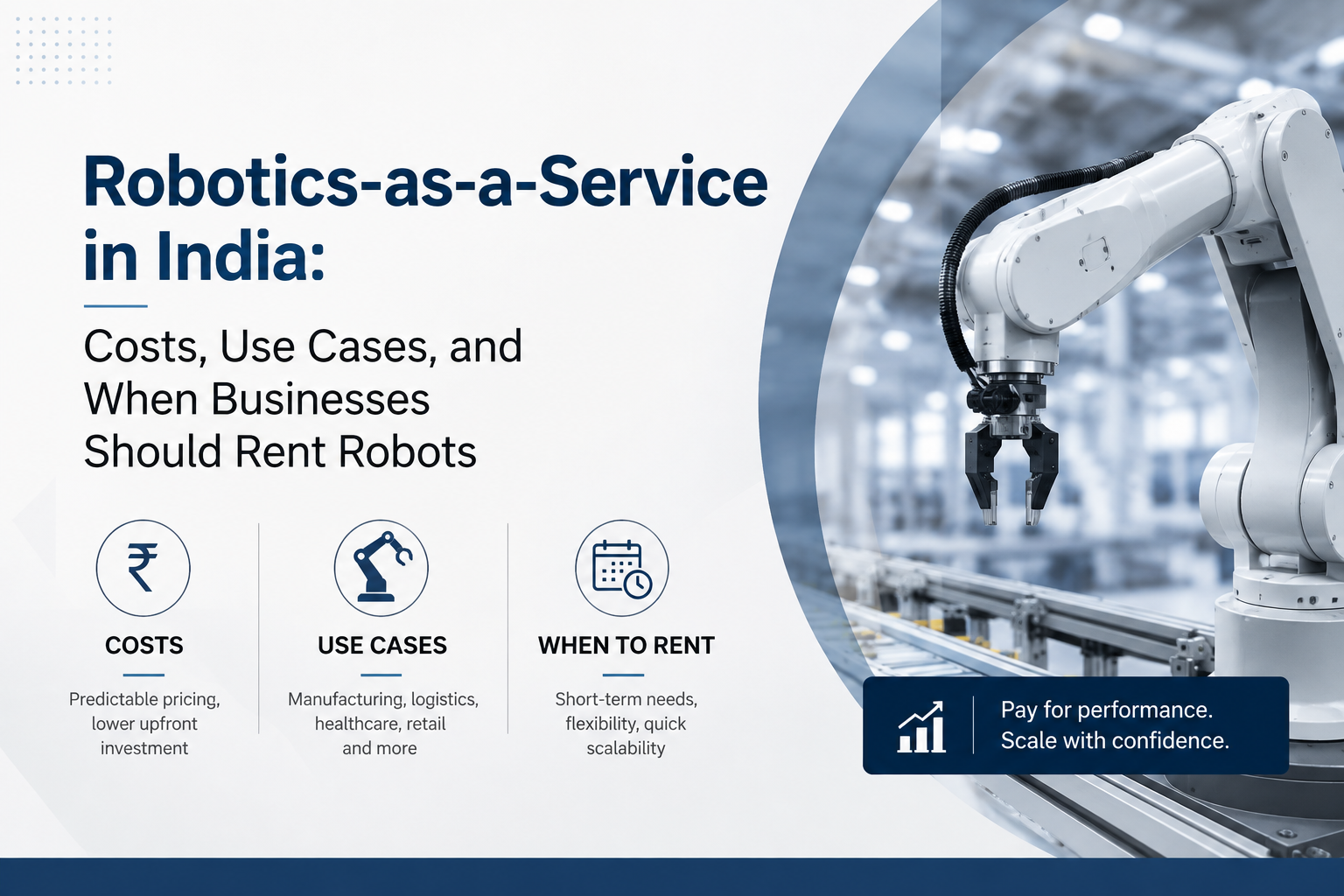
Robotics-as-a-Service (RaaS) is transforming how Indian businesses access automation, shifting robotics from a high-capital purchase to a flexible, subscription-based operational expense. Instead of investing lakhs upfront in hardware, Indian SMEs and enterprises can now deploy robots through monthly or usage-based plans that bundle hardware, software, maintenance, and upgrades. This model is especially powerful for seasonal fulfillment, logistics, and small-to-medium enterprises (SMEs) seeking to lower upfront capital barriers while preserving liquidity for growth.
What Is Robotics-as-a-Service (RaaS)?
Robotics-as-a-Service (RaaS) is a subscription or pay-per-use deployment model where businesses access robotic systems, including hardware, cloud orchestration software, maintenance, and performance upgrades, without owning the assets outright. RaaS converts major capital expenditures (CapEx) into predictable operational expenses (OpEx), enabling faster ROI and reducing initial deployment hurdles.
Unlike traditional robotics programs that demand significant upfront investment and in-house engineering teams, RaaS providers handle installation, integration, routine servicing, calibration, repairs, and cloud fleet management. This allows businesses exploring robots in India to focus on their core operations while leveraging advanced automation on demand.
Costs and Pricing Models in India
RaaS pricing in India typically follows three structures, each designed to align costs with operational outcomes and cash-flow preferences.genrobotics+2
Subscription Fee
A fixed recurring monthly or yearly cost per robot that bundles hardware, software, and upgrades. Ideal for businesses with stable, predictable workflows.genrobotics+1
Pay-Per-Use
Billing based on actual operational metrics like hours run, tasks completed, or square footage covered. Best for seasonal or project-based needs where demand fluctuates.techstoriess+1
OpEx Shift
RaaS converts major upfront capital expenses (CapEx) into predictable operational expenses (OpEx), preserving working capital for hiring, marketing, or expansion instead of locking it in depreciating hardware.genrobotics+2
All-Inclusive Maintenance
Provider handles routine servicing, calibration, repairs, and cloud fleet management software, eliminating hidden ownership costs like software updates, spare parts, and downtime.
Cost Comparison: Buying vs. Renting in India
The true financial landscape of robotics in India spans hardware, integration, and continuous maintenance. The table below highlights how the RaaS model shifts these numbers into predictable operational costs.
| Robot Category & Type |
Outright Purchase Cost (CapEx) |
Estimated Monthly RaaS Cost (OpEx) |
Ideal Indian Business Footprint |
| Collaborative Robots (Cobots) – Pick-and-place, basic assembly |
₹3 Lakh – ₹8 Lakh per unit (Excludes engineering) |
₹25,000 – ₹60,000 per month |
Tier 2/3 electronics workshops, MSMEs, light assembly lines |
| Autonomous Mobile Robots (AMRs / AGVs) – Warehouse sorting, material transit |
₹5 Lakh – ₹15 Lakh (Depends on payload) |
₹40,000 – ₹90,000 per month |
E-commerce hubs in logistics corridors (e.g., Bhiwandi, Chennai, NCR) |
| 6-Axis Industrial Articulated Robots – Heavy welding, precision painting |
₹8 Lakh – ₹25 Lakh per unit (Excludes custom cells) |
₹80,000 – ₹2,00,000+ per month |
Automotive tier-1 component suppliers, heavy engineering plants |
| Complete Robotic Cell – With custom tooling & safety enclosures |
₹20 Lakh – ₹80 Lakh upfront deployment cost |
Bundled into Tiered RaaS or a hybrid setup fee |
Full factory floor automation setups seeking quick multi-shift ROIs |
| Hidden Ownership Costs – Software updates, maintenance, parts |
8% – 15% of initial cost paid annually |
₹0 (Fully covered by provider) |
Businesses lacking dedicated internal automation engineering teams |
Primary Use Cases for RaaS in India
RaaS is gaining traction across sectors where flexibility, scalability, and cost-efficiency matter most.techstoriess+2
Logistics & E-Commerce Fulfillment
Autonomous Mobile Robots (AMRs) and Automated Guided Vehicles (AGVs) manage complex sorting, automated palletizing, and intra-warehouse material movements, eliminating bottlenecks during major Indian festive online sales like Diwali.
Automotive & Ancillary Assembly
Tier-1 and Tier-2 manufacturers deploy rented robotic arms to handle precise arc welding, automated spray painting, and component testing, reducing defects and improving throughput.
Electronics Manufacturing Services (EMS)
High-speed SCARA robots handle micro-component pick-and-place actions and repetitive circuit board assembly, critical for India’s growing electronics export sector.
Industrial Inspection & Surveillance
Specialized AI-backed inspection drones and crawlers check surface defects, structural flaws, and pipeline integrity across critical infrastructure fields, enhancing safety and reducing downtime.
Healthcare & Medical Logistics
Hospitals lease medical robots for touchless room sanitation, pharmaceutical supply tracking, and surgical assistance workflows. improving hygiene and operational efficiency.
Facility Management & Cleaning
cleaning Robotic floor scrubbers and security patrol bots are deployed in malls, airports, and corporate campuses, reducing labor costs and improving consistency.
Agriculture (Pilot Programs)
Precision crop monitoring, weeding, and spraying robots are being tested in Indian farms, addressing labor shortages and improving yield predictability.
When Businesses Should Rent (RaaS) vs. Buy
Choosing between RaaS and outright purchase depends on operational predictability, capital strategy, and technical readiness.
Choose RaaS (Renting) If:
-
Seasonal Demand Surges:
Your facility needs extra throughput strictly during peak quarters (e.g., Diwali e-commerce spikes), allowing you to scale down automation when demand slows. For businesses considering whether to buy robots in India or use RaaS, this flexibility can help avoid investing in equipment that may sit underutilized during off-peak periods.
-
Technological Obsolescence Risks: Your manufacturing processes require frequent upgrades to keep pace with evolving component designs, RaaS lets you swap older models for newer generations at contract renewal.
-
Capital Conservation: Your organization prefers preserving core liquidity for strategic marketing, hiring, or expansion rather than locked hardware asset investments.
-
No In-House Engineering Team: Your factory floor lacks specialized robotics technicians to perform custom coding, complex integration, and routine repairs, RaaS providers handle all maintenance and support.
Choose Outright Purchase If:
-
Predictable 24/7/365 Operations: Your production line runs standardized, invariant cycles continuously for 5 to 10 years without process updates, making CapEx more economical long-term.
-
Strict Data Privacy Requirements: Your data governance policies completely forbid connecting internal factory floor machinery to external cloud orchestration layers.
-
Custom, Non-Standard Configurations: The automated task requires deeply complex, custom-engineered tooling configurations that service providers cannot reuse across other clients.
Looking for a Robotics-as-a-Service Solution?
Get a customized estimate based on your facility size, robot type, operating hours, and automation requirements.
Implementation Roadmap for Indian Businesses
To successfully adopt RaaS, follow this structured approach:
-
Operational Assessment: Evaluate workflows, material flows, cycle times, and safety conditions to identify automation opportunities.
-
Pilot Deployment: Start with a targeted, quantifiable pilot (e.g., one warehouse zone or assembly line) to validate ROI and KPIs.
-
SLA & Contract: Formalize a subscription agreement with clear KPIs, uptime guarantees, and escalation paths.
-
Integration: Ensure seamless connectivity with existing ERP, WMS, or MES systems for real-time data flow.
-
Scale & Optimize: Expand fleet size based on performance metrics, leveraging provider support for continuous improvement.
Frequently Asked Questions (FAQs)
How much is 1 robot in Indian rupees?
The cost of one robot in India varies widely by type and capability. Collaborative robots (cobots) start around ₹3–8 lakh per unit, while autonomous mobile robots (AMRs) range from ₹5–15 lakh. Industrial 6-axis articulated robots can cost ₹8–25 lakh or more, excluding integration and safety systems. Under RaaS, these same robots can be accessed for ₹25,000–₹2,00,000+ per month depending on payload, SLA, and usage metrics.genrobotics+2
Is RaaS cheaper than buying a robot in India?
It depends on your utilization and cash-flow strategy. For short-term, seasonal, or pilot deployments, RaaS is often cheaper because it avoids large upfront CapEx and includes maintenance. However, for long-term, high-utilization operations (e.g., stable manufacturing lines running several years), outright purchase can be more cost-effective over the asset’s lifetime. As a general rule, buying tends to make more financial sense for highly utilized, stable operations over several years, while RaaS can be attractive for seasonal, variable, or pilot deployments.genrobotics+2
Who are the big 4 in robotics?
The “Big 4” in industrial robotics refers to ABB, FANUC, KUKA, and Yaskawa, global leaders in industrial robot manufacturing and automation solutions. These companies dominate heavy-duty, high-precision industrial arms used in automotive, metalworking, and electronics.nextmsc+1
Separately, in warehouse and mobile robotics, leading players include Locus Robotics, Exotec, inVia, and Berkshire Grey, but these are not part of the traditional “Big 4” industrial manufacturers.
What are 5 disadvantages of robots?
While robots deliver significant efficiency gains, key disadvantages include:
-
High Initial Investment (if purchased outright) – CapEx can be prohibitive for SMEs.
-
Technical Complexity – Requires skilled engineers for programming, integration, and maintenance.
-
Job Displacement Concerns – Automation can reduce low-skill roles, requiring workforce reskilling.
-
Limited Adaptability – Traditional robots struggle in unstructured environments without AI upgrades.
-
Dependency on Providers – RaaS models create vendor lock-in risks if SLAs or support degrade.
Market Trends & Growth Drivers in India
India’s robotics market is at an inflection point, driven by policy tailwinds, labor shortages, and digital transformation.
-
Policy Support: Make in India, PLI schemes, and the Draft National Robotics Strategy are accelerating adoption across manufacturing, logistics, and healthcare.
-
Labor Shortages: Rising wages and workforce gaps in warehousing, manufacturing, and facility management are pushing firms toward automation.
-
SME Access: RaaS models are unlocking automation for Tier 2/3 cities and MSMEs by lowering entry barriers and converting CapEx to OpEx.
Final Thoughts: Is RaaS Right for Your Business?
Robotics-as-a-Service is not just a pricing model; it’s a strategic enabler for Indian businesses looking to adopt cutting-edge automation without the burden of ownership. As physical AI in India continues to shape the next generation of robots for businesses, RaaS offers a practical way for companies in logistics, manufacturing, healthcare, and facility management to access flexible, scalable, and predictable automation.
If you’re exploring automated workflows for your facility, share a few details so we can narrow down your deployment strategy:
-
What primary industry vertical or core task are you looking to automate?
-
What is your typical daily operating schedule (e.g., single shift, or 24/7 continuous operations)?
-
Do you have an in-house technical team available to oversee daily machinery operations?
With the right RaaS partner, Indian businesses can turn automation from a capital-intensive dream into an operational reality. Whether you’re researching cobot price in India, comparing RaaS plans, or planning a larger automation project, the right solution can help drive efficiency, safety, and growth across Tier 1, Tier 2, and Tier 3 cities.
Planning to Automate Your Warehouse or Factory?
Compare robot types, estimated monthly RaaS costs, and deployment requirements before making a decision.
[Request a Robotics Consultation →]