
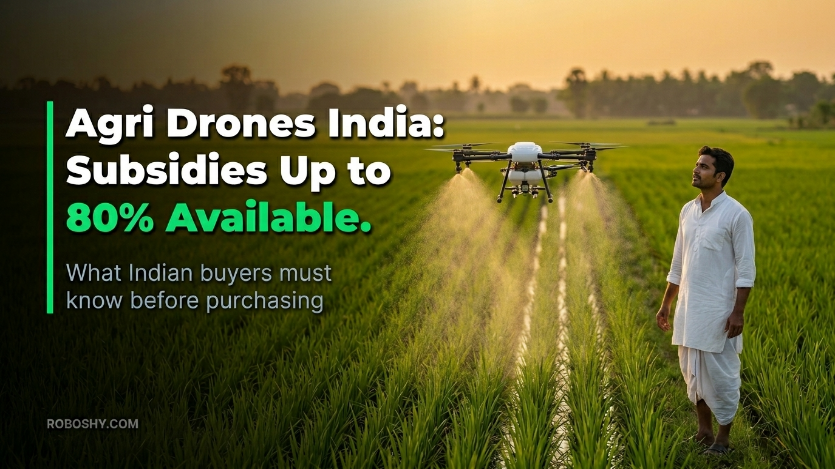
Agricultural Drones in India: Subsidies, Prices and Buyer Guide
Here is something most agri-drone sellers do not tell you upfront: the price tag on the product page is almost never what an eligible Indian buyer actually pays. The Government of India’s Namo Drone Didi scheme alone budgets INR 1,261 crore to place agricultural drones with 14,500 women-led Self-Help Groups, covering up to 80 percent of the cost, capped at INR 8 lakh per unit. Layer on SMAM, state-level mechanization grants, and AIF financing, and you have a situation where a drone listed at INR 8 lakh can land with a qualified SHG for under INR 2 lakh, complete with batteries, training, and a year of warranty. The sticker price, in short, is a starting point for negotiation with the government, not the final number.
That said, subsidy access is not automatic, and this is where most first-time buyers lose either money or time. The drone has to come from a DGCA-certified manufacturer listed on the Digital Sky Platform. The buyer has to apply before purchasing, not after. The pilot has to hold a Remote Pilot Certificate before the machine can legally fly commercially. Get any one of those three wrong and you have bought an expensive piece of equipment that neither qualifies for subsidy reimbursement nor can be operated without legal risk. This guide exists precisely to walk through those details in the order that matters: what the drones do, what they cost before and after subsidy, how to claim the money, what DGCA actually requires, and where to find a verified seller on Roboshy.
What Agricultural Drones Actually Do at Field Scale
Most of the noise around agricultural drones in India centres on spraying, and that is the right place to focus for any buyer making a first purchase. A 10-litre agri-drone covers 1.8 to 3.3 acres per sortie at a flow rate of 2 to 3 litres per minute, which adds up to roughly 8 to 15 acres per working hour depending on terrain, operator speed, and how many battery packs are cycling through the charger. Compare that to a single backpack sprayer operator covering 2 to 3 acres in a full day, and the mathematics stop being subtle.
The efficiency argument is real, but it only applies if the spraying operation is large enough to justify the drone sitting in a shed for nine months of the year. That is why acreage is the first number every prospective buyer needs to write down before they do anything else. We will return to the break-even calculation in the hire-versus-buy section; for now, the point is that the drone earns its keep through volume of coverage, not through any single magical application.
Crop Monitoring and Soil Mapping
Beyond spraying, multispectral-camera-equipped drones read vegetation index data across a field in a single pass, flagging nutrient deficiencies, pest pressure, or moisture stress at a resolution that ground-level scouting simply cannot match. For a farm of more than 10 acres, catching a pest outbreak three days earlier than you would have on foot is not a marginal benefit; it can be the difference between a localised treatment and a full-crop intervention. The third use case, soil mapping and digital elevation modelling, sits mainly with agri-tech companies, state agriculture departments, and precision farming services rather than individual farmers, though the technology is trickling into FPO-level operations as costs fall.
Agricultural Drone Prices in India: What the Market Actually Looks Like
The honest price range for a DGCA-certified agricultural drone in India runs from about INR 4 lakh at the entry end to INR 12 lakh or more for the high-capacity international models. Three things drive where a specific model sits within that band: tank capacity (because more litres per sortie means more acres per hour), type certification status (because an uncertified model disqualifies you from every subsidy on the market), and the manufacturer’s service network reach (because a drone that needs to travel 300 kilometres for a nozzle replacement is not really a working farm asset).
The table below reflects verified market pricing current as of early 2026. Unit price only; batteries, training, registration, and insurance are separate and addressed immediately after.
| Category | Tank Capacity | INR Price (Unit) | Representative Models | DGCA Status |
| Entry Level | 6 to 8 litres | INR 4L to 6L | InsideFPV Krishi, IoTechWorld Agribot | Type certified |
| Mid Range | 10 to 16 litres | INR 6L to 9L | Garuda Kisan G8, Marut AgriDrone, Krishi Viman KV-10 | Type certified |
| High Capacity | 20 to 30 litres | INR 9L to 12L | DJI AGRAS T40, Marucom W10 | Type certified |
| Enterprise | 30 litres and above | INR 12L and above | DJI AGRAS T60, specialised models | Type certified |
The Costs That Do Not Appear on the Product Page
Battery sets are the expense that most first-time buyers underestimate. A standard battery provides 15 to 25 minutes of flight time, which covers one or two sorties before you need 30 to 45 minutes on a fast charger. Running 40 to 60 acres through a day’s work means three to five battery sets in rotation simultaneously, and that adds INR 1 lakh to INR 2.5 lakh to the initial outlay before anything else. On top of that: Remote Pilot Certificate training at a DGCA-approved organisation runs INR 15,000 to INR 25,000 per operator (more on this in the compliance section), drone registration and UIN assignment are non-optional before first flight, and annual maintenance for a mid-range unit in serious commercial use runs INR 1.5 lakh to INR 2 lakh per year according to Leher’s January 2026 cost analysis.
The same Leher analysis puts the full entry-into-service cost for a mid-range agri-drone at INR 6 lakh to INR 8 lakh before subsidies. After eligible subsidies are applied, a priority-category individual farmer is looking at INR 3 lakh to INR 4 lakh, an FPO at INR 3.5 lakh to INR 4.5 lakh, and a qualifying SHG under Namo Drone Didi at INR 1.5 lakh to INR 2 lakh for the full package. Those are materially different numbers, and which one applies to you is entirely a function of your buyer category and whether you apply in the right order.
Government Subsidies for Agricultural Drones: SMAM and Namo Drone Didi
Two central government schemes do most of the work here. Neither is a loan. Both operate via direct benefit transfer to the buyer’s linked bank account after purchase verification by a district agriculture officer. The key word is after: you apply first, get written approval, then buy from an approved vendor. Reversing that sequence is the most common and most expensive mistake in drone subsidy applications.
Sub-Mission on Agricultural Mechanization (SMAM)
SMAM sits under the Ministry of Agriculture and Farmers Welfare and runs through agrimachinery.nic.in. The Revised SMAM Guidelines 2025 set the following subsidy structure, applying only to drones from DGCA-empaneled manufacturers listed on Digital Sky.
SMAM Subsidy by Buyer Category
KVKs, ICAR institutes, and State Agricultural Universities get a full 100 percent subsidy up to INR 10 lakh per unit, which effectively means the government is funding their demonstration equipment outright. FPOs, cooperatives, and Custom Hiring Centres under these organisations receive 40 percent up to INR 4 lakh. Agricultural graduates setting up CHCs get a slightly better deal at 50 percent up to INR 5 lakh. Individual farmers who are SC/ST, women, small/marginal, or from Northeastern states also qualify for 50 percent up to INR 5 lakh. Everyone else in the individual farmer category gets 40 percent up to INR 4 lakh.
The Application Process
Register on the agrimachinery.nic.in portal under your beneficiary category. Submit Aadhaar details, land records, PAN, and a bank account linked to Aadhaar for DBT. Get a price quotation from a DGCA-empaneled vendor only; the system rejects quotations from unlisted sellers. Upload documents, collect your Application Reference ID, and wait for District Agriculture Officer verification, which may include a physical land inspection. Only after written approval should you purchase the drone. Post-purchase, upload your invoice and photographs, a field officer does a final check, and the subsidy lands in your account via DBT. The full cycle runs 30 to 60 days in states with active digital portals; slower in others. Buy before approval and you lose the subsidy entirely, with no appeal mechanism.
Namo Drone Didi
This scheme is different in character. It is not a mechanization incentive spread across all farmers; it is a targeted women’s livelihoods program built around a specific commercial model. The Government of India committed INR 1,261 crore for the 2024-25 to 2025-26 period, targeting 14,500 women-led SHGs with a subsidy of 80 percent up to INR 8 lakh per unit, per the official PIB release. That subsidy covers the drone plus spray assembly, battery sets, propeller sets, a downward camera, dual fast chargers, an anemometer, a pH meter, a full year of onsite warranty, and 15 days of training for both the pilot and an assistant. Not just the hardware: the entire operating kit.
For SHGs whose cluster federation accesses an Agriculture Infrastructure Fund loan for the remaining balance, the AIF offers 3 percent interest subvention, pushing the effective out-of-pocket cost down to INR 1.5 lakh to INR 2 lakh for a package that retails at INR 10 lakh or more. The business logic is that the SHG then provides spraying services to surrounding farmers at commercial rates, typically targeting INR 60,000 to INR 1,00,000 in annual service income. Applications for this scheme go through the Ministry of Rural Development or state nodal agencies, not through agrimachinery.nic.in; contact your district Rural Development Office to find the current application window.
DGCA Compliance: The Four Things You Must Confirm Before Any Purchase
A drone bought from a non-certified seller is not just ineligible for subsidy; it likely cannot be legally registered, which means it cannot fly commercially, which means it is an expensive ornament. This is not a theoretical risk. The grey market for agri-drones in India includes sellers who claim DGCA approval without appearing on the Digital Sky Platform. Always verify the model yourself at digitalsky.dgca.gov.in before placing an order. If you cannot find it by name and model number, do not buy it.
Type Certification, Registration, Pilot Certification, and Operational Rules
Type certification is the first gate: the drone model, not just the manufacturer, must be listed on Digital Sky as DGCA-certified. That listing is model-specific, so confirm the exact variant you are purchasing. The second gate is UIN registration: every individual drone unit gets its own Unique Identification Number through Digital Sky before it can legally take off. You need the serial number, your identity documents, and the type certificate reference to complete registration.
The third gate is the Remote Pilot Certificate. Every person who flies the drone commercially must individually hold one, issued by a DGCA-approved Remote Pilot Training Organisation. The certificate is not transferable and does not come with the drone. Training runs 5 to 15 days depending on prior flying experience and costs INR 15,000 to INR 25,000 per person where not bundled into the purchase package. Many manufacturers have partnered with RPTOs and include training in the deal; ask specifically before signing anything.
The fourth gate is operational compliance under DGCA’s standard operating procedures: Visual Line of Sight flights only, altitude under 400 feet, no-fly zones respected, and NPNT (No Permission No Take-off) active on every flight to log it through Digital Sky. If you are building a commercial spraying business rather than flying your own land, you additionally need a UAS Operator Permit from DGCA before the first paid job. Flying without any of these in place carries civil penalties and can cost you your certifications permanently.
Should You Buy a Drone or Hire Drone Spraying Services?
This is where a lot of people spend too little time before committing to a purchase. The question is not whether drone technology works; it clearly does. The question is whether your farm’s economics justify owning the technology versus accessing it through a Custom Hiring Centre or service operator at INR 150 to INR 300 per acre.
The Case for Hiring
For a 5-acre farm with four spray cycles per year, hiring costs INR 3,000 to INR 6,000 annually. Even at post-subsidy ownership cost of INR 3 lakh to INR 4.5 lakh, you are looking at a payback period measured in decades through farm use alone. Leher’s January 2026 analysis sets the break-even at roughly 150 acres per season, combining your own land and any neighbouring farms you spray commercially. Below that threshold, you are better off paying someone else. The government has placed Custom Hiring Centres in every district as part of SMAM, and state agriculture departments maintain CHC directories through agrimachinery.nic.in and district agriculture offices.
The Case for Owning
Above 25 acres of personal land, or for any buyer who has concrete arrangements to service neighbouring farms and can credibly reach 150 acres per season, the ownership case holds. FPOs with 200 to 500 acres of aggregated member land sit squarely in the ownership zone, especially under SMAM’s 40 percent subsidy. For women’s SHGs under Namo Drone Didi, the calculation is different again: the scheme is specifically designed for SHG ownership and commercial service provision, with the subsidy, training, and equipment package structured to get a new drone-based business to profitability within one or two growing seasons. For that buyer category, ownership is the right answer; the question is simply whether the local farmer base in the SHG’s cluster area can sustain 150-plus acres of seasonal spraying demand.
How to Check Whether an Agricultural Drone Seller Is Legitimate
The agri-drone market in India carries a meaningful number of sellers who are either reselling uncertified imports, operating as informal dealers for brands without Indian service infrastructure, or listing products with subsidy claims they cannot actually document. None of these is a vendor you want to hand money to before independently verifying three things.
Three Checks Before Signing Any Purchase Order
First, find the specific drone model on India’s Digital Sky Platform at digitalsky.dgca.gov.in by name and model number. Not the brand name. Not the product family. The exact model you are being asked to buy. If it is not there, it does not qualify for any subsidy under any scheme, and it may not be legally registerable for commercial operation. A seller saying the model is DGCA approved carries zero weight without that listing.
Second, ask the seller directly: where is your nearest service centre relative to my operating location? Agricultural drones in hard commercial use fail. Nozzles wear. Pumps block. Calibration drifts. A unit that has to travel 400 kilometres for a workshop visit creates downtime during the exact weeks it needs to be working hardest. For a spraying business that books out by the acre during sowing and harvesting windows, a week of grounded downtime is a week of lost income that no warranty clause covers.
Third, confirm the training pathway. Does the seller provide RPTO-accredited pilot training as part of the purchase, or do they hand you the drone and point you toward an independent training organisation? Both arrangements exist; the difference is in time, cost, and how smoothly the compliance pathway runs from payment to first legal commercial flight. Roboshy lists verified agricultural drone sellers across the Drones product category, with sellers accessible for direct contact to confirm empanelment status, service geography, and training provision before you commit to any purchase.
Frequently Asked Questions
What is the actual price of an agricultural drone in India after subsidy?
The honest answer is: it depends entirely on which buyer category you fall into. The unit price before any intervention runs from INR 4 lakh for a basic 6-litre entry model to INR 12 lakh or more for a 30-plus-litre commercial machine. Under SMAM, an SC/ST or women or small/marginal farmer gets 50 percent off up to INR 5 lakh in subsidy; all other individual farmers get 40 percent up to INR 4 lakh; FPOs and cooperatives also get 40 percent up to INR 4 lakh; agricultural graduates setting up CHCs get 50 percent up to INR 5 lakh; and institutions like KVKs and ICAR get the whole thing paid up to INR 10 lakh. Women’s SHGs eligible for Namo Drone Didi get the best deal anywhere: 80 percent up to INR 8 lakh for a complete operational package, with AIF loan access for the rest at 3 percent interest subvention. Those subsidy figures are for hardware only. Battery packs add INR 1 lakh to INR 2.5 lakh, pilot training adds INR 15,000 to INR 25,000 per operator, and annual maintenance adds INR 1.5 lakh to INR 2 lakh per year. None of that is covered by SMAM. And none of it applies if you buy from an unapproved seller; that purchase produces no subsidy, no legal registration, and no path to commercial operation.
How do I apply for the SMAM drone subsidy in India?
Everything runs through agrimachinery.nic.in. Start by registering under your beneficiary category: individual farmer, FPO, SHG, agricultural graduate, or institution. You will need Aadhaar, land records, PAN, and a bank account linked to Aadhaar for direct benefit transfer. The application needs a price quotation from a DGCA-empaneled vendor specifically; the portal rejects quotations from unapproved sellers, which is a useful early signal about whether the vendor you are talking to is legitimate. Submit the application, note your Application Reference ID, and wait for District Agriculture Officer verification; some states require a physical land visit. Only after you receive written approval should you actually buy the drone. Post-purchase, upload your invoice and photographs to the portal. A field officer does a final verification, then the subsidy amount transfers directly to your linked account, typically within 30 to 60 days of a complete application in states with working digital infrastructure. The cardinal rule: do not buy first and apply later. That sequence is not eligible under any circumstances, and there is no appeals process once the purchase precedes the approval. For Namo Drone Didi, the application route is through the Ministry of Rural Development or your state nodal agency rather than agrimachinery.nic.in; your district Rural Development Office has the current application window and contact details.
What DGCA requirements apply to operating an agricultural drone in India?
Four distinct requirements apply under the Drone Rules, 2021. The drone model must hold DGCA type certification and be findable on the Digital Sky Platform by exact model name and number. Each individual unit needs its own Unique Identification Number registration through Digital Sky before the first flight, using the unit’s serial number and your identity documents. Every person flying the drone commercially must hold a Remote Pilot Certificate from a DGCA-approved RPTO; this is per-pilot, not per-drone, and training runs 5 to 15 days at INR 15,000 to INR 25,000 per person. If you are running a commercial spraying service rather than flying your own land, you additionally need a UAS Operator Permit from DGCA before the first paid flight. All flights must be within Visual Line of Sight, under 400 feet altitude, outside designated no-fly zones, and NPNT-compliant so that every flight is logged through Digital Sky. Flying with an unregistered UIN, without an RPC, or in restricted zones puts you in violation of the 2021 Rules, with civil penalties and potential loss of certification. It also makes you ineligible for any current or future government subsidy.
Which agri-drone model is best suited to Indian farm conditions?
For farms between 5 and 25 acres with two to four spray cycles per season, Indian-manufactured 6-litre to 10-litre models from InsideFPV, IoTechWorld, and Marut Drones offer the most practical starting point. They are built for irregular parcel boundaries and varied Indian terrain, they are easier to maintain without specialist tooling, and their post-subsidy acquisition cost is the lowest in the market. For farms above 25 acres, or for FPOs and CHCs managing aggregated acreage, the mid-range 10-litre to 20-litre machines from Garuda Aerospace, Krishi Viman, and DJI through authorised distributors provide the daily coverage throughput needed to justify ownership economics. Two things matter more than brand for any buyer: first, check that the exact model variant appears on the Digital Sky Platform before you negotiate price, because technical specifications mean nothing if the drone cannot be registered or subsidised; second, find out specifically where the nearest service centre is relative to your operating location, because a drone that cannot be repaired quickly during peak season is an overhead cost, not a productivity asset.
Is it better to hire drone spraying services or buy your own drone?
Hire, unless you can credibly reach 150 acres of spraying per season. That is Leher’s January 2026 break-even figure for Indian agri-drone ownership under current service rates, and it is the number to test your own situation against. Custom Hiring Centres, which operate under SMAM funding and charge INR 150 to INR 300 per acre, are present in every district and accessible through agrimachinery.nic.in or district agriculture offices. For a 5-acre farm with four spray cycles, annual CHC costs run INR 3,000 to INR 6,000; against a post-subsidy ownership investment of INR 3 lakh or more, the payback arithmetic does not work through farm use alone. For farms of 25 acres and above where the owner intends to service neighbouring farms commercially, the ownership case closes. For FPOs with 200-plus acres of aggregated member land, ownership is clearly right. For women’s SHGs evaluating Namo Drone Didi, the scheme was specifically designed for drone ownership as a commercial service business, so the question is not whether to own but whether the local farmer demand in your cluster area is large enough to sustain 150-plus acres of seasonal work. The hiring option has no DGCA compliance requirement on the farmer’s side; all compliance obligations sit with the CHC operator.
How long does an agri-drone battery last and what does maintenance actually cost?
One battery pack gives 15 to 25 minutes of flight depending on payload weight, temperature, altitude, and spraying intensity. In a commercial operation running 40 to 60 acres a day, you need three to five packs in rotation with at least two fast chargers cycling continuously, otherwise the drone sits on the ground more than it flies. Battery packs are consumables; 200 to 400 charge cycles is the typical useful life before performance falls below working standards, which translates to one to two growing seasons of serious commercial use. Replacement pack costs for mid-range models run INR 25,000 to INR 45,000 per set. Annual maintenance for a commercial-intensity mid-range unit, covering nozzle set replacement, propeller sets, pump servicing, motor inspection, and software updates, runs INR 1.5 lakh to INR 2 lakh according to Leher’s 2026 cost analysis. That figure assumes regular maintenance; a drone running through Indian agricultural conditions (dust, agrochemical residue, humidity) without scheduled servicing fails faster, and the repair costs are not linear. Before purchasing, get the specific manufacturer’s recommended maintenance schedule in writing, and ask the seller directly whether they offer a service contract or just a warranty.
Where can I actually find and buy a verified agri-drone seller in India?
Three channels give you verified access. First, the manufacturer’s own website for Indian-made brands: InsideFPV, Garuda Aerospace, Marut Drones, IoTechWorld, and Krishi Viman all list their authorised state-level dealers. Second, agrimachinery.nic.in maintains a list of DGCA-empaneled vendors whose quotes are accepted for subsidy applications; any seller whose product you are planning to use in a subsidy application must appear here, and checking that list is a non-negotiable verification step. Third, Roboshy’s Drones category lists verified sellers across payload categories at transparent INR pricing. Sellers on the platform can be contacted directly to confirm their Digital Sky empanelment status, which states their service network covers, and whether they bundle RPTO training with purchase. For buyers in rural or remote agricultural areas, that third question, how close is their nearest service centre to your operating location, is genuinely as important as everything else on the spec sheet.
Is buying an agricultural drone actually worth it for an Indian farmer?
Worth it under three conditions, all of which need to hold at the same time. One: your acreage and commercial service plan can reach 150 acres of spraying per season, which is the rough break-even figure. Two: your buyer category qualifies for a subsidy that reduces hardware cost to something your cash flow can carry without strain. Three: you have a real plan for DGCA compliance, including pilot training and UIN registration, before the first commercial flight. When all three line up, the financials make sense. A women’s SHG under Namo Drone Didi buying a full drone package for a net INR 2 lakh outlay and earning INR 80,000 to INR 1,00,000 monthly in spraying fees is recovering the investment in under three months at reasonable utilisation. A 30-acre farmer with a 50 percent SMAM subsidy who also services five neighbouring farms covers the residual hardware cost within one or two growing seasons. Where one or two of those three conditions is missing, CHC rental at INR 150 to INR 300 per acre is the better answer, and there is no shame in that. The discipline is to run the numbers honestly before the subsidy application is in, not after.
Finding Verified Agricultural Drone Sellers Through Roboshy
Roboshy is India’s first dedicated robots and drones marketplace. The Drones category lists verified sellers across all payload categories, entry-level through enterprise, at transparent rupee pricing, with direct seller contact available to confirm DGCA empanelment, service geography, subsidy documentation support, and training provision before any purchase decision. Buyers can browse verified agricultural drone listings on Roboshy and reach out to sellers whose coverage and compliance status match their operating requirements.
Robotics-as-a-Service in India: Costs, Use Cases, and When Businesses Should Rent Robots
August 12, 2026
6:45 am

From Automation to Physical AI: How Robots Will Transform Indian Businesses
August 8, 2026
1:38 pm
Food Serving Robot for Indian Restaurants: The Complete Guide
May 18, 2026
5:25 am
Agricultural Drones in India: Subsidies, Prices and Buyer Guide
May 7, 2026
5:18 am
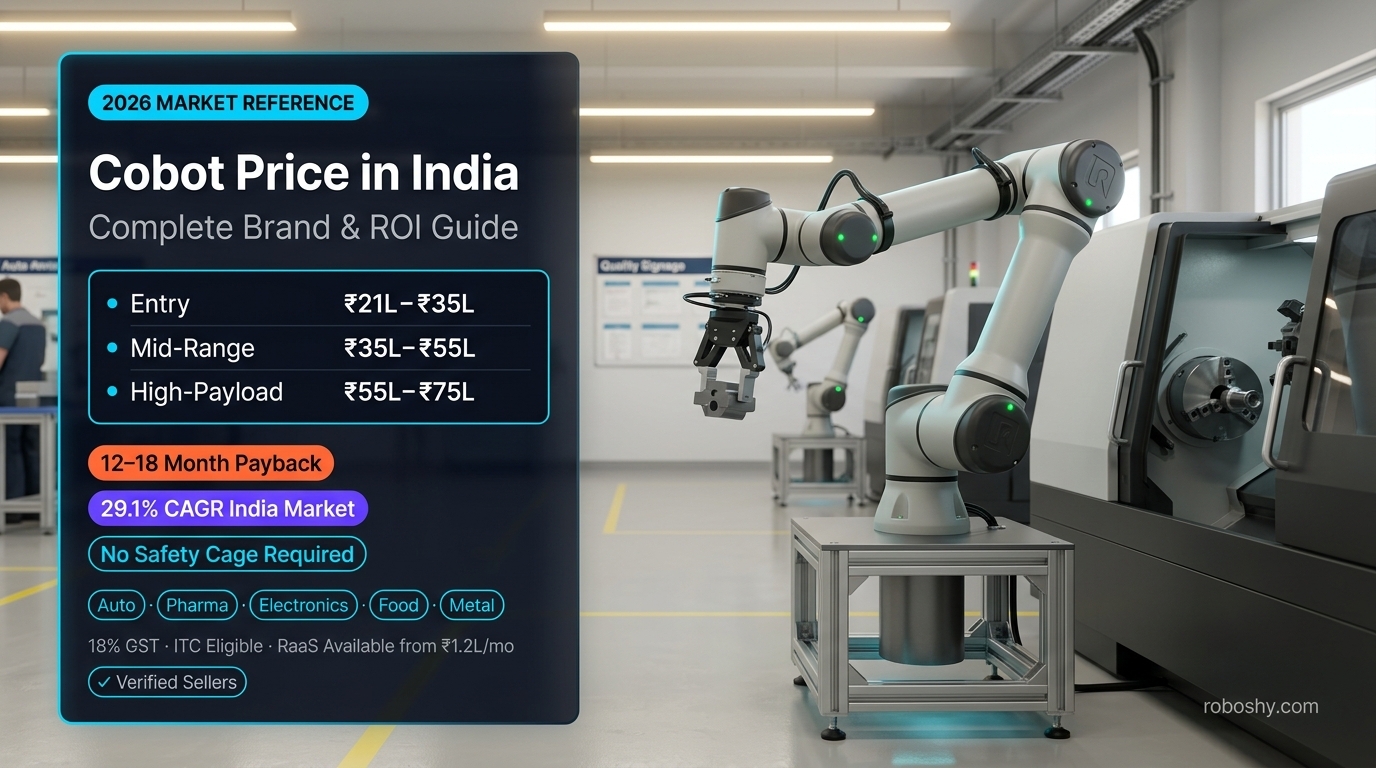
Cobot Price in India: What Indian Businesses Actually Pay in 2026
April 23, 2026
5:30 am

Buy Robots in India: The Complete Marketplace Buyer’s Guide
April 2, 2026
10:30 am
How Security Robotics Drive Business Impact and Operational Efficiency
March 13, 2026
9:52 am

Humanoid Robots Launching in 2026: What Buyers Need to Know Before They Purchase
February 28, 2026
10:34 am
Robotics-as-a-Service in India: Costs, Use Cases, and When Businesses Should Rent Robots
August 12, 2026
6:45 am
From Automation to Physical AI: How Robots Will Transform Indian Businesses
August 8, 2026
1:38 pm
Food Serving Robot for Indian Restaurants: The Complete Guide
May 18, 2026
5:25 am
Agricultural Drones in India: Subsidies, Prices and Buyer Guide
May 7, 2026
5:18 am
Cobot Price in India: What Indian Businesses Actually Pay in 2026
April 23, 2026
5:30 am
Buy Robots in India: The Complete Marketplace Buyer’s Guide
April 2, 2026
10:30 am
How Security Robotics Drive Business Impact and Operational Efficiency
March 13, 2026
9:52 am
Humanoid Robots Launching in 2026: What Buyers Need to Know Before They Purchase
February 28, 2026
10:34 am