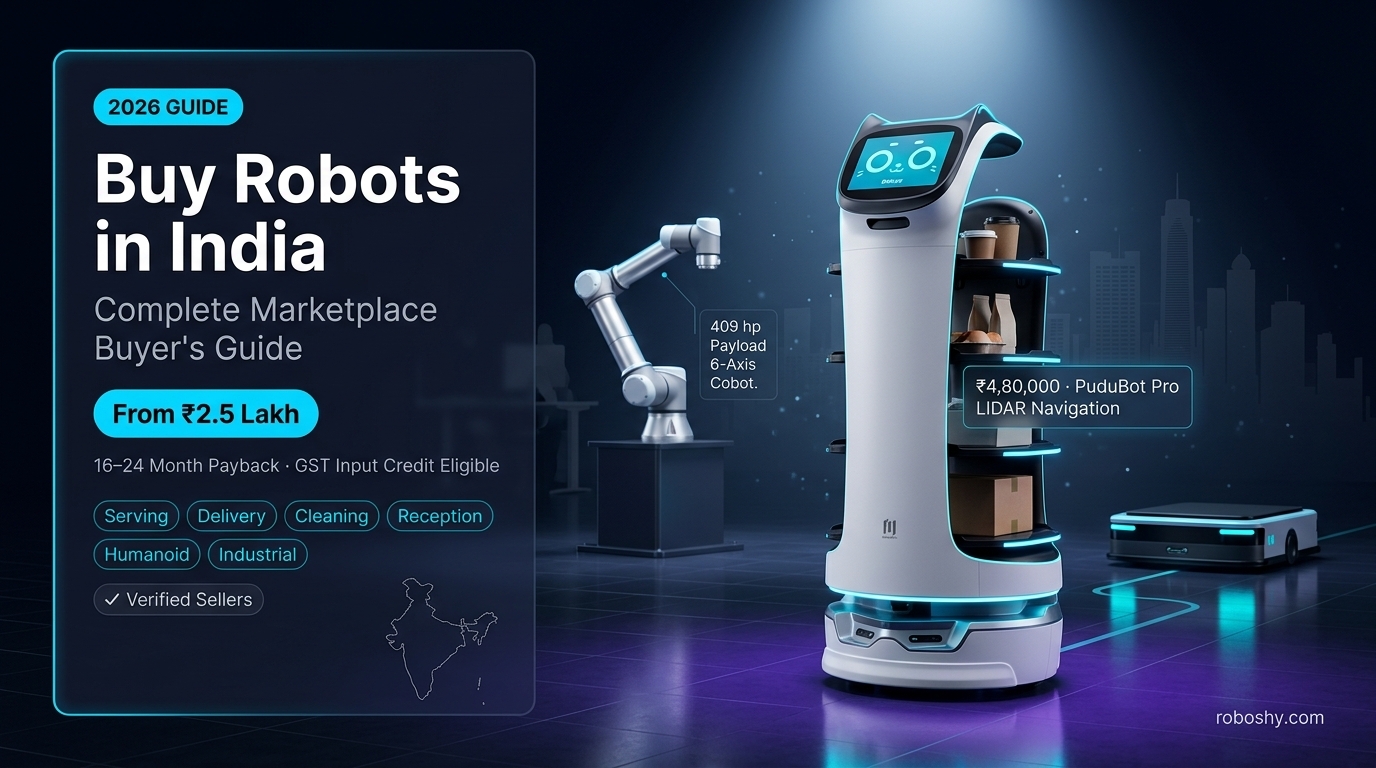
Buy Robots in India: The Complete Marketplace Buyer’s Guide
India’s robotics market hit USD 1.98 billion in 2025; that’s 15.74 percent compound growth through 2034, per IMARC Group. Most businesses trying to buy a robot still burn two or three weeks pinging manufacturer websites, chasing unverified resellers, and scrolling through B2B platforms where industrial robots share a page with pipe fittings and adhesive tape. That process wastes time you don’t have.
Roboshy exists to fix exactly that. It’s India’s first marketplace built only for robots, six categories, verified sellers, INR pricing, and full specs all in one place. No guessing who actually stocks the unit or holds the distribution rights in India.
This guide is for anyone planning to buy robots in India in 2026. Inside, you get every major robot category explained, live rupee pricing, a six-step buying framework pulled from real deployments, payback period data from actual Indian operators, and direct answers to the ten questions first-time buyers ask most. By the end, you’ll have a clear view of what to buy, what it costs, and who to buy it from.
This guide draws on competitive analysis of India’s leading robotics suppliers, deployment data from restaurants, hotels, hospitals and factories across India, and Roboshy’s own marketplace intelligence gathered since launch. We’ve laid it out to take you from first question to confident purchase, section by section.
What You’ll Learn
- What Are the Types of Robots You Can Buy in India?
- Why Indian Businesses Are Buying Robots Right Now
- Robot Prices in India: A Category by Category Rupee Breakdown
- How to Buy Robots in India: A Six-Step Marketplace Framework
- Robots for Restaurants, Hotels, Hospitals and Factories in India
- The ROI of Buying Robots in India: Real Payback Period Data
- Seven Mistakes Indian Buyers Make and How to Avoid Them
- How Roboshy Works for Buyers and Sellers
- Frequently Asked Questions About Buying Robots in India
What Are the Types of Robots You Can Buy in India?
Six distinct robot categories are alive in India’s market right now, and each one is solving a completely different problem for completely different kinds of businesses. Serving robots take food from kitchen to table. Delivery robots carry supplies through hospital corridors and hotel floors. Cleaning robots run airport terminals and malls when everyone’s gone home. Reception robots handle visitors at lobbies and OPDs. Humanoid robots turn up at brand events and campuses. Industrial robots run the factory floor.
Serving Robots
A serving robot takes food and drinks from the kitchen pass, threads around chairs and guests, drops off the order at the right table, and heads back on its own for the empty trays. Restaurants and hotels moved first because food service attrition in India runs 40 to 60 percent a year. A robot doesn’t quit mid-shift, doesn’t call in sick, and doesn’t need replacing every eight months. On Roboshy’s network right now, the BellaBot Pro and PuduBot 2 are the most consistently ordered models.
Pricing runs from Rs 2.5 lakh to Rs 7.5 lakh excluding GST. The right model comes down to your table count, floor layout, and whether guest interaction matters as much as delivery speed does.
Delivery Robots
Inside a building, delivery robots carry supplies, medicines, linen, and documents without anyone pushing them. Hospitals send them between floors. Hotels use them for contactless room service. Offices put them on mail and parcel runs. They run on LIDAR and SLAM navigation, scan the building once, and after that move through it confidently without floor markers or track installations. Hospitals with 200-plus beds in India have reported saving four to six staff hours per day just from a single robot handling delivery runs.
Cleaning Robots
Don’t confuse these with the robot vacuums you see in home appliance stores. Commercial cleaning robots sweep, scrub, and mop anywhere from 2,000 to 5,000 square feet an hour. That’s a viable scale for airports, shopping malls, hospitals, and large office campuses. Over the last 18 months, adoption jumped sharply, mainly because of how fast India’s commercial real estate and hospitality sectors have been growing. Price range: Rs 5 lakh to Rs 15 lakh, depending on how large an area you need covered and what features matter.
Reception Robots
At a hotel lobby, hospital OPD, or corporate reception, a reception robot greets visitors, handles the routine questions, gives directions, and doubles as a visible brand statement all at the same time. Most models handle multiple Indian languages, which genuinely matters in a country where a single lobby might see Hindi, Tamil, Gujarati, and English speakers before 11am. Pricing runs from Rs 3 lakh to Rs 6.5 lakh excluding GST.
Humanoid Robots
Humanoid robots are showing up commercially in India now, mostly at brand events, educational institutions, and high-visibility engagement settings where the visual impact matters as much as the function. ABI Research puts the global average selling price at USD 158,400 for 2025. Entry-level educational units in India start at Rs 8 lakh. Commercial-grade models go considerably higher than that. Most Indian buyers in this space are early adopters, they come in with a specific event or demo scenario already in mind.
Industrial Robots
Industrial robots cover a wide range: articulated arms, SCARA robots, collaborative robots (cobots), and autonomous mobile robots (AMRs). Straits Research put India’s industrial robotics segment at USD 522 million in 2025, growing at 9.6% annually. Automotive accounts for 36% of all industrial robot purchases in India. Electronics, pharma, and food processing make up most of the rest. Cobots start from Rs 8 lakh. Heavy six-axis arms for welding, painting, and machine tending go up to Rs 1.5 crore and beyond.
The table below gives you a quick reference across all six categories.
| Robot Type | Primary Function | INR Price Range | Best Fit Industries |
| Serving Robot | Food and drink delivery at tables | Rs 2.5L to Rs 7.5L | Restaurants, Hotels, Banquets |
| Delivery Robot | Indoor supply and logistics movement | Rs 3.5L to Rs 8L | Hospitals, Hotels, Offices |
| Cleaning Robot | Commercial floor cleaning at scale | Rs 5L to Rs 15L | Malls, Airports, Hospitals |
| Reception Robot | Guest greeting and wayfinding | Rs 3L to Rs 6.5L | Hotels, Corporates, Clinics |
| Humanoid Robot | Engagement, education, brand events | Rs 8L and above | Events, Institutions |
| Industrial Robot | Manufacturing, assembly, warehousing | Rs 8L to Rs 1.5Cr+ | Auto, Electronics, Pharma |
Why Indian Businesses Are Buying Robots Right Now
Three things are driving robot adoption forward across Indian businesses in 2026. Labour costs keep climbing. Service-sector demand keeps growing. And there are real government incentives on the table for automation. Understanding all three makes it a lot easier to justify the investment internally.
Labor Costs Keep Climbing
Across most states, minimum wages have gone up every year for three years running. In food service, hospitality, and light manufacturing, annual attrition sits at 40 to 60%. And every time someone leaves, replacing and retraining them costs three to six months of that person’s salary.
From actual Indian restaurant deployment data: a Rs 4.8 lakh serving robot pays back in 16 to 24 months purely through what you save on labour. And that math improves every year, wages go up, and robot prices come down.
India’s Robotics Market Grows 15% Annually
IMARC Group’s projections take India’s robotics market from Rs 16,500 crore in 2025 to Rs 61,000 crore by 2034, a 15.74% compound rate. Service robotics is the fastest-growing piece of that number. Statista separately projects India’s service robotics revenue at USD 430 million for 2025 alone.
Businesses buying robots now are locking in supplier relationships, getting their teams trained, and building a customer experience edge before the market fully matures. Operators in restaurants and hotels are already telling us that a robot on the floor is a competitive differentiator, not just a line item on the P&L.
Government Incentives Make Automation Financially Strategic
India’s Production Linked Incentive scheme creates a direct financial case for automation in electronics, pharmaceuticals, auto components, and textiles. Manufacturers deploying robots as part of their PLI commitments can claim those linked incentives on top of the standard GST input tax credit. Under current GST provisions, robot purchases for business use qualify for input tax credit, which cuts the effective cost by 18% for registered businesses.
Post-COVID Customers Expect Technology-Forward Service
A 2024 Deloitte survey found that 67% of urban Indian consumers actively prefer businesses that visibly use automation, for hygiene reasons as much as service ones. A robot in your restaurant or hotel lobby isn’t a novelty anymore. It tells customers something about how seriously you run your operation, and they’re comparing you against every brand they dealt with through and after the pandemic.
Not sure which robot fits your business? Browse Roboshy’s verified marketplace and compare models across all six categories with INR pricing and seller contacts in one place.
Robot Prices in India: A Category by Category Rupee Breakdown
Robot prices in India vary quite a bit, and the gap between a basic model and a premium one can be enormous. Category, brand, payload capacity, and what’s included in the after-sales package all drive the number. Every price below comes from live INR listings on Roboshy’s marketplace and public distributor data as of Q1 2026. GST at 18 percent applies to most categories under HSN 8479 and is excluded from all figures here.
Serving Robot Price in India
| Model Tier | Price Range (Ex-GST) | Best Suited For |
| Entry level serving robot | Rs 2,50,000 to Rs 4,00,000 | Small cafes and QSRs |
| Mid-range (e.g. PuduBot 2) | Rs 4,00,000 to Rs 5,50,000 | Restaurant chains and food courts |
| Premium (e.g. BellaBot Pro) | Rs 6,00,000 to Rs 7,50,000 | Luxury dining and hotel F&B |
Table 2: Serving robot prices in India across three tiers, Q1 2026. Source: Roboshy marketplace data.
Delivery Robot Price in India
| Deployment Environment | Price Range (Ex-GST) | Key Requirement |
| Hospital or healthcare | Rs 4,50,000 to Rs 7,00,000 | Multi-floor LIDAR navigation |
| Office or corporate building | Rs 3,50,000 to Rs 5,00,000 | Document and parcel delivery |
| Hotel room service | Rs 4,00,000 to Rs 6,50,000 | Quiet operation and elevator integration |
Table 3: Delivery robot prices in India by deployment environment, Q1 2026.
Cleaning Robot Price in India
| Scale of Operation | Price Range (Ex-GST) | Cleaning Coverage Per Hour |
| Small commercial space | Rs 4,00,000 to Rs 6,00,000 | Up to 1,500 sq ft |
| Mid-scale commercial | Rs 6,00,000 to Rs 10,00,000 | 2,000 to 3,500 sq ft |
| Large industrial scale | Rs 10,00,000 to Rs 15,00,000 | 4,000 sq ft and above |
Table 4: Cleaning robot prices in India by operational scale, Q1 2026.
Industrial Robot Price in India
| Robot Type | Price Range (Ex-GST) | Common Application |
| Cobot (collaborative robot) | Rs 8,00,000 to Rs 20,00,000 | Assembly, pick-and-place, inspection |
| 6-axis articulated arm | Rs 15,00,000 to Rs 60,00,000 | Welding, painting, machine loading |
| AMR (Autonomous Mobile Robot) | Rs 12,00,000 to Rs 45,00,000 | Warehouse picking and sorting |
| SCARA robot | Rs 8,00,000 to Rs 25,00,000 | High-speed light assembly |
Table 5: Industrial robot prices in India by type, Q1 2026. Prices vary by payload, reach, and integration complexity.
How to Buy Robots in India: A Six-Step Marketplace Framework
Buying a robot is a meaningful business investment, you’re committing to a three to five year operational relationship with a piece of equipment. These six steps come directly from how successful buyers on Roboshy approach it. Skip steps one or two and you usually end up with a robot that doesn’t solve the actual problem, or one that costs far more to own over three years than you expected.
Step 1: Define the Problem, Not the Product
Most buyers make their biggest mistake right here, they start looking at products before they’ve actually defined what problem they’re solving. Before you open a catalogue, ask yourself one question: what single task, if you could automate it, would most reduce your cost or increase your revenue?
For a restaurant, that’s almost always food running during the lunch or dinner rush. For a hospital, it’s usually medicine or linen delivery between floors. Get clear on the task first. The right robot category follows directly from that answer.
Step 2: Calculate Your ROI Before Choosing a Model
Before you look at a single spec sheet, run this formula: monthly labor saved, times 12, divided by the robot’s purchase price. That gives you payback period in years. Example: a PuduBot 2 at Rs 4.8 lakh, saving you Rs 30,000 a month on runner wages, pays back in 16 months. A Rs 10 lakh cleaning robot replacing two contract cleaners at Rs 18,000 each pays back in 28 months.
That number gives you a hard ceiling on what you should spend. It’s what stops you from buying a Rs 7 lakh premium model when a Rs 4 lakh unit would do the same job for your operation.
Step 3: Compare Verified Sellers on a Marketplace
Roboshy brings together verified manufacturers, authorised distributors, and certified resellers on one platform. Going through a focused marketplace gives you something a direct approach to one manufacturer can’t: transparent INR pricing, independent seller reviews, and multiple brands compared side by side without anyone’s sales pitch colouring the picture.
Before you engage any seller seriously, ask for three things: their GST registration, product authorisation documents, and a map of their local service coverage. If they can’t produce all three, move on. After-sales support in your city matters just as much as what the robot can do.
Step 4: Request a Live Demo in Your Actual Space
Any serious seller will bring the robot to your premises for a live demo, especially for purchases above Rs 5 lakh. Don’t let them substitute a showroom walk-through for this. A robot that navigates a controlled showroom perfectly can behave very differently inside your actual restaurant, with your specific flooring, table gaps, lighting conditions, and staff moving around it at the same time.
Run the demo in the space it’ll actually operate in, during a realistic busy period if you can arrange it. That single step will tell you more than any brochure or showroom visit ever could.
Step 5: Negotiate Warranty, AMC, and Training Terms
What you pay on day one is only the beginning. Before signing anything, get four things in writing from every seller: the warranty period (12 months is standard, 24 months is what better sellers offer), Annual Maintenance Contract pricing after warranty expires (typically Rs 40,000 to Rs 1,20,000 per year), what staff training is included or charged separately, and the software update policy, because some brands bill separately for firmware upgrades.
Calculate your total three-year cost before you compare models on price. A cheaper robot with expensive AMC and paid software updates often ends up costing more over three years than a model with a comprehensive support package built in.
Step 6: Verify GST Compliance and Invoice Terms
For any business purchase, you need a proper GST invoice to claim input tax credit. Check the seller’s GSTIN on the government portal before a single rupee changes hands. Make sure the invoice shows the correct HSN code, the 18 percent GST rate, and the unit’s full specifications. Skip this and you’re effectively paying 18 percent more for the robot than you need to.
Roboshy verifies GST registration and incorporation documents for every seller before they go live. Every invoice you receive through the platform is compliance-ready.
Robots for Restaurants, Hotels, Hospitals and Factories in India
Each of these sectors has very different requirements; different environments, different technical specs, and different ROI profiles. These four sectors account for the large majority of robot purchases that move through Roboshy.
Robots for Restaurants in India
Running a restaurant in India in 2026 means managing three simultaneous pressures: wages that keep going up, staff who keep walking out, and customers who’ve developed real expectations around visible hygiene and service quality since COVID. A serving robot addresses all three. In a typical Indian restaurant, the kitchen-to-table stretch is where labor costs pile up and where errors happen most often. That’s exactly where a serving robot earns its place.
One mid-range serving robot covers 15 to 20 tables per shift. In a 40-table restaurant, that typically cuts the runner headcount from three people down to one. Operators running robots on the floor report 15 to 25 percent higher customer dwell time and meaningfully better repeat visit rates. The impact is strongest in metro markets, but cities like Ahmedabad, Pune, Jaipur, Kochi, and Lucknow are catching up quickly.
Wedding venues are moving in the same direction. In a banquet hall serving 300 or more guests, a robot that handles starter service and dish clearing between courses frees the human team to focus on actual guest management and kitchen coordination.
Robots for Hotels in India
In hotels, robots have found their way into three departments. Room service delivery gets handled by robots, cutting the need for a dedicated runner on every floor. Housekeeping runs cleaning robots through lobby spaces and corridors during the overnight hours when traffic is lowest. And front-of-house teams use reception robots for guest information and wayfinding at the lobby.
The five-star and business hotel segment in Mumbai, Delhi, Bengaluru, and Hyderabad led the adoption. Mid-scale chains have followed, largely because robots help them close the gap between what guests expect and what their staffing budgets allow. A 200-room property running two delivery robots on alternate floors typically recovers the full investment in under 20 months, from labor savings alone, not counting any revenue or service quality benefits.
Robots for Hospitals in India
In hospitals, the use case for delivery robots is straightforward. Medicine, linen, and meal delivery between wards and the pharmacy is time-consuming for nursing staff and carries cross-contamination risk in infection-sensitive departments. Robots handle the logistics; nurses handle the patients. Every hour a nurse spends on delivery runs is an hour not spent on patient care. That’s the argument hospital administrators find hardest to ignore.
The one technical requirement that matters most in a hospital is multi-floor navigation. Any robot running across floors needs elevator integration and LIDAR obstacle avoidance that actually works in a busy OPD corridor at 9am, not just in a controlled test environment. Always confirm elevator compatibility with the seller before purchase. It’s a detail that causes problems post-installation if it isn’t checked upfront.
Robots for Factories and Warehouses in India
Manufacturing is India’s largest buyer of industrial robots by a significant margin. Automotive alone accounts for 36 percent of total purchases. Electronics, pharmaceuticals, and food processing make up much of the rest. For Indian SMEs taking their first steps into automation, cobots are the logical starting point. No safety cages required, they redeploy between tasks with minimal reprogramming, and they’re priced 40 to 60 percent below traditional industrial arms.
In warehousing and e-commerce, AMRs are displacing manual forklifts and tuggers at pace. Indian logistics operations that have shifted to AMR fleets report 30 to 40 percent improvements in pick accuracy and throughput per shift compared to their manual baseline.
The ROI of Buying Robots in India: Real Payback Period Data
Payback periods for robots in India typically run 16 to 36 months, the range depends on robot type, how hard it works, and what labor cost it’s replacing. The figures in the table below come from active Indian deployments and cover direct labor savings only. Revenue upside from faster service, higher table turns, or fewer errors isn’t included, which means real-world payback is often shorter than what these numbers suggest.
| Robot Type | Average Purchase Price | Monthly Saving (Direct Labor) | Payback Period |
| Serving robot (mid-range) | Rs 4,80,000 | Rs 25,000 to Rs 30,000 | 16 to 20 months |
| Serving robot (premium tier) | Rs 7,10,000 | Rs 25,000 to Rs 30,000 | 24 to 30 months |
| Delivery robot (hospital) | Rs 5,50,000 | Rs 35,000 to Rs 50,000 | 11 to 16 months |
| Cleaning robot (commercial) | Rs 8,00,000 | Rs 36,000 to Rs 45,000 | 18 to 22 months |
| Cobot (factory, light duty) | Rs 12,00,000 | Rs 60,000 to Rs 80,000 | 15 to 20 months |
| AMR (warehouse operations) | Rs 18,00,000 | Rs 70,000 to Rs 90,000 | 20 to 26 months |
Table 6: Payback period data for robot deployments in India by category. Direct labor cost savings only. Source: Roboshy marketplace data and distributor deployment reports, Q1 2026.
The Three-Year Value Calculation
Buy a serving robot at Rs 4.8 lakh, save Rs 30,000 a month, over three years, that’s Rs 10.8 lakh saved. Net gain of Rs 6 lakh after the full purchase cost. With Indian wage inflation running at 8 to 10 percent a year, every year you wait, the payback period gets shorter, not longer. The robot’s cost stays fixed. The labor it’s replacing keeps getting more expensive.
Factor in wage inflation plus the productivity gains from redirecting human staff to higher-value tasks, and the true three-year return on a robot deployment in India typically runs two to three times the purchase price. The operators who figure this out in 2026 are already ordering their second and third units by the time their competitors are still deliberating on the first.
Seven Mistakes Indian Buyers Make and How to Avoid Them
When robot deployments fail in India, the problem usually traces back to the purchase decision, not the robot. Here are the seven mistakes Roboshy sees most often, and what to do instead.
Choosing Price Over After-Sales Support
The cheapest listing isn’t always the best value. A Rs 2.5 lakh robot with no local service engineer is genuinely a worse investment than a Rs 4.5 lakh unit backed by a 24-month warranty and a national AMC network. Ask every seller one direct question: where is your nearest service engineer to my location? Get the response time commitment in writing, in the contract, not as a verbal assurance.
Skipping the Site Assessment
Different robots have different space requirements, and they’re not always obvious until something goes wrong. Serving robots need flat, smooth flooring and consistent lighting levels. Cleaning robots need clear operation pathways. Cobots need verified ceiling clearance and floor load ratings. Buyers who skip the pre-deployment site visit regularly discover after payment that their space needs modification before the robot can actually function. All Roboshy-listed sellers conduct a mandatory site assessment before deployment sign-off.
Underestimating Staff Training Requirements
A robot works alongside your team, not as a replacement for them. Your staff has to load it correctly, respond to navigation alerts, explain what it’s doing to curious customers, and stay calm when it occasionally does something unexpected. Most suppliers include one to two days of on-site training as standard. That’s not enough. Build at least two weeks of supervised operation into your launch plan before you let it run independently. Restaurants that skip the supervised launch period report 60 percent more incidents in the first month.
Ignoring Total Cost of Ownership
The invoice price is just the opening figure. AMC fees kick in after warranty expires, software updates may or may not be included, batteries have replacement cycles, and connectivity costs add up. All of that comes after you’ve already paid for the unit. Calculate the full three-year cost before you compare models on purchase price. The cheapest robot to buy is often the most expensive one to own.
Buying Without Verifying GST Compliance
Not every reseller in India operates cleanly on GST. Some don’t have proper registration. Some issue invoices with the wrong HSN code. Either way, you lose the ability to claim ITC, which makes your purchase 18 percent more expensive than it should be. Verify the GSTIN on the government portal before any payment. It takes two minutes and protects 18 percent of your purchase value. Roboshy verifies GST registration and company documents for every seller before they appear on the platform.
Purchasing Based on a Showroom Demo Only
Showroom conditions and real operating conditions are not the same thing. A robot that navigates beautifully in a quiet, controlled demo space may struggle in your busy restaurant with its specific flooring, furniture gaps, and staff movement. Insist on a demo in your actual space. Run the demo during a realistic busy period, not a quiet window set up for your benefit. This is the single most effective thing you can do to avoid regret after purchase.
Forgetting to Plan for Staff Communication
Before the robot arrives, your staff needs to know why it’s coming. How you frame it matters enormously. Frame it as something that takes the repetitive, physical work off their plate, so they can focus on the parts of the job that actually need a human, and most teams get behind it. Announce it without context and you get quiet resistance that makes the whole deployment harder. The operators who get the smoothest launches brief their teams two weeks before go-live and deliberately involve floor staff in the mapping and initial training sessions.
How Roboshy Works for Buyers and Sellers
Roboshy is India’s first dedicated robot marketplace, built specifically around the robot buying and selling experience, not adapted from a general industrial catalogue. On platforms like IndiaMART, a robot listing competes with pipe fittings, packaging machinery, and office furniture for attention. On Roboshy, every listing is a robot. Every seller is vetted before they go live. Every buyer gets transparent INR pricing, complete specifications, and direct access to the seller.
The Roboshy team has worked directly with manufacturers, authorised distributors, and certified resellers across all six robot categories in India. Before any seller goes live on the platform, we verify their GST registration, product authorisation, and service network coverage. Buyers know that whoever they’re talking to has passed that check.
What Buyers Get on Roboshy
- Browse verified listings across all six robot categories in one place
- Compare models and sellers with INR pricing and full specifications visible
- Request quotes directly from verified distributors and manufacturers
- Access Roboshy’s buyer support team for pre-purchase guidance on category selection
- Receive GST-compliant invoices from every listed seller as a platform requirement
What Sellers and Manufacturers Get on Roboshy
- Reach restaurant owners, hotel chains, hospital administrators, factory managers, and corporate buyers searching to buy robots in India
- List products in front of a focused, purchase-intent audience rather than a general industrial catalogue
- Manage listings, respond to buyer inquiries, and track performance through the Vendor Dashboard
- Join India’s only dedicated robot marketplace rather than competing for attention on platforms designed for pipe fittings and office furniture
Whether you want to buy or sell robots in India, Roboshy is your platform. Browse the marketplace, connect with verified sellers, and make your first robot purchase with complete confidence.
The Business Case for Buying Robots in India Has Never Been Clearer
India’s robot market isn’t something to watch and wait on. The businesses buying robots in 2026 are building a cost and service advantage that compounds over three years, as adoption spreads and labor costs keep climbing, the gap between early movers and late ones only gets wider.
Getting the purchase right takes category knowledge, honest ROI modelling in rupees, and a platform that gives you clean, verified options in one place. That’s what Roboshy was built to give you. Gartner’s research puts it plainly: 40 percent of automation projects fail, not because the technology doesn’t work, but because buyers didn’t have the right information when they made the decision.
If you’re ready to move from research to purchase, start on Roboshy. Browse every category, compare sellers, run your ROI numbers, and request a quote from a verified seller, all in one place.
Frequently Asked Questions About Buying Robots in India
What is the price of a robot in India?
The range is wide: entry-level serving robots start from Rs 2.5 lakh, while heavy-duty industrial systems can hit Rs 1.5 crore or more. The category you’re buying into determines the price band more than any other single factor. Serving and delivery robots for restaurants, hotels, and hospitals generally sit between Rs 4 lakh and Rs 8 lakh excluding GST. Reception robots are typically Rs 3 lakh to Rs 6.5 lakh. Commercial cleaning robots start around Rs 5 lakh. Industrial cobots begin at Rs 8 lakh. Within each category, exact price depends on brand, payload, navigation system, and what after-sales support comes with the unit. Add 18 percent GST to all of these for your actual landed cost. For current pricing on a specific configuration, request a quote from a verified seller on Roboshy, INR pricing is visible across all listed models.
Which robot works best for a restaurant in India?
For most restaurant setups in India, the PuduBot 2 is the practical answer. At around Rs 4.8 lakh excluding GST, it navigates without floor markers, carries up to 40 kg across three adjustable trays, and uses VSLAM navigation that maps your floor in a single session. It handles the core job reliably. If you’re running a luxury dining environment where the robot’s appearance and guest interaction are part of the experience, the BellaBot Pro at approximately Rs 7.1 lakh adds expressive interaction features, a customisable display screen, and a design that genuinely draws attention. Both are available on Roboshy through verified distributors with service networks across India.
How does a robot marketplace work for Indian buyers?
A robot marketplace works by bringing verified sellers across all categories onto one platform with transparent pricing. Instead of approaching five manufacturer websites separately and comparing specs across disconnected PDF brochures, you can see multiple brands, configurations, and sellers in one place, contact sellers directly, request quotes, and schedule demos, all from the same interface. Roboshy adds a verification layer: GST registration, product authorisation, and service network coverage are checked before any seller appears on the platform. There’s also a buyer support team that helps you identify the right robot category before you start talking to sellers.
Can manufacturers and distributors sell robots on Roboshy?
Manufacturers, authorised distributors, and certified resellers can apply through the Roboshy Partner Program. The verification process covers GST registration, company incorporation documents, and product authorisation. Once a seller clears that and goes live, they get access to a Vendor Dashboard to manage listings, respond to buyer inquiries, and monitor performance. The audience on Roboshy includes restaurant owners, hotel chains, hospital procurement teams, factory managers, and corporate buyers actively searching to purchase robots in India. If you’re a seller or distributor, the application is through the Partner Program page on roboshy.com.
Which industries in India are buying the most robots in 2026?
Five sectors are driving the majority of robot purchases in India right now. Food service leads in the commercial robot segment, restaurants, QSRs, cafes, and cloud kitchens are all deploying serving robots to cut labor costs and handle throughput. Hospitality follows closely, with hotels running delivery and cleaning robots across F&B and housekeeping. Healthcare is the third major buyer, primarily using delivery robots for medicine, meal, and linen runs inside hospitals. When you include industrial robots, manufacturing becomes the largest buyer overall, automotive alone accounts for 36 percent of industrial robot purchases (IMARC Group, 2025). Retail and e-commerce warehouses round out the top five, using AMRs for picking, sorting, and staging.
How long does robot deployment take after purchase in India?
It depends heavily on the robot type and how complex your site is. Serving robots like the PuduBot 2, which use VSLAM navigation, typically deploy in one to three days, no floor modifications or markers needed. Commercial cleaning robots need a mapping session and two to five days of calibration before they run autonomously. Industrial cobots and AMRs take the longest: two to six weeks, because they require safety zone setup, task programming, and integration with your existing production or warehouse systems. Whatever the timeline, get it in writing from the seller before purchase. Informal estimates become problems when go-live slips.
Is GST applicable on robot purchases in India?
Yes, 18 percent GST applies to most robot purchases in India. Service robots typically classify under HSN 8479 (machines for individual functions), while industrial robots may fall under HSN 8428 or 8479 depending on application. The good news for business buyers: GST-registered companies can claim full input tax credit on the purchase, which brings the net cost down by 18 percent. To claim ITC, you need a compliant invoice showing the correct HSN code, the seller’s GSTIN, and full unit specifications. Roboshy verifies GST registration for every seller on the platform before they go live.
What after-sales support should I expect from a robot seller in India?
At minimum, expect a 12-month on-site warranty, better sellers offer 24 months. Annual Maintenance Contract pricing after warranty ends typically runs Rs 40,000 to Rs 1,20,000 per year depending on the robot type. Staff training of one to two days on-site should come included or be clearly priced as an add-on. Remote software support through a dashboard or app is standard on any modern commercial robot. The piece most buyers forget to check: where is the seller’s nearest service engineer relative to your city? A seller with their entire service operation in Mumbai cannot realistically support a deployment in Coimbatore or Indore. Get the service territory and response time commitment in writing before you sign anything.
Can I rent or lease robots in India instead of buying?
Yes, rental and lease options exist, most commonly for serving robots, cleaning robots, and event deployments. Short-term rental for a serving robot runs Rs 8,000 to Rs 20,000 per month. Twelve to 24-month leases typically come in at Rs 5,000 to Rs 12,000 per month for comparable models. Leasing makes sense if you want to validate performance before committing capital, or if your operation is seasonal, a banquet venue that’s only at full capacity for eight months of the year, for example. Several Roboshy-listed sellers offer rental, lease, and rent-to-own structures alongside outright purchase. When you request a quote through the platform, specify which arrangement you’re considering so sellers respond with the right commercial structure.
Why should I use Roboshy to buy robots in India?
The short answer: Roboshy is the only platform in India built specifically for buying and selling robots, with nothing else in the catalogue. On IndiaMART or similar platforms, a robot listing competes with thousands of unrelated industrial products and typically comes with no category-specific verification. On Roboshy, every seller has passed GST compliance checks, product authorisation verification, and service network review before their listing goes live. Buyers get transparent INR pricing, complete specifications, and a support team that helps identify the right robot category before seller conversations start. If you’re buying a robot in India, Roboshy is the most direct path to a verified seller who can actually support your deployment.
Robotics-as-a-Service in India: Costs, Use Cases, and When Businesses Should Rent Robots
August 12, 2026
6:45 am
From Automation to Physical AI: How Robots Will Transform Indian Businesses
August 8, 2026
1:38 pm
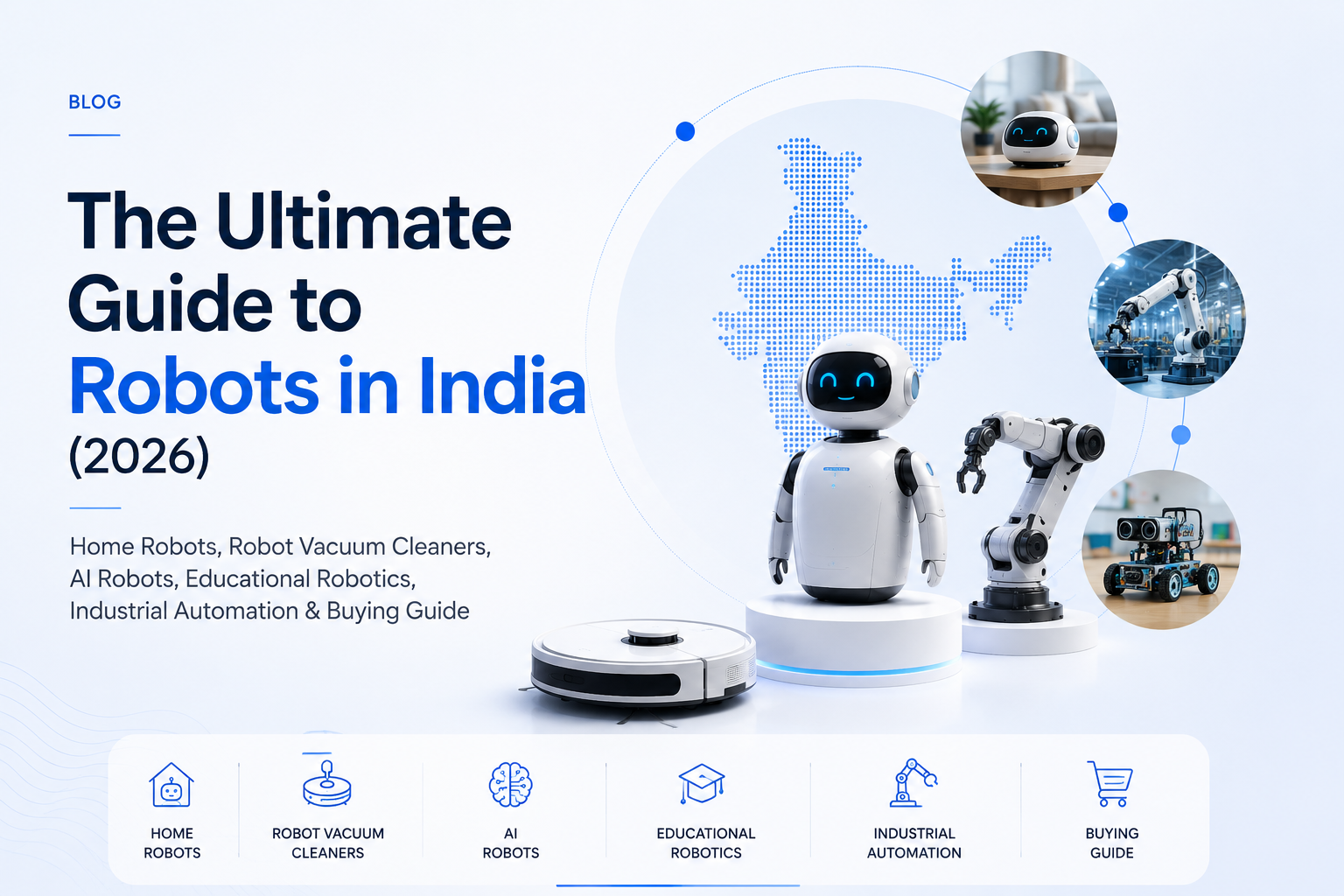
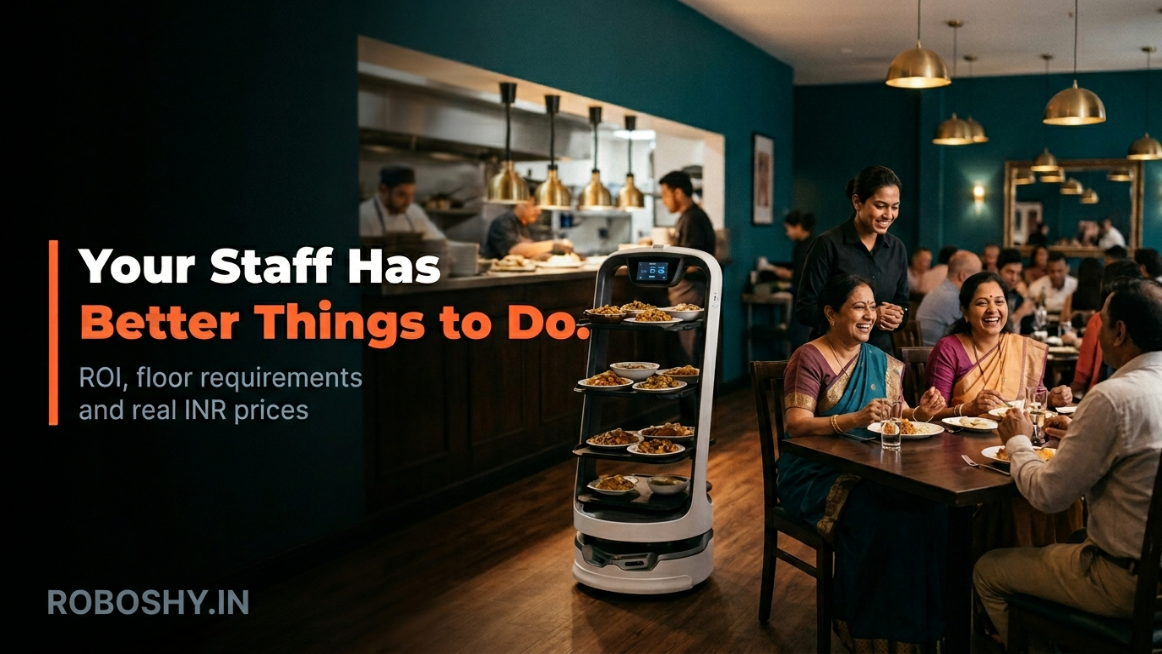
Food Serving Robot for Indian Restaurants: The Complete Guide
May 18, 2026
5:25 am
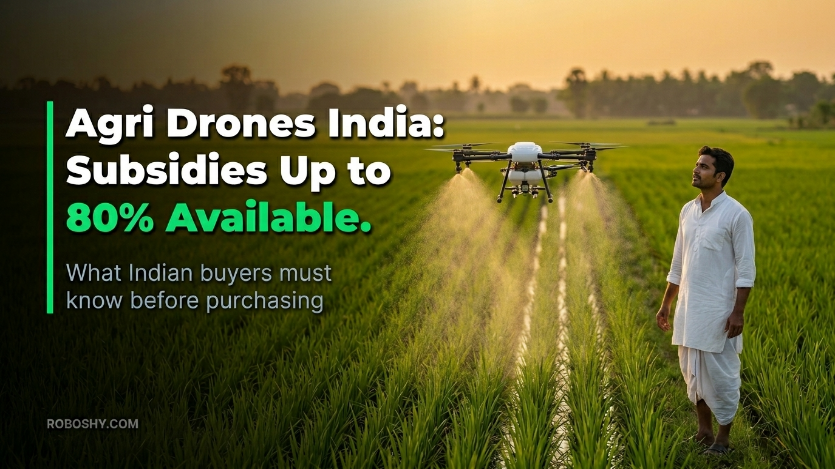
Agricultural Drones in India: Subsidies, Prices and Buyer Guide
May 7, 2026
5:18 am
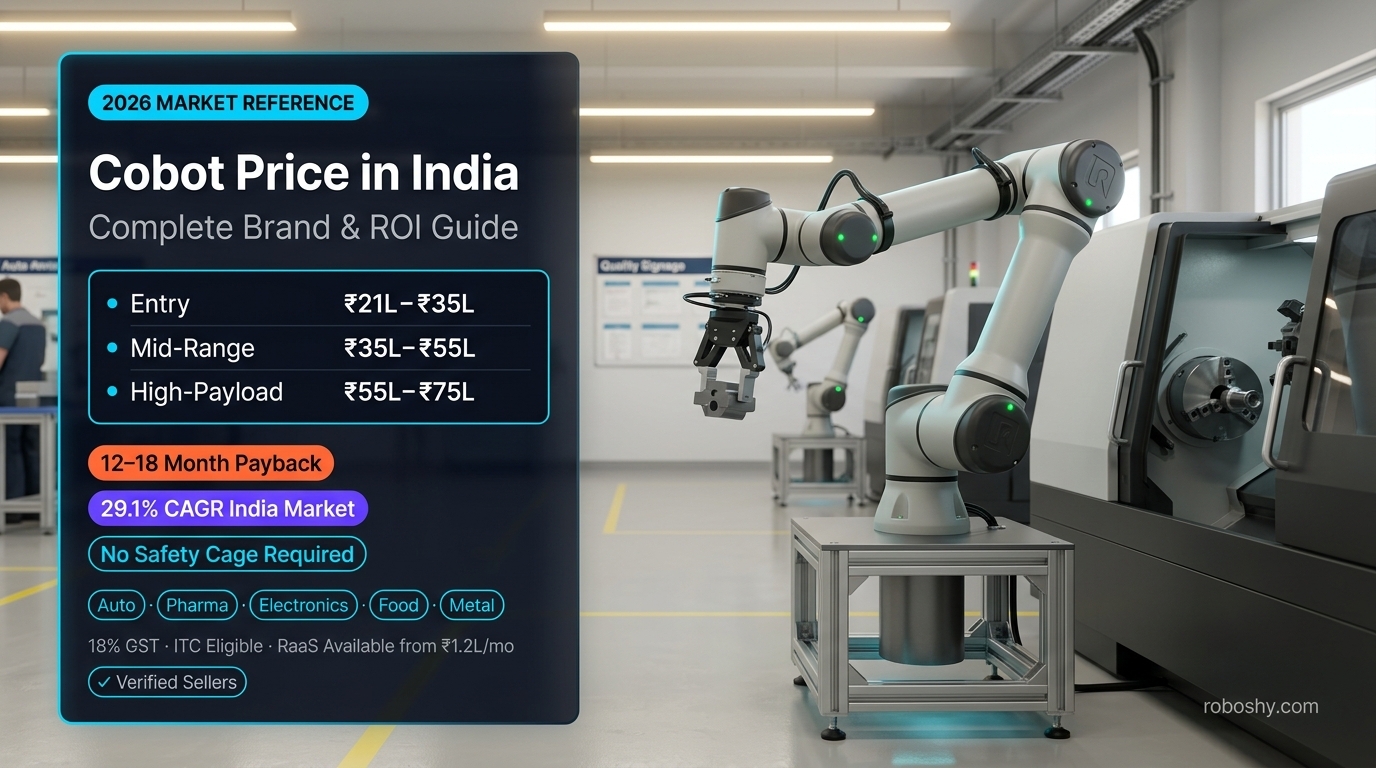
Cobot Price in India: What Indian Businesses Actually Pay in 2026
April 23, 2026
5:30 am
Buy Robots in India: The Complete Marketplace Buyer’s Guide
April 2, 2026
10:30 am
How Security Robotics Drive Business Impact and Operational Efficiency
March 13, 2026
9:52 am
Humanoid Robots Launching in 2026: What Buyers Need to Know Before They Purchase
February 28, 2026
10:34 am
Robotics-as-a-Service in India: Costs, Use Cases, and When Businesses Should Rent Robots
August 12, 2026
6:45 am
From Automation to Physical AI: How Robots Will Transform Indian Businesses
August 8, 2026
1:38 pm
Food Serving Robot for Indian Restaurants: The Complete Guide
May 18, 2026
5:25 am
Agricultural Drones in India: Subsidies, Prices and Buyer Guide
May 7, 2026
5:18 am
Cobot Price in India: What Indian Businesses Actually Pay in 2026
April 23, 2026
5:30 am
Buy Robots in India: The Complete Marketplace Buyer’s Guide
April 2, 2026
10:30 am
How Security Robotics Drive Business Impact and Operational Efficiency
March 13, 2026
9:52 am
Humanoid Robots Launching in 2026: What Buyers Need to Know Before They Purchase
February 28, 2026
10:34 am