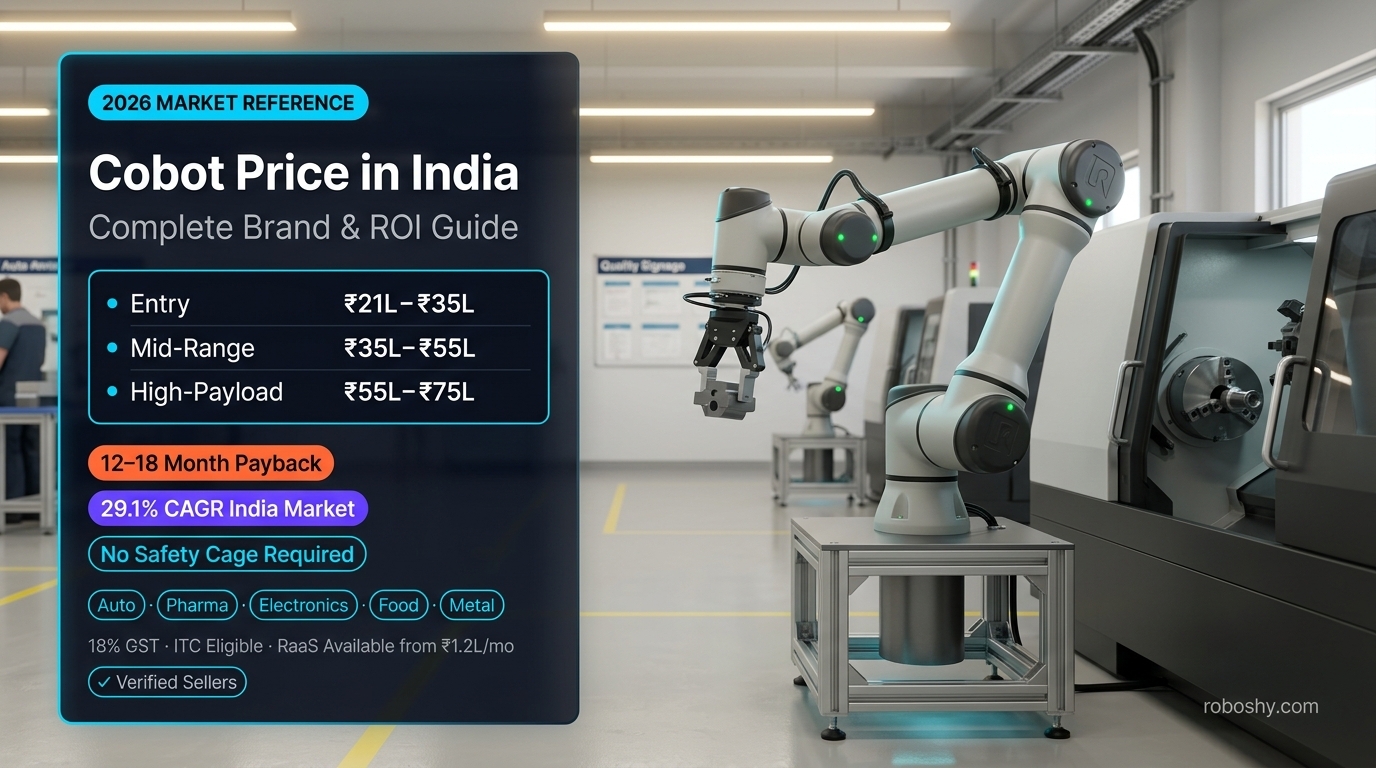
Cobot Price in India: What Indian Businesses Actually Pay in 2026
A factory owner in Pune. A pharma lab manager in Hyderabad. A packaging unit head in Ahmedabad. All three asked the same question in the past six months: how much does a cobot cost in India? Not in dollars. Not in some global benchmark figure. In rupees. With real delivery terms, GST, and a realistic integration budget.
That’s exactly what this article covers. No fluff, no vague ranges. By the time you reach the end, you’ll know the price of every major cobot model sold in India today, what those prices include, what they don’t, and how to calculate your specific ROI before spending a single rupee.
India’s cobot market crossed USD 148 million in 2025 and is heading to USD 689 million by 2031 at a 29.1% CAGR the highest growth rate in the entire robotics space. That surge is being driven by one thing: Indian SMEs are discovering that collaborative robots pay for themselves in 12 to 18 months. The math is finally working.
1. What Is a Cobot? A Plain-English Answer for Indian Buyers
A cobot, short for collaborative robot, is a robotic arm that works side-by-side with human operators on the same floor, at the same workstation, without a safety cage around it. That last part matters a lot in India’s factory context.
Traditional industrial robots are fast, precise, and powerful but they need to be caged. They can’t safely share space with people. Setting up that safety infrastructure adds ₹30 to ₹60 lakh to a project before you’ve done any actual production work. Cobots cut all of that out.
The cobot knows when a human is nearby. Built-in force sensors stop it the moment it encounters unexpected resistance meaning if a worker accidentally reaches into its path, the arm stops. No injury. No shutdown. Just a pause, a check, and a restart.
Cobot vs. Industrial Robot: The Cost Difference in Indian Rupees
| Factor | Traditional Industrial Robot | Cobot |
| Robot unit price (INR) | ₹40L – ₹1.2Cr+ | ₹21L – ₹75L |
| Safety cage / infrastructure | ₹30L – ₹60L extra | Minimal / none |
| Installation time | 4–8 weeks | 1–3 weeks |
| Programming complexity | High dedicated engineers | Low drag-and-teach |
| Redeployability | Fixed to one task | Reprogrammed in hours |
| ROI payback (typical) | 24–48 months | 12–18 months |
For Indian SMEs with constrained floor space, smaller production batches, and limited technical staff, cobots hit the right spot. You don’t need a robotics engineer on payroll. You need someone who can follow a setup guide and most cobot makers train operators in under a week.
2. Cobot Price in India: Complete Range in Indian Rupees (2026)
The honest answer: cobot prices in India currently range from approximately ₹21 lakh for compact desktop models to ₹75 lakh and above for high-payload, full-integration systems. That range covers the robot arm only. The full installed system costs more see Section 4 for the complete cost breakdown.
Here’s how prices break down by payload tier, converted at current exchange rates:
| Cobot Tier | Payload | INR Price (Arm Only) | Best For |
| Desktop / Entry-Level | Up to 3 kg | ₹21L – ₹35L | Electronics, pharma lab, light assembly |
| Mid-Range | 5–10 kg | ₹35L – ₹55L | Auto components, packaging, machine tending |
| High-Payload | 10–16 kg | ₹55L – ₹75L | Palletizing, welding, heavy assembly |
| Specialized / Enterprise | 20 kg+ | ₹75L – ₹1.2Cr+ | Automotive OEMs, large-format logistics |
These figures come from verified IndiaMART listings, Indian distributor price sheets, and direct quotations from integrators in Pune, Bangalore, and Delhi the three largest cobot deployment cities in the country.
3. Brand-by-Brand Cobot Price Comparison for India
Not all cobot brands price identically in India. Import duties, distributor margins, and after-sales support costs create meaningful price gaps between brands that look similar on spec sheets. Here is a brand-by-brand breakdown based on current Indian market data:
Universal Robots (UR) The Market Leader in India
Universal Robots was the first major cobot brand to officially enter India in 2016, partnering with Bajaj Auto as its first customer. Today, UR has the widest distributor network in the country over a dozen authorized partners across India.
India price range (arm only, approximate):
| Model | Payload / Reach | India Price (INR) | Typical Application in India |
| UR3e | 3 kg / 500 mm | ₹21L – ₹30L | Pharma, electronics, light assembly |
| UR5e | 5 kg / 850 mm | ₹30L – ₹40L | Pick-and-place, inspection, packaging |
| UR10e | 10 kg / 1300 mm | ₹40L – ₹55L | Machine tending, palletizing, loading |
| UR16e | 16 kg / 900 mm | ₹52L – ₹68L | Heavy assembly, metal processing |
UR is more expensive than Chinese alternatives by 30 to 50%, but Indian buyers consistently cite its distributor network, software (PolyScope), and resale value as justifying the premium. Bajaj Auto, Tata Motors, and dozens of Tier 1 auto ancillaries run UR cobots on their lines.
AUBO Robotics The Chinese Value Option
AUBO i-series cobots are priced between ₹15 lakh and ₹30 lakh in India, depending on payload. Chennai-based distributor Deceler Vibrotek sells AUBO models with a direct service network in Tamil Nadu, Gujarat, and Maharashtra. The AUBO i20 at 20 kg payload is particularly popular in metal fabrication because it handles heavier-than-usual loads at a price significantly below UR.
DOBOT Desktop Cobots for Labs and Electronics
DOBOT’s CR Series and MG400 desktop cobot are sold in India starting from ₹2.5 lakh for the desktop MG400 up to ₹12 lakh for the CR series. These numbers come directly from Hibex India listings. DOBOT targets pharma QC labs, electronics inspection, and R&D environments where payload requirements are modest but precision matters.
ABB, KUKA, and FANUC Cobots in India
These German and Japanese brands occupy the premium end of India’s cobot market. ABB’s YuMi dual-arm cobot runs ₹60 lakh to ₹75 lakh+. KUKA’s LBR iiwa ranges from ₹65 lakh to ₹80 lakh+. FANUC’s CRX series sits in the ₹55 lakh to ₹75 lakh range. All three brands have authorized distributors in Pune, Bangalore, and Delhi.
When do these brands make sense in India? Primarily for automotive OEM lines where safety certification requirements are extremely high, where the cobot needs to integrate into an existing ABB or KUKA robotic cell, or where the buyer needs the brand’s global 24×7 support network.
4. The Real Total Cost of a Cobot in India: What the Price List Doesn’t Tell You
Here is the single most important pricing insight this guide can give you: the robot arm is only 40 to 60 percent of your total cobot investment. Indian buyers who budget only for the arm consistently run into cost surprises during integration. Here’s the full picture:
| Cost Component | Typical INR Range | Notes |
| Cobot arm (robot unit) | ₹21L – ₹75L | Base hardware. See Section 3 by brand. |
| End-of-arm tooling (gripper/sensor) | ₹3L – ₹20L | Gripper type depends on your application |
| Vision system (camera + software) | ₹5L – ₹25L | Optional but standard for inspection tasks |
| Integration & programming | ₹5L – ₹30L | Varies by complexity and local integrator rates |
| Operator training | ₹1L – ₹5L | UR and AUBO offer India-based training programs |
| Annual maintenance (AMC) | ₹2L – ₹8L/year | Typically 8–12% of arm price per year |
| GST on import (cobots) | 18% on taxable value | Input credit available for registered businesses |
| Total installed system cost | ₹60L – ₹1.5Cr+ | Full deployment, all-in, typical Indian SME |
| 💡 Marketplace Tip: Roboshy lists verified cobot sellers across India. Compare hardware pricing from multiple distributors before you budget for integration. Getting competitive quotes on the arm alone can save ₹3 to ₹10 lakh before you even discuss tooling. |
5. What Makes Cobot Prices Different Across Brands?
Two cobots with identical spec sheets can be priced ₹20 lakh apart in India. Here’s why:
Payload Capacity
Payload is the single biggest price driver. A 3 kg cobot arm costs less than half of a 16 kg arm from the same brand. Every extra kilogram of payload requires stronger motors, heavier structural components, and more sophisticated safety sensors. Most Indian SME applications assembly, inspection, packaging run comfortably on 3 to 10 kg cobots.
Number of Axes
Standard cobots have 6 axes, giving them a full human arm range of motion. Some desktop models have 4 axes, which is sufficient for pick-and-place or simple insertion tasks and reduces the price by 15 to 25 percent. If your application involves placing a part into a fixture from a single angle, 4-axis is enough. If you need the cobot to orient parts at complex angles, 6-axis is non-negotiable.
Brand Safety Certification Level
Cobots selling into automotive or pharma environments in India need ISO/TS 15066 compliance, CE marking, and in some cases IATF 16949 documentation. This certification stack adds to the unit price. Chinese cobots entering India at ₹21 to ₹30 lakh often carry CE marking but may lack supplemental automotive-grade certifications that UR, ABB, and FANUC units carry.
Bundled Software
Some cobots include all programming software in the purchase price. Others charge separately for motion planning modules, vision integration kits, or simulation tools. UR’s PolyScope and its URCap ecosystem are included in the arm price. KUKA’s KUKA.Sim software and ABB’s RobotStudio are licensed separately, adding ₹1.5 to ₹5 lakh to the system cost.
Local Distributor Support Network
In India, the real cost of a cobot is not just the sticker price.It’s the downtime cost when something goes wrong. A cobot without a local service partner in your city can mean waiting 3 to 5 days for support. UR and ABB have the most robust India support networks. Newer Chinese brands may require sending units to the distributor’s base city, adding indirect costs.
6. Cobot ROI in India: The Numbers That Make Procurement Offices Say Yes
The business case for a cobot in India rests on one number: payback period. Here is how to calculate it for your specific situation, followed by benchmarks from Indian manufacturing deployments.
The ROI Formula
| Payback Period (months) = Total Installed Cost ÷ Monthly Net BenefitMonthly Net Benefit = Labor Savings + Productivity Gains + Quality Savings − Monthly Operating CostsROI (%) = [(Annual Benefits − Annual Costs) ÷ Total Investment] × 100 |
India-Specific Payback Benchmarks
India’s labor cost structure is different from Europe or North America, which affects the payback calculation. Here’s what documented deployments in the Indian market show:
| Application Type | Typical Investment (INR) | Payback Period | India Context |
| Pick-and-place / inspection | ₹60L – ₹85L | 12–18 months | Electronics, pharma, FMCG packaging lines |
| Machine tending (CNC/injection molding) | ₹75L – ₹1.1Cr | 10–16 months | Auto ancillaries, metal components, mold shops |
| Welding / screwdriving | ₹85L – ₹1.3Cr | 14–22 months | Auto fabrication, home appliance assembly |
| Palletizing / packaging | ₹80L – ₹1.2Cr | 12–20 months | F&B, FMCG, consumer goods warehousing |
One documented case from the Indian market: an auto components manufacturer deployed three UR10 cobots for CNC machine tending at a Pune facility. Production capacity quadrupled within one quarter, going from single-shift manual operation to three-shift automated loading with just one supervisor per shift. The installed cost recovered in 14 months.
A mid-sized FMCG packaging unit in Gujarat using AUBO cobots for case-packing reported labor savings of ₹18 lakh per year across two lines running double shifts. At a total installed cost of ₹75 lakh, payback hit 50 months slower than average but still positive because the cobot eliminated 3 AM shift staffing challenges entirely.
The India-Specific Factor: Labor Cost Is Lower, But Benefits Are Real
Some consultants argue that India’s lower labor costs make the cobot ROI weaker compared to Europe. That argument misses three India-specific realities:
- Labor cost is rising in Tier 1 manufacturing cities Pune, Bengaluru, Surat, Hosur where skilled operators for precision assembly are genuinely scarce and command premium wages
- Cobots eliminate quality variability, reducing rejection rates by 40 to 60 percent in precision tasks savings that scale with India’s high-volume production runs
- Night shift and weekend shift availability is inconsistent in Indian SMEs; a cobot eliminates that staffing gap entirely, often recovering its full cost through extended operating hours alone
7. Industry-Wise Cobot Deployment in India: Where the Action Is
Automotive and Auto Components
India’s auto sector was the first to adopt cobots at scale. Bajaj Auto ran over 100 Universal Robots cobots before the technology became mainstream. Today, Tier 1 and Tier 2 auto ancillaries in Pune, Chennai, and Gurugram are the largest cobot buyers in the country. Use cases: screw driving, torque testing, part insertion, quality inspection, welding. Budget range: typically ₹85 lakh to ₹1.2 crore per deployed cell.
Pharmaceuticals and Medical Devices
Pharma is India’s fastest-growing cobot segment by deployment growth rate. Clean-room compatible cobots from UR, DOBOT, and Techman are being used for blister packing, vial handling, laboratory dispensing, and medical device assembly. The appeal: cobots meet GMP standards without requiring a full robotics engineering team on-site. Typical investment: ₹60 lakh to ₹90 lakh per application.
Electronics and Consumer Technology
Board assembly, connector insertion, display testing, cable routing electronics manufacturing in Noida, Chennai, and Bengaluru are deploying desktop cobots for high-precision, low-payload tasks. DOBOT’s CR5 and UR3e dominate this segment. Average spend: ₹30 lakh to ₹60 lakh installed.
Food and Beverage
F&B cobots need to be washdown-rated and food-safe. UR, FANUC, and ABB offer food-grade cobots for pick-and-place, packaging, and quality vision systems. Parle, Hindustan Unilever, and regional FMCG manufacturers have begun deploying them for high-speed repetitive packing tasks where worker fatigue and hygiene compliance are simultaneous challenges. Budget: ₹75 lakh to ₹1.2 crore per line.
Metal Fabrication and Machine Shops
India has over 50,000 registered machine shops. The vast majority have never deployed a robot. Cobots especially the Chinese value models from AUBO and Han’s Robot at ₹20 to ₹35 lakh are the first automation most of these shops will ever adopt. CNC machine tending (loading/unloading parts from lathes or mills) is the killer application. Setup time: typically 1 to 2 weeks. ROI: often under 14 months.
8. RaaS in India: Renting a Cobot Instead of Buying One
Robotics-as-a-Service (RaaS) is a model where you pay a monthly fee for a cobot instead of purchasing it outright. In India, this model is in early stages but growing. Companies like GreyOrange have pioneered RaaS for logistics robots. Several integrators now offer cobot RaaS packages for SMEs who can’t commit ₹60+ lakh upfront.
Typical RaaS structure in India:
- Monthly subscription: ₹1.2 lakh to ₹3.5 lakh per cobot depending on payload and application
- Includes: maintenance, software updates, operator support, and replacement guarantees
- Contract term: usually 24 to 48 months
- Effective all-in cost over 36 months is comparable to purchase, but with zero capital outlay and no residual asset risk
For Indian SMEs who are uncertain about the ROI or want to test the technology before committing, RaaS is worth exploring before signing a purchase order.
9. How to Source and Verify Cobots Through a Marketplace Like Roboshy
India has no shortage of cobot distributors. What it has had, until recently, is a shortage of verified, comparable, transparent listings in one place. When you call an IndiaMART listing, you often get a quote three days later with no context on what’s included, what the warranty covers, or whether the distributor has deployed that specific model before.
Roboshy, India’s first dedicated robots marketplace, is built to solve that problem. It connects verified cobot sellers across India distributors, integrators, and manufacturers with buyers who need real pricing, real specs, and real seller credentials before starting a conversation.
What to Check Before Buying a Cobot in India
- Distributor authorization letter from the original manufacturer
- Number of live deployments of that specific model in India (not the global total ask for India references)
- Local service availability: ask explicitly how many service engineers the distributor has in your city or the nearest one
- Training program: does the purchase price include operator training, and where is it conducted?
- Warranty terms: typically 12 to 24 months on the arm; clarify whether the warranty covers joint motors and force sensors
- GST invoice and HSN code: cobot arms fall under HSN 8479 at 18% GST with input tax credit available for registered buyers
- Integration support: does the distributor provide a systems integrator, or do you source that separately?
| 🔗 Find verified cobot sellers on Roboshy.com India’s first robot marketplace. Compare multiple distributors, check credentials, and connect with a seller who has live deployments in your industry. |
10. Frequently Asked Questions: Cobot Price in India
Q1. What is the minimum budget to deploy a cobot in India?
The minimum realistic budget for a fully operational cobot deployment in India is ₹60 lakh to ₹80 lakh. This covers a desktop-class cobot arm (₹21 to ₹35 lakh), a basic gripper (₹3 to ₹6 lakh), integration and programming (₹8 to ₹15 lakh), and basic operator training (₹2 to ₹4 lakh). Any budget below ₹60 lakh forces compromises on tooling or integration quality that typically extend the payback period significantly.
Q2. Which cobot brand is best for Indian SMEs in 2026?
For most Indian SMEs in manufacturing, Universal Robots (UR3e or UR5e) remains the safest first choice due to its widest distributor network, proven India track record, and strong resale value. For budget-conscious buyers in machine shops or light assembly, Chinese brands like AUBO or DOBOT offer comparable functionality at 30 to 50 percent lower cost with growing India service presence.
Q3. How long does a cobot last in Indian factory conditions?
Most cobot manufacturers specify a 35,000 to 50,000-hour service life for the arm. At two-shift operation (16 hours/day), that translates to roughly 6 to 8 years before major maintenance. Indian factory conditions with dust and heat can reduce joint life if not maintained; ensure your distributor has a documented preventive maintenance schedule for Indian operating environments.
Q4. Is a cobot cheaper than hiring additional workers in India?
For simple repetitive tasks (inspection, pick-and-place, machine loading), yes within 12 to 18 months in most cases. At ₹60 lakh total installed cost versus ₹6 to ₹10 lakh annually for an operator doing two shifts, the math is straightforward. For complex, judgment-heavy tasks, cobots still require human supervision and the ROI calculation changes significantly.
Q5. What is GST on cobots in India?
Cobot arms are classified under HSN 8479 (machines and mechanical appliances having individual functions). The applicable GST rate is 18%. For registered businesses, full input tax credit is available, effectively reducing the real acquisition cost for companies in the manufacturing or service sectors.
Q6. Can I get a cobot on EMI or lease in India?
Yes. Several cobot distributors in India now offer structured financing, typically through NBFC partners, with EMI terms of 24 to 36 months. The effective interest rate ranges from 10 to 14% per annum. Some integrators also offer RaaS (Robotics-as-a-Service) at ₹1.2 to ₹3.5 lakh per month, which requires no capital outlay and includes maintenance.
Q7. What payload do I need for my application?
A simple rule: choose a cobot rated at 1.5x your maximum expected part weight. If your heaviest component is 3 kg, go with a 5 kg payload cobot. The safety margin covers gripper weight (typically 0.5 to 2 kg), accounts for weight variance in batches, and ensures the cobot operates below its rated force threshold, extending joint life significantly.
Q8. How long does cobot installation take in India?
For a standard pick-and-place or machine-tending application, most experienced Indian integrators complete installation, programming, and operator sign-off in 2 to 4 weeks. Complex welding or multi-robot cells can take 6 to 10 weeks. The programming time depends heavily on application complexity drag-and-teach on a UR or AUBO cobot is measurably faster than KRL scripting on a KUKA system.
Q9. Do cobots require safety cages in India?
Cobots are designed to operate without safety cages for low-risk collaborative applications. However, Indian factory environments often require a formal risk assessment per ISO/TS 15066 before removing fencing. For applications where the cobot lifts heavy tools or sharp components, partial guarding may still be required even with collaborative robots. Always consult your distributor for a documented risk assessment as part of the installation.
Q10. Where can I buy a verified cobot in India?
Authorized distributors in Pune, Bengaluru, Delhi-NCR, Chennai, and Ahmedabad sell all major cobot brands. Roboshy.com lists verified cobot sellers across India with transparent credentials and real deployment references. Before purchasing, compare at least two to three quotes, confirm local service availability, and request a reference from a buyer who has deployed the same model in a similar application.
Final Word: The Cobot Decision in India in 2026
The cobot market in India has crossed a tipping point. Prices have come down. The distributor ecosystem has matured. And the ROI math even at India’s labor rates is working for a widening range of applications.
The question is no longer whether cobots make sense for Indian manufacturing. For SMEs in auto components, pharma, electronics, food processing, and metal fabrication, that question is settled. The real questions now are which brand fits your specific application, how to structure the investment, and where to find a distributor who has actually deployed that model before.
Roboshy exists to answer that last part. As India’s first dedicated robot marketplace, it connects buyers with verified sellers who have real India experience not just global spec sheets. Compare pricing, check distributor credentials, and find the right cobot partner for your floor.
| 🔍 Explore verified cobot listings on Roboshy.com India’s first robots marketplace. Compare brands, distributors, and specifications before starting any RFQ. |
| About Roboshy
Roboshy is India’s first dedicated robot marketplace, connecting buyers and sellers of industrial robots, service robots, cobots, drones, and smart automation solutions across India. The platform offers verified seller credentials, transparent pricing, and direct access to distributors, manufacturers, and systems integrators nationwide. |
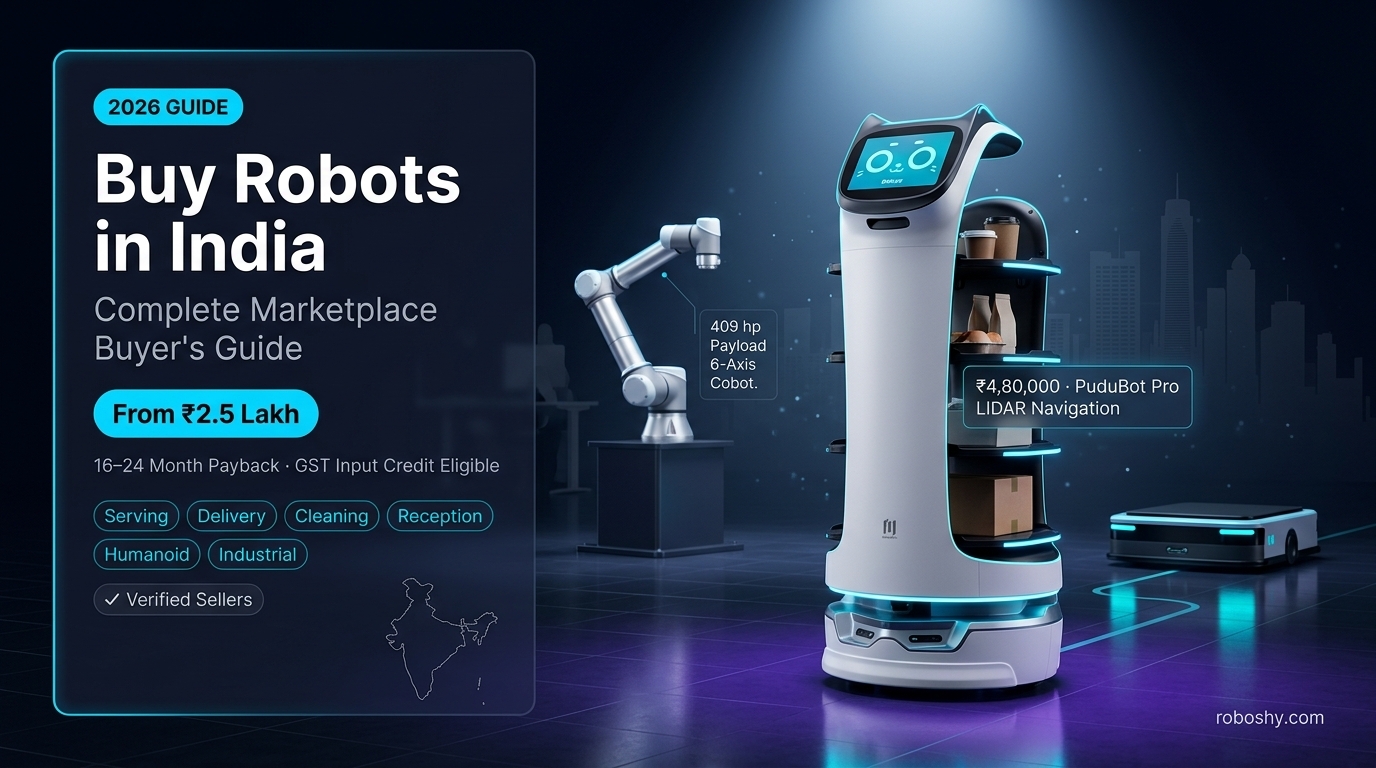
Buy Robots in India: The Complete Marketplace Buyer’s Guide
April 2, 2026
10:30 am
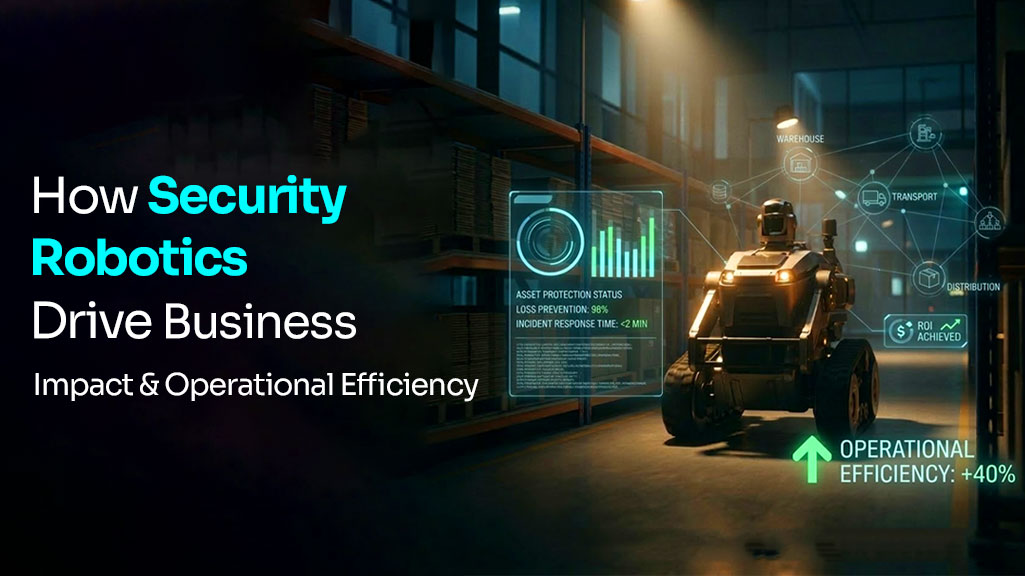
How Security Robotics Drive Business Impact and Operational Efficiency
March 13, 2026
9:52 am

Humanoid Robots Launching in 2026: What Buyers Need to Know Before They Purchase
February 28, 2026
10:34 am

AI Summit India 2026: Robotics, Humanoid AI, Automation & Future Technology Trends
February 21, 2026
6:12 am

How to Sell Robots Successfully: A Step-by-Step Business Guide by Roboshy
February 6, 2026
6:03 am

The Role of Advanced Robotics in Industrial Transformation in 2026
January 23, 2026
11:20 am
Robots are shaping Industry
January 9, 2026
3:22 pm

Consumer Robotics
July 30, 2024
5:24 am

Industrials Robotics
July 30, 2024
5:19 am
Cobot Price in India: What Indian Businesses Actually Pay in 2026
April 23, 2026
5:30 am
Buy Robots in India: The Complete Marketplace Buyer’s Guide
April 2, 2026
10:30 am
How Security Robotics Drive Business Impact and Operational Efficiency
March 13, 2026
9:52 am
Humanoid Robots Launching in 2026: What Buyers Need to Know Before They Purchase
February 28, 2026
10:34 am
AI Summit India 2026: Robotics, Humanoid AI, Automation & Future Technology Trends
February 21, 2026
6:12 am
How to Sell Robots Successfully: A Step-by-Step Business Guide by Roboshy
February 6, 2026
6:03 am
The Role of Advanced Robotics in Industrial Transformation in 2026
January 23, 2026
11:20 am
Robots are shaping Industry
January 9, 2026
3:22 pm
Consumer Robotics
July 30, 2024
5:24 am
Industrials Robotics
July 30, 2024
5:19 am