Food Serving Robot for Indian Restaurants: The Complete Guide
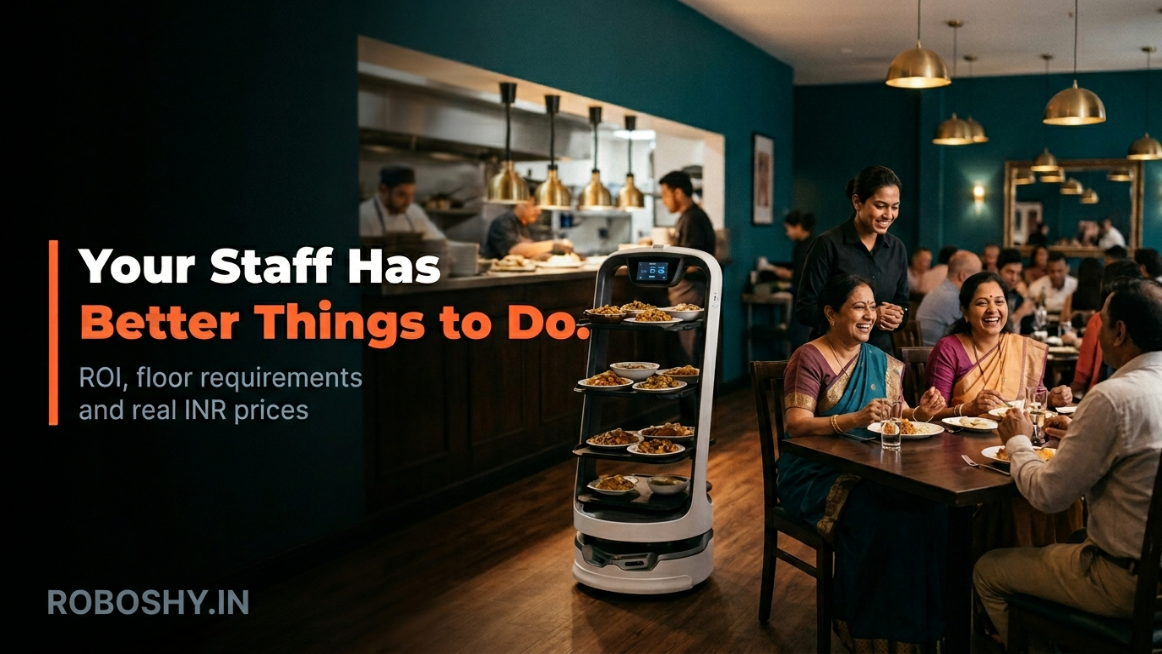
The National Restaurant Association of India’s India Food Services Report 2024 found that close to 60 percent of Indian restaurant operators report shortages in both kitchen and service staff, a figure that has not improved since the post-pandemic recovery flattened hiring pipelines across Tier 1, 2, and 3 cities alike. A food serving robot does not eliminate that problem, but for a restaurant running 60 to 120 covers per shift with three or four delivery runs per table, it addresses the part of that problem that is most visible to guests: the gap between food leaving the kitchen pass and food reaching the table.
Deployments in India are no longer experimental. The Print’s April 2026 investigation into Indian restaurant automation confirmed active deployments at Roseate Hotels and Resorts, Hilton Gurugram Baani City Centre, Mie.Roboluscious in Mohali, and Cafe Safar, with operators consistently reporting the same outcome: the robot handles the repetitive delivery run while human servers focus on the tableside interaction that drives repeat covers and positive reviews. What operators did not anticipate before purchase, in almost every documented case, was the gap between the robot’s listed capabilities and the actual conditions of their floor. Aisle width, floor surface, table layout, and peak-hour foot traffic determine whether a food serving robot works reliably or sits idle because its navigation system cannot clear a path.
This guide covers what a food serving robot actually does in Indian restaurant conditions, which formats produce a return and which do not, the verified INR price range for every major model available through Roboshy’s marketplace, the floor and layout requirements that determine whether a robot will work in a specific space before purchase, the ROI calculation built on Indian restaurant economics, and the questions to ask any seller before placing an order. Every claim in this guide is sourced. No manufacturer marketing language appears without a verified figure behind it.
What a Food Serving Robot Does and What It Does Not Do
A food serving robot is an autonomous mobile robot designed to transport dishes from a kitchen pass or serving station to a specified table number, using onboard sensors, SLAM navigation, and pre-mapped floor plans to find its path without human guidance on each delivery. The category covers robots with between two and four tray levels capable of carrying eight to forty kilograms of food and beverage in a single run, operating for ten to twenty-four hours on a single charge or a swappable battery, and navigating through occupied dining rooms at speeds between 0.5 and 1.2 metres per second.
The robot’s functional contribution in a restaurant is specific and limited. It moves food from a fixed dispatch point to a fixed table destination. A staff member loads the tray, presses the table number, and the robot departs. At the table, either the robot announces arrival and guests retrieve their dishes, or a server meets the robot and transfers the plates. The robot then returns to the dispatch point for the next run, or proceeds to a secondary stop if the operator has programmed a multi-table delivery sequence. Nothing about this process involves the robot taking an order, handling cash, interacting with a complaint, recommending a dish, or managing a guest who asks for a menu change.
Understanding that boundary is the most important step in the purchase decision. A restaurant owner who expects the robot to reduce total front-of-house headcount by two or three positions is working from a model that does not match deployed performance. A restaurant owner who expects the robot to free one or two servers from the physical delivery run so they can be present at more tables for order-taking, upselling, and complaint resolution is working from a model that does match deployed performance. The ROI case rests on the second model, not the first.
The Washington State University study published in the International Journal of Contemporary Hospitality Management in May 2024, drawing on data from 620-plus lodging and food service employees, found that staff framing matters as much as the robot’s capabilities. Operators who introduced the robot as a delivery assistant rather than a replacement saw lower turnover intention among their floor staff. The operators who communicated the shift most clearly achieved the best outcomes on both productivity and retention.
Which Indian Restaurant Formats Produce a Return and Which Do Not
Restaurant format determines whether a food serving robot generates a measurable return or becomes an underutilised asset within six months. Four variables drive the format suitability assessment: table count, aisle width, service model, and peak-hour delivery frequency. Each of the five major restaurant formats in India scores differently across these variables.
Casual Dining: Strongest ROI Category
Casual dining restaurants operating between 40 and 120 covers, with fixed table layouts and a service model where one server manages four to eight tables simultaneously, represent the format where a food serving robot delivers the clearest return. Delivery runs to the table are high-frequency, the path between kitchen and dining room is consistent, and the server’s time is the primary constraint during peak service. A single robot handling twelve to eighteen delivery runs per hour across a 90-cover floor allows two servers to manage what would otherwise require three, which changes the staffing cost calculation without eliminating the human relationship at the table.
Banquet Halls and Wedding Function Venues: High Volume Return
Banquet operations serving buffet-style functions or seated multi-course events use food serving robots differently from casual dining. In large-format events with 200 to 500 guests, robots carry food from staging stations to service points across the floor, reducing the number of service staff required for the physical transport of food while human staff focus on portion service and guest interaction at the station. The consistent floor layout, the absence of walk-in traffic during service, and the high per-event food volume make banquet deployments among the most financially efficient in India’s hospitality context.
QSR and Counter Service: Not Suited
Quick service restaurants and counter service formats do not have a delivery path that a food serving robot fills. Guests collect their own orders at a counter, which means there is no table-to-kitchen delivery sequence to automate. Deploying a robot in a QSR environment addresses a process that does not exist in that format and generates no operational return.
Fine Dining: Marginal Fit
Fine dining restaurants with wide, low-density floor plans and a service model where one server is responsible for the complete guest experience at two to four tables do not have the delivery frequency or the staffing pressure that generates a robot return. The robot’s presence in a fine dining context creates friction with the service expectation rather than resolving an operational bottleneck. Several fine dining operators in India have used the robot as a branded novelty for specific experiences, which is a marketing decision rather than an operational one and should be evaluated as such.
Café Chains and Multi-Outlet Operations: Scale-Dependent
Café formats with consistent layouts across multiple outlets represent a specific opportunity where the initial configuration cost, which is the primary upfront investment beyond the hardware, is amortised across multiple sites. An operator who configures a food serving robot for one outlet’s floor plan and then deploys identical units in five additional outlets with matching layouts pays the floor-mapping and programming cost once and replicates the configuration at a fraction of the per-unit cost. This is the format where multi-unit operators see the strongest total return across their estate.
Food Serving Robot Models and Verified INR Prices in India
Every model listed below is available through verified sellers on Roboshy’s marketplace or through their authorised Indian distributors. Prices reflect the robot unit and control system. End-of-year maintenance contracts, additional tray sets, and floor-mapping services are additional costs addressed in the total cost of ownership section.
| Model | INR Price | Payload | Battery Life | Best Suited For |
| PuduBot 2 | INR 4.8 lakh | 40 kg, 4 trays | 24 hours | Casual dining, café chains, cloud kitchens |
| BellaBot | INR 8 to 10 lakh | 40 kg, 4 trays | 12 to 24 hours | Branded dining, themed restaurants, premium casual |
| BellaBot Pro | INR 7.1 lakh | 40 kg, 4 trays | 11 hours | High-interaction environments, luxury hotel F&B |
| KettyBot | INR 3 to 5.5 lakh | Standard delivery | 12 hours | Budget casual dining, café formats |
| Dasher (Kody Robots) | Available on lease | Multi-tray | Full shift | Operators preferring lease over purchase |
| Penguin Aisha 2.0 | INR 1.48 lakh | Remote control | Per shift | Entry-level, novelty deployments |
Price data for PuduBot 2 and BellaBot Pro sourced from Autofinarobotics’ verified January 2026 market pricing. BellaBot standard range sourced from Rife Technologies’ January 2026 listings. Penguin Engineering price sourced from Indiamart verified listing. All figures exclude GST.
Floor and Layout Requirements Every Buyer Must Check Before Purchase
The single most common reason a food serving robot underperforms after purchase in an Indian restaurant is floor plan incompatibility that was not assessed before the order was placed. A robot that cannot navigate a floor reliably will not be used, and a robot that is not used is a capital loss rather than a return. Three measurements determine navigability before any site visit from a seller is needed.
Minimum Aisle Width: 65 Centimetres
A food serving robot using SLAM navigation requires a minimum clear aisle width of 65 centimetres between obstacles to navigate without stopping and rerouting. Pudu Robotics’ BellaBot Pro specification sheet (2026) cites this figure explicitly for its path-clearance algorithm. This measurement applies to the narrowest point in any path the robot must traverse between its dispatch point and any table it serves. Tables, chairs pushed back by seated guests, service trolleys, and plant decorations all narrow the effective aisle width below the physical measurement of the empty restaurant. A restaurant owner measuring their floor with chairs pushed in will see clearances they will never see during a service.
Indian restaurants in metro locations where floor space is priced at a premium frequently have aisle widths between 55 and 75 centimetres when measured chair-out during a full-cover service. The buyer’s check is this: walk every path from the kitchen pass to every table position during a busy service and measure the minimum clearance at the narrowest point on each route. If any route falls below 65 centimetres at any point, either that table is excluded from robot service or the floor layout requires modification before the robot is ordered.
Floor Surface and Gradient
Food serving robots are designed for smooth, level commercial flooring. Most models tolerate a maximum gradient of 5 degrees, which accommodates minor variations in commercial tile but not ramps, steps, or the uneven surfaces common in older Indian restaurant properties where original flooring has been covered rather than levelled. The robot’s suspension system manages vibration on standard commercial floors but cannot compensate for significant height differences at doorways, between zones of different flooring materials, or at threshold strips between kitchen and dining room surfaces. Each of these transition points must be physically tested with the specific robot model before installation is confirmed.
Multi-Floor Operations
Restaurants and hotels requiring service across multiple floors need a robot model with confirmed lift integration capability and must verify that their specific lift model is compatible with the robot’s control system. Not all lifts in Indian commercial properties have the API or the physical dimensions required for robot integration. A food serving robot that cannot enter a standard-sized Indian service lift independently cannot serve multiple floors without a human operator to manage the lift on every run, which eliminates the operational efficiency the robot is purchased to provide. Buyers with multi-floor operations must confirm lift compatibility with the specific robot model before placing any order.
The ROI Calculation for Indian Restaurant Economics
Return on investment for a food serving robot in India is calculated across three sources of measurable financial benefit: staff cost savings, additional covers served per shift, and reduced food delivery errors. The relative weight of each source varies by restaurant format. A buyer who cannot assign a credible number to at least two of these three sources does not yet have enough data to make the investment decision.
- Staff cost saving: Identify how many hours per shift are currently spent by serving staff on the physical delivery run between kitchen and tables. A 90-cover casual dining restaurant running three servers on a Friday evening shift, where each server spends an estimated 35 percent of their time on delivery runs rather than tableside, loses 3.15 server-hours per shift to delivery alone. At an all-in monthly staff cost of INR 22,000 per server, that equals INR 7,700 per month in delivery-only staff time that the robot replaces at zero marginal cost per run.
- Additional covers served per shift: When a server is freed from delivery runs, they can manage more tables or spend more time at existing tables on upsell conversations. A restaurant that moves from a 4-table-per-server assignment to a 5-table-per-server assignment on a 90-cover floor gains 20 percent more table capacity for the same server headcount. At an average spend of INR 800 per cover and two covers per table per evening shift, each additional table managed generates INR 1,600 per shift. Across 25 operating days per month, one additional table per server adds INR 40,000 in monthly revenue from the same floor space.
- Error reduction: Delivery errors, defined as wrong dishes delivered to wrong tables, generate plate returns, remakes, and in the worst cases, comped meals. A robot that delivers to the correct table number every run eliminates the class of delivery error that originates from a server carrying multiple orders and placing them incorrectly under pressure. The financial value of this varies by menu price point and error frequency, but an operator running 150 covers per day with a 2 percent delivery error rate and an average error cost of INR 300 in remakes and comps saves INR 900 per day, or INR 22,500 per month, from error elimination alone.
Payback period formula: Total robot deployment cost divided by total monthly financial benefit equals payback period in months. A PuduBot 2 at INR 4.8 lakh with INR 80,000 in floor-mapping and integration costs produces a total deployment cost of INR 5.6 lakh. Monthly benefit of INR 7,700 in staff time saving plus INR 40,000 in additional cover revenue plus INR 22,500 in error savings equals INR 70,200 per month. Payback period: 5,60,000 divided by 70,200 equals 7.98 months. Autofinarobotics’ January 2026 verified market data places the PuduBot 2 payback range at 16 to 24 months on the staff-saving calculation alone, which is the conservative case without the revenue and error components. The full-model calculation produces a faster payback wherever the additional cover and error numbers are credible.
Five Questions to Ask Any Seller Before Placing an Order
A seller who cannot answer all five of the following questions with specific, verifiable information is a seller whose post-purchase support will be equally unspecific. These questions are not negotiating positions. They are the minimum information a restaurant or hotel buyer needs to make a deployment decision with real data rather than sales literature.
- Will you do a site visit to measure our aisle widths and confirm navigability before we order? A seller who skips the site visit and relies on the buyer’s self-reported measurements is transferring the floor-compatibility risk to the buyer. The site visit is where incompatibilities are discovered before they become post-purchase surprises. Any seller confident in their product’s capability should welcome the opportunity to confirm it on the buyer’s specific floor before an order is placed.
- What is the floor-mapping and configuration cost, and is it included in the purchase price or charged separately? Floor mapping is the process of walking the robot through the restaurant space to build its internal navigation map. Some sellers include this in the purchase; others charge INR 30,000 to INR 80,000 as a separate line item. A buyer who discovers this cost after signing the purchase order has been given an incomplete price.
- What is the response time on the annual maintenance contract, and what does the contract cover? A food serving robot in active commercial use will require servicing. Wheel assembly wear, tray sensor calibration, battery degradation, and software updates all fall within the annual maintenance window. A seller who cannot specify whether their maintenance contract covers parts, labour, or both, and cannot specify an on-site response time in working hours rather than working days, cannot protect the buyer’s operational uptime.
- Which specific lift models in India have you integrated this robot with, and can you provide a reference contact at a site that uses lift integration? This question applies only to multi-floor buyers, but for those buyers it is the most important technical question on the list. A seller who cannot name a completed lift integration in India is a seller who has not done it, which means the buyer would be the first site in the country to attempt it.
- What happens to the floor map and configuration data if I need to change my table layout? Restaurants rearrange seating seasonally, for private events, and for capacity changes. A food serving robot whose floor map cannot be updated by the restaurant’s own staff, and which requires a paid seller visit for every layout change, creates an operational dependency that undermines the value of the investment. The answer to this question determines whether the buyer owns the configuration or whether the seller retains that control.
Selecting the Right Robot for Your Restaurant Floor
A food serving robot earns its place in a restaurant when three conditions hold at the same time: the floor plan can support the robot’s navigation requirements without modification, the format generates enough delivery frequency to produce a measurable staff-time saving, and the total deployment cost closes within a payback period the business can absorb. Where all three conditions are present, the financial case is straightforward and the operational case has been demonstrated across deployments in India at the properties documented by The Print in April 2026.
Where one of those three conditions is absent, the buyer faces either a floor modification cost that belongs in the ROI model, a format mismatch that produces low utilisation, or a deployment cost that pushes payback beyond the point where the investment makes commercial sense. Identifying which condition is absent before the order is placed is the purpose of the site visit, the ROI model, and the five questions in the preceding section. None of that analysis requires engineering expertise. It requires accurate measurements, honest staff cost data, and a seller who answers direct questions with direct numbers.
Roboshy’s marketplace connects restaurant and hotel buyers in India with verified food serving robot sellers across all major models, from the PuduBot 2 and BellaBot range to KettyBot, Dasher, and entry-level options. Every seller on the platform has been assessed for authorisation and domestic service capability. Buyers can browse verified listings by model, compare specifications and prices in Indian Rupees, and contact sellers directly to arrange site visits and request floor-compatibility assessments before any purchase commitment is made. The shop at Roboshy is where the evaluation process turns into a confirmed deployment.
Frequently Asked Questions: Food Serving Robots in India
What is the price of a food serving robot in India?
A food serving robot in India ranges from approximately INR 1.48 lakh for an entry-level remote-control model like the Penguin Aisha 2.0, to INR 4.8 lakh for the PuduBot 2, INR 7.1 lakh for the BellaBot Pro, and INR 8 to 10 lakh for the BellaBot standard and premium configurations. These figures cover the robot unit and its control system and exclude GST. Three categories of additional cost must be budgeted beyond the purchase price. Floor mapping and configuration, which is the process of walking the robot through the restaurant to build its navigation map, costs INR 30,000 to INR 80,000 when charged separately by the seller, though some sellers include it in the purchase. Annual maintenance contracts covering parts and labour typically run 8 to 12 percent of the robot’s purchase price per year. Any infrastructure modification required to meet the minimum 65-centimetre aisle clearance, such as repositioning furniture, removing fixed decorative elements, or levelling floor transitions, is a site-specific cost that varies by restaurant layout. Buyers should request a total deployment cost figure from any seller before comparing prices, because a robot at INR 4.8 lakh with INR 1.2 lakh in additional deployment costs represents a different investment than one at INR 6 lakh with all costs included. Kody Robots also offers the Dasher food serving robot on a lease basis in India for operators who prefer to avoid the capital commitment of outright purchase, which changes the financial structure of the decision significantly.
How does a food serving robot navigate inside a restaurant?
A food serving robot navigates using SLAM, which stands for Simultaneous Localisation and Mapping. During the initial floor-mapping session, a trained technician walks the robot through the complete restaurant space while the robot’s onboard sensors, typically a combination of LiDAR, RGBD depth cameras, and radar, build a digital map of the environment. This map records the positions of walls, fixed furniture, support columns, kitchen doors, and service stations. Once the map is complete and table positions are programmed into the robot’s control interface, the robot uses its sensor array to navigate from dispatch point to table number by following the most efficient path through the stored map while dynamically detecting and avoiding obstacles that were not present during the initial mapping session. Seated guests, pushed-back chairs, and moving staff are detected as dynamic obstacles; the robot slows, reroutes around them, or waits for the path to clear depending on the obstacle’s movement pattern. The BellaBot Pro uses a navigation system Pudu Robotics calls VSLAM Plus, which combines visual SLAM with multi-modal sensing and is specifically designed for tight-space navigation in dense dining environments with a minimum path clearance of 65 centimetres. PuduBot 2 uses dual LiDAR for its navigation, achieving obstacle detection frequency of up to 5,400 times per minute according to Pudu Robotics’ published specification sheet. Map updates are required whenever the restaurant’s physical layout changes, including seasonal furniture rearrangements or table configuration changes for private events.
Which restaurants in India are already using a serving robot?
Confirmed Indian deployments as of April 2026 include Roseate Hotels and Resorts, Hilton Gurugram Baani City Centre, Mie.Roboluscious in Mohali, and Cafe Safar, all documented in The Print’s April 12, 2026 investigation into robot adoption in Indian food and beverage operations. The Print’s reporting describes the consistent operational pattern across these sites: the robot handles food delivery runs between kitchen and tables while human servers focus on tableside interaction, order-taking, and guest relationship management. This operational model, where the robot addresses the physical delivery bottleneck rather than replacing the complete server role, is the one that has produced sustained operational deployment rather than a short-term novelty that is quietly discontinued. Earlier attempts at robot restaurant concepts in India, such as the Bangalore robot restaurant that opened in 2019, used different operational models and did not achieve sustainable deployment. The current generation of food serving robots, which uses SLAM navigation rather than fixed-track systems and integrates with existing restaurant operations rather than requiring a purpose-built environment, addresses the operational limitations of those earlier concepts. Buyers evaluating a purchase can request reference contacts from any seller to speak with restaurant operators currently running the specific model being considered.
How long does it take to set up a food serving robot in a restaurant?
Setting up a food serving robot in an Indian restaurant takes between one day and one week from delivery, depending on three variables. Floor mapping is the first and most time-consuming step for restaurants with complex layouts, multiple service zones, or tight aisle configurations. A straightforward single-floor layout with clear paths and wide aisles can be mapped in two to four hours. A multi-zone restaurant with tight corridors, interior doors, and varied flooring surfaces can take one to two full days of mapping and calibration before the navigation system operates reliably at service speed. Table programming, which is the process of assigning each physical table a number in the robot’s control interface and verifying that the robot routes correctly to each position, adds two to four hours for a restaurant of 40 to 80 covers. Staff orientation, covering how to load trays, select destinations, initiate return sequences, and handle basic navigation interruptions, takes one to three hours for a team of six to ten serving staff. Sellers who include floor-mapping and installation in the purchase price typically commit to completing the setup within two to three business days of delivery. The timeline from purchase order to first operational service shift is typically five to ten business days, accounting for shipping from the seller’s warehouse to the restaurant, physical installation of any required accessories, and the full mapping and training sequence.
What is the minimum aisle width for a food serving robot?
The minimum aisle width for a food serving robot is 65 centimetres of clear passage at every point along the robot’s navigation path. This figure comes from Pudu Robotics’ 2026 specification sheet for the BellaBot Pro, which cites 65 centimetres as the minimum path clearance for its VSLAM Plus navigation system. Other models from the same manufacturer and from competing brands operate within a similar clearance requirement, as the physical width of the robot chassis and the sensor coverage pattern that determines safe passage are comparable across the major models available in India. The 65-centimetre requirement applies to the minimum clearance during active service, not the empty restaurant measurement. Chairs pushed back by seated guests, service trolleys parked at stations, and waitstaff carrying trays all reduce effective aisle width below the furniture measurement of the empty floor. A restaurant with 75-centimetre aisles between table rows and chairs pushed in may have effective clearances of 55 to 60 centimetres when those chairs are occupied and pushed back during a full-cover service. That 10 to 20-centimetre reduction is the difference between a robot that navigates reliably and one that stops frequently, takes longer routes, and creates interruptions during peak service. Buyers should measure every aisle during a simulation of full-cover service, not during the empty restaurant walk-through, before concluding that their floor plan is robot-compatible.
Should I buy or lease a food serving robot for my restaurant?
Buying a food serving robot outright is the appropriate decision for a restaurant or hotel whose floor plan is confirmed compatible, whose format generates the delivery frequency to produce a measurable return, and whose operator has the capital or financing to absorb the upfront investment without cash flow strain. Outright purchase at INR 4.8 lakh to INR 10 lakh produces total ownership over the robot’s useful life of five to seven years at zero recurring unit cost beyond maintenance, which is the most economical structure for an operator confident in the deployment. Leasing a food serving robot, which Kody Robots offers through its Dasher model in India, is the appropriate structure for an operator who wants to confirm the operational fit before committing capital, who cannot absorb the upfront purchase cost without affecting other operational priorities, or who wants to trial the technology across a seasonal peak before a full purchase decision. The lease structure removes the capital risk and the maintenance liability in exchange for a recurring monthly cost that is higher than the annualised cost of ownership over a multi-year period. A restaurant that leases for twelve months and then purchases outright, informed by twelve months of actual deployment data, makes a more risk-adjusted decision than one that purchases on the basis of a sales presentation and discovers the floor-compatibility issue after delivery. The decision between buying and leasing is ultimately a cash flow decision and a confidence decision, not a technology decision.
How do I calculate the payback period for a food serving robot?
Calculating the payback period for a food serving robot in an Indian restaurant requires three verified input numbers. The first is total deployment cost, which is the purchase price plus floor-mapping cost plus any infrastructure modification cost, expressed as a single capital figure. The second is monthly staff cost saving, which is the number of server-hours per month freed from delivery runs multiplied by the fully loaded hourly cost of a serving staff member. The third is additional monthly revenue from increased cover capacity, if the robot allows servers to manage more tables per shift. Dividing total deployment cost by the sum of monthly staff saving and monthly additional revenue gives the payback period in months. A worked example using verified market data: PuduBot 2 at INR 4.8 lakh plus floor mapping at INR 70,000 equals INR 5.5 lakh total deployment cost. Monthly staff saving of INR 7,700 based on one helper position partially offset, plus monthly additional cover revenue of INR 40,000 from one additional table per server across 25 operating days, equals INR 47,700 monthly benefit. Payback period: 5,50,000 divided by 47,700 equals 11.5 months. Autofinarobotics’ January 2026 market data places the PuduBot 2 payback at 16 to 24 months on staff saving alone, which is the conservative single-variable model. Adding the additional cover revenue component, where the format supports it, reduces payback materially. Buyers should build the model from their own verified cost and revenue data rather than from a seller’s illustrative figures, which will always reflect the most favourable assumptions.
Where can I buy a food serving robot in India?
A food serving robot in India can be purchased through four types of channels, each with different levels of verified seller quality and post-purchase support reliability. Authorised brand distributors for Pudu Robotics, which manufactures the BellaBot and PuduBot range, include Autofinarobotics and Rife Technologies, both of which operate verified distribution agreements with the manufacturer and can provide warranty support, spare parts, and trained service technicians. Kody Robots distributes the Dasher model and offers both purchase and lease options with domestic service coverage. Penguin Innovative Engineering in Ahmedabad manufactures and distributes the Aisha range of entry-level and mid-range food serving robots domestically, with pricing starting at INR 1.48 lakh for the remote-control model. General B2B platforms including Indiamart list multiple sellers at varying price points, with quality and post-purchase support that varies significantly between listings and requires individual verification. Roboshy’s marketplace lists verified food serving robot sellers across all major models available in India, covering the PuduBot and BellaBot range, KettyBot, Dasher, and domestic brands, with seller authorization and domestic service capability confirmed before listing. Buyers can browse by model and price range, compare specifications, and contact sellers directly to arrange site visits and floor-compatibility assessments. The Roboshy shop is the point where a buyer who has completed the format suitability assessment, confirmed their floor measurements, and built their ROI model takes the verified next step toward a confirmed deployment.
Food Serving Robot for Indian Restaurants: The Complete Guide
May 18, 2026
5:25 am
Agricultural Drones in India: Subsidies, Prices and Buyer Guide
May 7, 2026
5:18 am
Cobot Price in India: What Indian Businesses Actually Pay in 2026
April 23, 2026
5:30 am
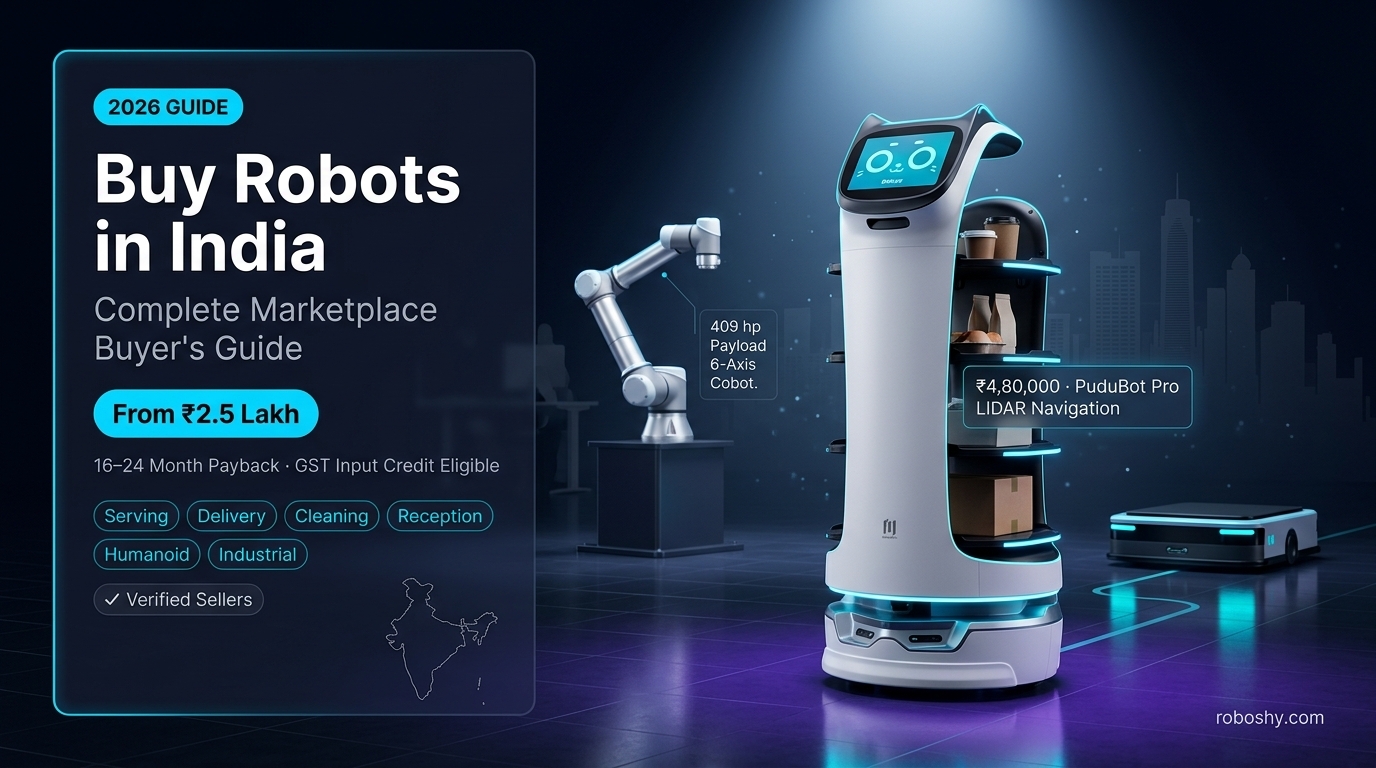
Buy Robots in India: The Complete Marketplace Buyer’s Guide
April 2, 2026
10:30 am
How Security Robotics Drive Business Impact and Operational Efficiency
March 13, 2026
9:52 am
Humanoid Robots Launching in 2026: What Buyers Need to Know Before They Purchase
February 28, 2026
10:34 am

AI Summit India 2026: Robotics, Humanoid AI, Automation & Future Technology Trends
February 21, 2026
6:12 am
How to Sell Robots Successfully: A Step-by-Step Business Guide by Roboshy
February 6, 2026
6:03 am

The Role of Advanced Robotics in Industrial Transformation in 2026
January 23, 2026
11:20 am
Food Serving Robot for Indian Restaurants: The Complete Guide
May 18, 2026
5:25 am
Agricultural Drones in India: Subsidies, Prices and Buyer Guide
May 7, 2026
5:18 am
Cobot Price in India: What Indian Businesses Actually Pay in 2026
April 23, 2026
5:30 am
Buy Robots in India: The Complete Marketplace Buyer’s Guide
April 2, 2026
10:30 am
How Security Robotics Drive Business Impact and Operational Efficiency
March 13, 2026
9:52 am
Humanoid Robots Launching in 2026: What Buyers Need to Know Before They Purchase
February 28, 2026
10:34 am
AI Summit India 2026: Robotics, Humanoid AI, Automation & Future Technology Trends
February 21, 2026
6:12 am
How to Sell Robots Successfully: A Step-by-Step Business Guide by Roboshy
February 6, 2026
6:03 am
The Role of Advanced Robotics in Industrial Transformation in 2026
January 23, 2026
11:20 am