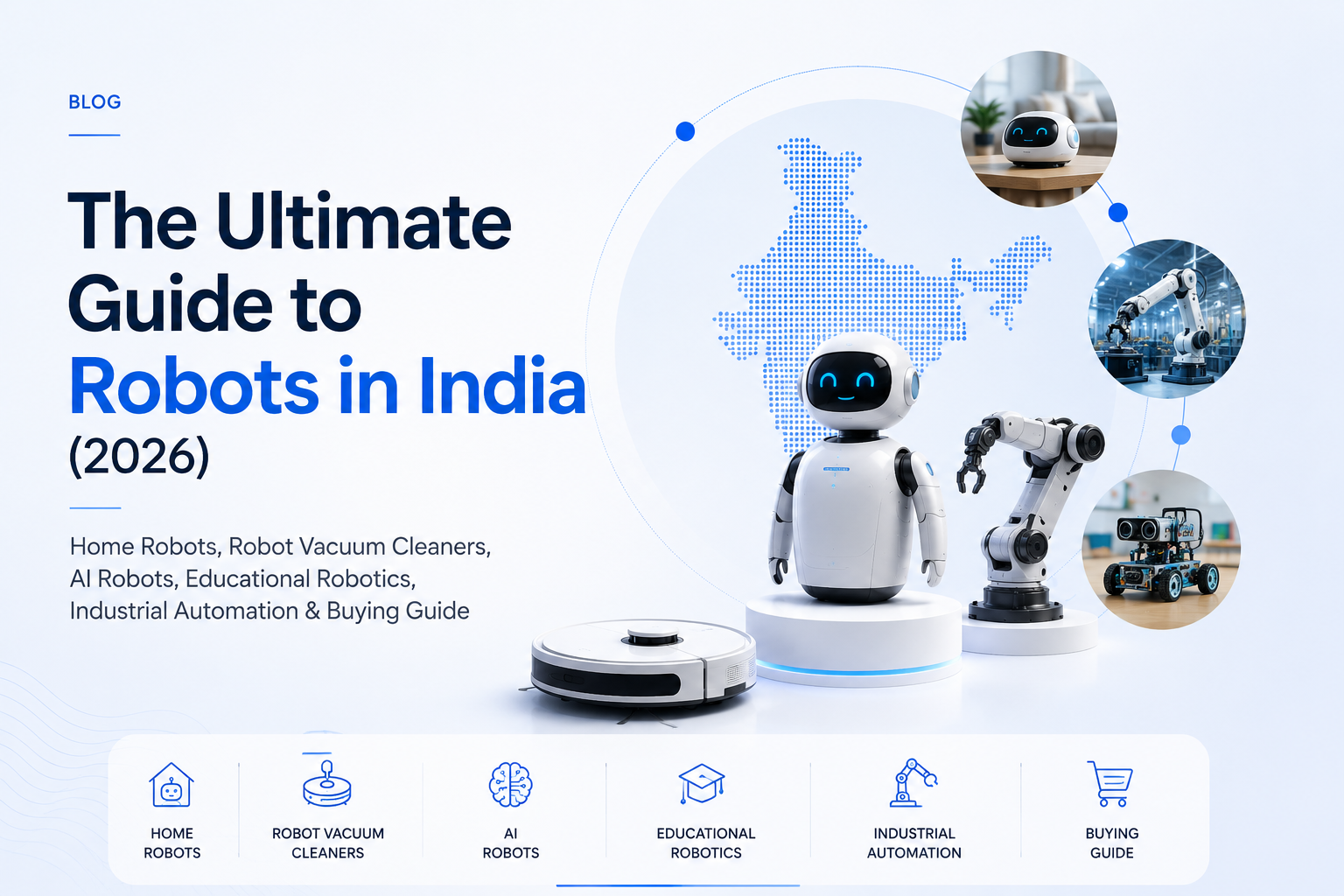
The Ultimate Guide to Robots in India (2026): Home Robots, Robot Vacuum Cleaners, AI Robots, Educational Robotics, Industrial Automation & Buying Guide
Robots in India in 2026 span five practical categories: home robots (vacuum cleaners, mops, security units), AI robots (computer-vision and machine-learning driven devices), educational robotics kits (Arduino and Raspberry Pi based), industrial robots (cobots, AMRs, AGVs for manufacturing and warehousing), and service robots (hospitality, retail, healthcare). Entry-level options start under ₹2,000 for educational kits and ₹8,000 for robot vacuums, while industrial robots range from ₹8 lakh to over ₹1.5 crore depending on application and payload.
Table of Contents
- Introduction: What Is a Robot, and Why Now?
- Chapter 1 — What Is a Robot?
- Chapter 2 — Types of Robots
- Chapter 3 — Home Robots
- Chapter 4 — Robot Vacuum Cleaners (Deep Dive)
- Chapter 5 — AI Robots
- Chapter 6 — Educational Robotics
- Chapter 7 — Robotics Components
- Chapter 8 — Industrial Robots
- Chapter 9 — Benefits of Robots Across Settings
- Chapter 10 — How to Choose the Right Robot
- Chapter 11 — Future of Robotics in India
- Chapter 12 — Frequently Asked Questions
- Conclusion
Introduction: What Is a Robot, and Why Now?
A robot is a programmable machine capable of carrying out a sequence of actions automatically, sensing its environment, processing that information, and acting on it through motors or other moving parts. That single definition now covers an extraordinarily wide range of devices sold and used in India: a ₹10,000 robot vacuum cleaner gliding under a sofa in Pune, a ₹1,500 Arduino kit being assembled by a ninth-grader in Coimbatore, and a six-axis welding arm running a night shift in a Chennai auto plant.
Robots for home use have moved from novelty to mainstream appliance category over the past five years. What used to be a single product, the robot vacuum cleaner, has expanded into a broader ecosystem of home robots: mops, window cleaners, lawn mowers, and security units that increasingly talk to each other and to voice assistants.
Why robots are becoming common in Indian homes and businesses comes down to three converging forces. First, component costs, motors, sensors, batteries, and microcontrollers, have fallen sharply as manufacturing scale increased globally. Second, India’s software engineering talent pool has made AI integration (computer vision, voice control, route optimisation) cheaper to build and deploy than it was even three years ago. Third, urban India’s smaller living spaces and dual-income households have created genuine demand for time-saving automation rather than novelty purchases.
Growth of robotics in India has been measurable rather than speculative. The country’s robotics market has grown at a double-digit annual rate through the mid-2020s, with home robots and warehouse automation as the two fastest-expanding segments, followed closely by educational robotics driven by school curriculum changes and STEM lab funding.
The future of AI-powered robots in India points toward deeper integration rather than entirely new product categories, vacuum cleaners that coordinate with smart locks, delivery robots that operate semi-autonomously, and humanoid robot pilots beginning to appear in controlled industrial and research settings.
This guide covers every major category of robot available in India today: how each works, what it costs, how to evaluate one before buying, and where the category is heading next.
What Is a Robot?
Quick Definition: A robot is a programmable machine that senses its environment through sensors, processes that data via a controller, and acts on it using actuators, with artificial intelligence increasingly layered on top to allow the robot to adapt rather than simply follow fixed rules.
The five components every robot shares
Regardless of category, a ₹1,500 educational kit or a ₹1.5 crore industrial arm, virtually every robot is built from the same five functional building blocks.
Sensors are the robot’s senses. Ultrasonic sensors measure distance using sound waves, infrared sensors detect heat or proximity, cameras capture visual data, and LiDAR units measure distance using laser light to build spatial maps. A robot vacuum cleaner typically combines several sensor types simultaneously, a cliff sensor to detect stairs, a bump sensor for collision detection, and either LiDAR or a camera for room mapping.
Controllers are the robot’s decision-making centre, typically a microcontroller (like an Arduino board) for simple, rule-based logic, or a microcomputer (like a Raspberry Pi) for more complex processing including computer vision or machine learning inference. The controller reads sensor input, runs the robot’s programmed logic, and sends commands to the actuators.
Actuators convert electrical signals into physical movement. This includes DC geared motors for wheel rotation, servo motors for precise angular movement (used in robotic arms and steering), and specialised actuators for tasks like opening a dustbin flap or extending a mop pad.
Artificial Intelligence (AI) is the layer that allows a robot to interpret complex, unstructured information, recognising a pet versus a chair leg, understanding a spoken command, or learning the most efficient cleaning route through a room, rather than executing only pre-programmed, fixed responses.
Machine Learning is the specific AI technique through which a robot’s software improves its decisions by analysing outcomes from past actions, without a human manually reprogramming it. A robot vacuum that gradually optimises its cleaning path across multiple sessions in your home is applying machine learning in practice.
How these components work together
Consider a basic obstacle-avoidance robot: an ultrasonic sensor detects an object ahead, the microcontroller processes that distance reading against its programmed logic (“if distance is less than 15cm, stop and turn”), and the DC motors execute the turn. Add a camera and machine learning, and the same robot could instead identify what the object is and decide whether to navigate around it, push past it, or wait for it to move, the architecture is the same, but the intelligence layer transforms the outcome.
Key Takeaway, Chapter 1: Every robot, regardless of price or category, is built from sensors, a controller, and actuators. AI and machine learning are an additional intelligence layer that makes a robot adaptive rather than purely rule-based; this layer is what separates a basic automation robot from a genuinely smart one.
Types of Robots
Robots sold and deployed in India fall into nine broad categories, each with distinct use cases, buyers, and price points.
Home Robots
Devices designed for domestic use, robot vacuum cleaners, robot mops, window cleaning robots, lawn mowing robots, pool cleaning robots, pet care robots, and home security robots. This is the largest consumer-facing category by unit volume in India.
Industrial Robots
Reprogrammable machines used in manufacturing, typically robotic arms with three or more axes of movement, performing welding, assembly, painting, and material handling on production lines, predominantly in automotive, electronics, and pharmaceutical manufacturing.
Medical Robots
Robotic systems assisting in surgery (surgical robots offering enhanced precision), hospital logistics (medicine and sample transport within facilities), and rehabilitation (robotic exoskeletons and physiotherapy assistance devices). Adoption in India is concentrated in metro-area private hospitals and select government medical research institutions.
Educational Robots
Programmable kits, typically Arduino or Raspberry Pi based, designed to teach coding, electronics, and engineering concepts to students through hands-on building rather than theoretical instruction alone.
Service Robots
Robots that interact directly with people in commercial settings, reception robots in hotels, table-delivery robots in restaurants, retail assistance robots, and indoor delivery robots in offices and residential complexes.
Agricultural Robots
Automation for farming tasks including precision seeding, automated irrigation control, crop health monitoring via drone and ground-based sensors, and selective harvesting. India’s agricultural robotics adoption remains early-stage relative to other categories but is growing through government-backed precision farming initiatives.
Military and Defence Robots
Robotic systems for reconnaissance, bomb disposal, and surveillance, developed largely through defence research institutions and select private-sector partnerships. This category sits outside consumer and most commercial buying decisions.
Companion Robots
Robots designed primarily for social interaction and companionship rather than task completion, relevant for elderly care support and, in limited cases, child engagement and therapy contexts.
Warehouse Robots
Automated systems for storage, picking, sorting, and internal transport within warehouses and fulfilment centres — including Automated Guided Vehicles (AGVs) and Autonomous Mobile Robots (AMRs), covered in depth in Chapter 8.
Quick Comparison: Robot Categories by Primary Buyer
| Category | Primary Buyer | Typical Price Entry Point |
|---|---|---|
| Home Robots | Individual households | ₹8,000+ |
| Industrial Robots | Manufacturers | ₹8 lakh+ |
| Medical Robots | Hospitals, research institutions | Highly variable, enterprise-level |
| Educational Robots | Students, schools | ₹1,200+ |
| Service Robots | Hotels, restaurants, retail businesses | ₹1.5 lakh+ |
| Agricultural Robots | Farms, agritech companies | Highly variable |
| Companion Robots | Households, care facilities | ₹15,000+ |
| Warehouse Robots | Logistics and fulfilment operators | ₹5 lakh+ |
Key Takeaway, Chapter 2: Most buyers in India will only ever interact with three of these nine categories directly, home robots, educational robots, and occasionally service robots. The remaining categories matter primarily to businesses and institutions making capital equipment decisions.
Home Robots
Home robots, also searched as robots for home, smart home robot, or domestic robot, now span considerably more than the vacuum cleaner that introduced most Indian households to the category.
Robot Vacuum Cleaner
The anchor category. A self-navigating device that vacuums (and often mops) floors automatically on a schedule or on demand, using sensors and mapping software to cover a space efficiently. Covered in full depth in Chapter 4 given its scope and buyer search volume.
Key features: LiDAR or camera-based navigation, app control, scheduling, zone cleaning, suction power measured in Pascals (Pa). Benefits: Time savings, consistent cleaning frequency, access to hard-to-reach areas under furniture.
Robot Mop
A robot mop wets and wipes hard flooring rather than vacuuming. Most mid-range and premium robot vacuum cleaners now integrate mopping into a single unit, though dedicated mop-only robots remain available for households that already own a strong vacuum-only device and want supplementary mopping power.
Key features: Water tank capacity, mop pad rotation or vibration mechanism, auto-wash docks on premium units. Benefits: Reduces manual mopping frequency, particularly valuable in homes with tile or marble flooring.
Window Cleaning Robot
A specialised robot that adheres to glass surfaces, typically via suction, and cleans windows automatically, relevant for high-rise apartments where manual window cleaning is inconvenient or risky.
Key features: Suction-based wall adherence, edge detection to avoid falling off the glass surface, battery backup in case of power loss during operation. Benefits: Removes the safety risk and physical difficulty of manual high-window cleaning.
Lawn Mowing Robot
An outdoor robot that autonomously mows grass within a defined boundary, typically set using a buried perimeter wire or, in newer models, GPS-based virtual boundaries.
Key features: Weatherproofing, automatic charging dock return, rain sensors that pause operation. Benefits: Relevant primarily for independent houses with garden space, a smaller addressable market in India compared to apartment-dominant urban centres, but growing in tier-1 city suburbs and gated communities.
Pool Cleaning Robot
An automated device that vacuums debris and algae from swimming pool floors and walls, relevant for villa communities, clubs, and hospitality properties with private pools.
Key features: Underwater navigation, filtration system, programmable cleaning cycles. Benefits: Reduces manual pool maintenance labour and chemical/filtration costs through more consistent debris removal.
Pet Care Robot
Devices supporting pet management while owners are away, automated feeders, interactive treat-dispensing cameras, and in some cases robotic litter management for cats.
Key features: App-based remote feeding schedules, two-way camera and audio for remote interaction. Benefits: Useful for working pet owners managing feeding schedules and basic pet monitoring during the day.
Home Security Robot
A mobile, often camera-equipped robot that patrols a home’s interior, sending alerts and live video on detecting unexpected movement, distinct from fixed security cameras through its ability to move and actively investigate.
Key features: Motion detection, mobile patrol routes, live video streaming to a mobile app, night vision. Benefits: Provides more comprehensive coverage than fixed cameras, particularly in larger homes with multiple rooms.
Key Takeaway, Chapter 3: Robot vacuum cleaners remain the gateway home robot for most Indian buyers, but the broader household robot ecosystem is expanding, and increasingly these devices are designed to integrate with each other and with voice assistants rather than operate as standalone gadgets.
Robot Vacuum Cleaners (Deep Dive)
The robot vacuum cleaner, interchangeably searched as robotic vacuum cleaner, vacuum cleaning robot, automatic floor cleaning robot, or smart vacuum cleaner, deserves dedicated, in-depth treatment given how much buying confusion exists around navigation technology, suction specifications, and which features genuinely matter for Indian homes.
How robot vacuum cleaners actually work
At a functional level, a robot vacuum cleaner repeats a four-stage cycle: it senses its environment (via LiDAR, camera, or basic sensors), builds or updates an internal map of the space, plans an efficient cleaning path across that map, and executes cleaning while continuously adjusting for newly detected obstacles. The sophistication of each stage is what separates a ₹9,000 budget unit from a ₹60,000 premium one.
LiDAR Navigation
LiDAR (Light Detection and Ranging) is a navigation system using rotating laser beams to measure distances to surrounding objects, building a precise, real-time spatial map. LiDAR-equipped robot vacuum cleaners clean in efficient, methodical row-by-row patterns rather than the random zig-zag movement typical of older bump-sensor models, covering more floor area in less time with fewer missed sections.
Laser Navigation vs. Camera-Based Navigation
LiDAR (a form of laser-based navigation) measures physical distance directly using laser light, while camera-based navigation, sometimes called vision SLAM, uses an onboard camera to visually recognise landmarks and reconstruct a map from image data. For Indian homes specifically, LiDAR generally performs more reliably because it functions independently of ambient lighting conditions and doesn’t depend on visually identifying cluttered furniture arrangements, a meaningful advantage in homes with varied lighting and dense furnishing.
SLAM Mapping
SLAM (Simultaneous Localization and Mapping) is the algorithmic layer that allows a robot to build a map of an unfamiliar space while simultaneously tracking its own position within that map as it moves. This is the software that converts raw LiDAR or camera sensor data into a usable, navigable floor plan, effectively the “brain” behind intelligent room-by-room cleaning rather than directionless wandering.
Cameras in Robot Vacuum Cleaners
Beyond pure navigation, cameras serve a secondary function in many modern units: object and obstacle recognition. A camera-equipped robot vacuum can distinguish between a charging cable, a pet, and a piece of furniture, adjusting its cleaning behaviour accordingly, such as avoiding a pet’s food bowl rather than attempting to clean directly into it.
Edge Detection and Obstacle Avoidance
Edge detection relies on dedicated cliff sensors that prevent a robot vacuum from rolling off raised platforms or down a staircase, a critical safety feature given how many Indian homes have multi-level living areas, raised thresholds between rooms, or open balconies. Obstacle avoidance more broadly covers how effectively a unit detects and routes around low furniture, trailing wires, and pet toys, common failure points for cheaper models that rely solely on physical bump-sensing rather than predictive detection.
Self-Emptying Technology
Self-emptying docks store collected dust and debris in a larger base-station reservoir, extending the interval between manual bin emptying from daily to roughly every 30–100 days, depending on home size and usage frequency. This feature matters most for households that want to minimise ongoing manual intervention, though it adds meaningfully to upfront cost.
Self-Washing Technology
Self-washing models extend the self-emptying concept to mopping, automatically rinsing, and on premium units, hot-air-drying mop pads after each cleaning cycle, preventing the buildup of bacteria or odour that can occur with manually washed mop pads left damp between uses.
Battery Life
Entry-level robot vacuum cleaners typically run 60–90 minutes per charge. Mid-range models generally manage around 120 minutes. Premium units with larger battery capacity can run 180–370 minutes, allowing a single cleaning cycle to cover large, multi-room homes without requiring a mid-clean recharge pause.
Robot Vacuum Cleaner Comparison Table: Budget vs. Mid-Range vs. Premium
| Tier | Price Range (India) | Suction Power | Navigation | Best For |
|---|---|---|---|---|
| Budget | ₹8,000–₹20,000 | 2,200–4,000 Pa | Gyroscope / basic sensors | Small apartments, first-time buyers, hard floors only |
| Mid-range | ₹20,000–₹45,000 | 4,000–8,000 Pa | LiDAR or LDS with app control | 2–3 BHK homes, mixed flooring, vacuum + mop combo |
| Premium | ₹45,000–₹80,000+ | 8,000–25,000 Pa | Advanced LiDAR with 3D mapping, multi-floor memory | Large homes, pet owners, full self-emptying & self-washing automation |
Pros and Cons of Robot Vacuum Cleaners
✓ Pros:
- Saves significant daily cleaning time across multi-room homes
- Reaches under furniture that manual cleaning often skips
- Operates on a fixed schedule even when nobody is home
- Most modern models handle tile, marble, and wood flooring equally well
- App control enables zone-specific cleaning and no-go area restrictions
✗ Cons:
- Struggles with thick carpets and high door thresholds
- Requires occasional manual brush and filter cleaning regardless of tier
- Premium self-emptying and self-washing models carry a steep price jump
- Not a substitute for deep cleaning in heavily soiled areas
- Requires stable Wi-Fi and app setup for full feature access
Buying tip for Indian homes: Prioritise at least 4,000 Pa suction power, a combined vacuum-and-mop function, and, critically, confirmed brand service availability and spare-part access in your specific city before purchasing. After-sales support varies dramatically by brand and region across India, and this single factor causes more buyer dissatisfaction than any individual spec-sheet number.
Can robot vacuum cleaners climb stairs?
No. Robot vacuum cleaners are designed for single-floor operation and use cliff sensors specifically to detect and avoid stairs, preventing falls rather than attempting to navigate them. Multi-storey homes require either a separate unit per floor or manually relocating a single unit between levels.
How long do robot vacuum cleaners typically last?
With regular filter and brush maintenance, most robot vacuum cleaners have a functional lifespan of 4–6 years, with battery degradation (rather than mechanical failure) typically being the limiting factor, most batteries can be replaced independently to extend a unit’s usable life further.
Key Takeaway, Chapter 4: LiDAR plus SLAM mapping consistently outperforms basic sensor navigation, particularly in larger or more cluttered Indian homes. A suction power of 4,000–6,500 Pa represents the practical sweet spot for most households, and the ₹20,000–₹45,000 mid-range tier offers the strongest value for typical 2–3 BHK apartments. Self-emptying and self-washing are genuine conveniences but remain optional rather than essential.
AI Robots
Quick Definition: An AI robot is any robot that uses artificial intelligence, computer vision, natural language processing, or machine learning, to perceive its environment, make decisions, and adapt its behaviour, rather than simply executing fixed, pre-programmed rules.
The practical difference between a basic robot and an AI robot comes down to adaptability. A standard robot vacuum follows a fixed cleaning pattern every single time. An AI vacuum cleaner or AI-powered home robot instead learns your home’s layout, remembers furniture changes between sessions, and progressively improves its cleaning route, adaptability is the feature actually worth paying for, separate from marketing terminology.
Artificial Intelligence in robots, defined plainly
Artificial Intelligence, in the context of consumer and industrial robotics, refers to software systems that can process complex, often unstructured input, an image, a spoken sentence, a sensor pattern, and produce a context-appropriate response, rather than following a single hardcoded rule for every situation.
Computer Vision
Computer vision allows a robot to interpret images and video the way a human eye and brain do, identifying objects, people, obstacles, and even text. In Indian homes and businesses, computer vision powers pet and human recognition in robot vacuum cleaners (so the unit avoids them rather than colliding), facial recognition in security robots, and object sorting in warehouse robotics.
Natural Language Processing (NLP)
NLP allows a robot to understand and respond to spoken or typed human language. This is the technology that lets a person say “clean the bedroom” to a smart home robot, or ask a companion robot a question and receive a relevant, context-aware spoken response.
Voice Control
Voice control combines three layered technologies: speech recognition (converting spoken audio into text), NLP (interpreting what that text actually means), and a response system (executing an action or replying). Most AI robots sold in India integrate with existing voice assistant ecosystems, Alexa or Google Assistant, rather than building proprietary voice recognition from scratch, which keeps costs down and reliability high.
Autonomous Navigation
Autonomous navigation is a robot’s ability to move through an environment, avoid obstacles, and reach a destination without a human directly steering it in real time. This builds on the sensing technologies covered in Chapter 4, LiDAR, cameras, and SLAM, combined with AI-based decision-making for handling complex or unpredictable spaces, such as a crowded warehouse aisle or uneven outdoor terrain.
Machine Learning in Practice
Machine learning allows a robot’s software to improve its decision-making by analysing data from past actions and outcomes, without requiring a human to manually reprogram it. A delivery robot, for instance, can learn which routes through a building consistently prove faster, while a warehouse robot can learn which shelf placements reduce picking time, and both adjust their behaviour automatically as a result.
Industry context: India’s robotics sector carries a particular structural advantage in the software layer of AI robotics, described by industry analysts as a global hub for robotics R&D talent, even in categories where the physical hardware components themselves are frequently imported from manufacturing hubs in East Asia.
Can AI robots genuinely “learn”?
Yes, within defined parameters. AI robots learn in the specific sense of optimising behaviour based on accumulated data, a vacuum refining its cleaning route, or a voice assistant improving command recognition accuracy over repeated use. This is narrow, task-specific learning rather than general intelligence; an AI robot vacuum cannot apply its “learning” to an unrelated task it wasn’t designed for.
Key Takeaway, Chapter 5: AI is the layer that converts a fixed-rule robot into an adaptive one, an upgrade, not a strict requirement for basic functionality. Computer vision, NLP, and machine learning are the three AI building blocks present in most consumer and industrial AI robots sold in India today, and India’s particular strength lies more in the software and algorithm layer than in physical hardware manufacturing, for now.
Educational Robotics
Quick Definition: Educational robotics is the use of programmable robot kits typically built on Arduino, Raspberry Pi, or similar open-source hardware to teach children and students coding, electronics, and engineering through hands-on building and programming rather than theory alone.
Robotics for Kids: where to start
India’s National Education Policy (NEP) explicitly pushes foundational coding and computational thinking from the upper-primary years onward, and government-backed school Tinkering Lab programmes have meaningfully accelerated demand for affordable robotics kits for students nationwide.
Children can realistically begin as early as age 8–9 using simple mechanical, block-coding kits with drag-and-drop programming interfaces. Around age 12–13, most students are ready to progress into text-based coding languages (commonly C++ or Python) alongside more complex electronics involving multiple simultaneous sensors.
STEM Robotics Kits
A STEM robotics kit is explicitly designed to teach Science, Technology, Engineering, and Mathematics concepts through robot-building rather than abstract classroom instruction combining mechanical assembly, circuit wiring, and programming logic into a single hands-on learning exercise.
Arduino vs. Raspberry Pi: which is better for learning robotics?
An Arduino robot kit uses a microcontroller best suited for direct, simple control of motors, sensors, and lights, making it ideal for an absolute beginner building their first robot. A Raspberry Pi robot kit uses a microcomputer capable of running a full operating system, processing computer vision, and supporting more advanced AI-integrated projects. Most learners start with Arduino and progress to Raspberry Pi as project complexity increases.
| Feature | Arduino | Raspberry Pi |
|---|---|---|
| Type | Microcontroller | Microcomputer (runs full OS) |
| Best for | Motors, sensors, simple automation | AI, computer vision, complex logic |
| Programming language | C / C++ (Arduino IDE) | Python, and almost any language |
| Beginner-friendly? | Very — ideal first board | Moderate — more setup involved |
| Typical India price (board only) | ₹400–₹800 | ₹3,500–₹8,000 |
What robotics kits typically cost in India
| Kit Type | Price Range (India) | Best For | Skills Taught |
|---|---|---|---|
| Basic Arduino starter kit | ₹1,500–₹2,500 | Ages 10–14, complete beginners | Circuits, basic sensors, simple coding |
| Advanced Arduino kit (multi-sensor) | ₹2,500–₹7,000 | Ages 13–17, intermediate learners | C++ programming, multiple sensor integration |
| DIY robotics chassis kit | ₹1,500–₹2,000 | Ages 8–12 | Mechanical design, motion control, line-following |
| Raspberry Pi robotics kit | ₹6,000–₹15,000 | Ages 13+, advanced learners | Python, computer vision, edge AI |
| Branded school robotics kit | ₹3,000–₹20,000 | School robotics labs, lab programmes | Mechanical design, app-controlled robotics, creativity |
Which robotics kit is best for absolute beginners?
A basic Arduino starter kit priced ₹1,500–₹2,500, including a chassis, DC motors, and an ultrasonic sensor, with block-based coding support, is the most cost-effective and genuinely beginner-friendly entry point for someone with zero prior programming or electronics experience.
Coding Robots and DIY Robots
A coding robot is any robot kit designed primarily to teach programming concepts often using simplified visual coding interfaces like Scratch or Blockly before introducing text-based syntax. A DIY robot project, by contrast, emphasises the mechanical and electronic assembly process itself building the chassis, wiring sensors, and integrating motors with programming as one part of a broader hands-on construction exercise.
Real beginner project ideas
Common robotics projects for college students and school learners include line-following robots (using IR sensors to track a path), obstacle-avoidance rovers (using ultrasonic sensing), simple robotic arm builds (introducing servo motor control), and basic home-automation demonstrations combining light, temperature, and motion sensors all achievable with a sub-₹3,000 kit and freely available open-source code libraries.
Robotics Competitions in India
Students can participate in World Robot Olympiad (WRO) India, Atal Tinkering Lab innovation challenges, FIRST LEGO League-style regional events, and a growing number of state-level and college-hosted robotics hackathons many of which now include dedicated AI and computer-vision categories alongside traditional mechanical challenges.
Do educational robots actually help learning outcomes?
Yes, particularly for engineering and computational thinking skills. Hands-on robotics building reinforces abstract programming concepts (loops, conditionals, sensor input handling) through immediate, visible physical feedback a student can see why their code didn’t work when the robot drives into a wall, which accelerates debugging skill development compared to purely screen-based coding exercises.
Key Takeaway, Chapter 6: Arduino remains the correct starting point for nearly all beginners simple, affordable, and forgiving. Raspberry Pi becomes relevant only once a learner specifically wants to add computer vision or more advanced AI logic to a project. India’s curriculum and lab-funding shifts mean robotics kits for students demand will likely keep growing well beyond 2026.
Robotics Components
Understanding the core hardware building blocks helps evaluate any robot, whether assembling a DIY educational project or assessing a commercial product’s specification sheet.
Motors
Robot motors convert electrical energy into mechanical rotation, forming the basis of nearly all robot movement. A DC geared motor provides continuous rotational drive for wheels at a controlled, reduced speed (via internal gearing), making it the standard choice for basic locomotion in everything from educational kits to robot vacuum cleaners. A servo motor, by contrast, rotates to a specific, precise angle and holds that position, essential for robotic arms, grippers, and steering mechanisms requiring accurate, repeatable positioning rather than continuous rotation.
Sensors
Robotics sensors are the perception layer covered briefly in Chapter 1, expanded here: ultrasonic sensors measure distance via sound wave reflection time, infrared (IR) sensors detect heat signatures or simple proximity, light sensors measure ambient brightness (useful for line-following robots), and gyroscopes/accelerometers measure orientation and movement for balance and navigation. Arduino sensors, the specific sensor modules compatible with Arduino boards, are typically the most affordable and widely available category for beginners in India, commonly sold in multi-sensor starter packs.
Wheels
Robot wheels vary by intended movement pattern. Standard wheels suit simple forward/backward/turning motion. Omni-directional wheels allow movement in any direction without first rotating the robot’s body, useful in tighter industrial or warehouse spaces. Mecanum wheels, a more advanced omni-wheel variant, provide even finer directional control, typically reserved for more sophisticated industrial AMRs rather than educational kits.
Chassis
The robot chassis is the structural frame or base that houses the motors, sensors, control board, and battery, effectively the robot’s skeleton. Educational chassis kits are typically acrylic or plastic for affordability and ease of drilling/mounting, while industrial robot chassis use machined metal for durability under continuous commercial use.
Microcontrollers
A microcontroller is a compact computer chip, Arduino being the most common example in educational and hobbyist contexts, that runs a robot’s programmed logic, continuously reading sensor inputs and sending corresponding commands to actuators like motors and servos. Microcontrollers are distinct from full microcomputers (like Raspberry Pi) in that they’re optimised for simple, real-time control tasks rather than running a general operating system.
Batteries
Robot batteries range from simple disposable AA cells in the most basic educational kits, to rechargeable lithium-ion packs in robot vacuum cleaners (balancing capacity against weight and charge cycle longevity), to large industrial battery banks in AMRs designed for multi-hour continuous warehouse operation between charges.
Cameras
Cameras serve dual roles depending on robot category: navigation (camera-based SLAM mapping, as covered in Chapter 4) and object/obstacle recognition (computer vision applications covered in Chapter 5). Camera quality and processing power requirements scale significantly between a basic educational robot’s simple line-detection camera and an industrial inspection robot’s high-resolution defect-detection system.
LiDAR
As detailed in Chapter 4, LiDAR units use rotating laser beams to measure precise distances to surrounding objects, enabling highly accurate real-time spatial mapping, now appearing not just in premium robot vacuum cleaners but increasingly in mid-tier AMRs and even some advanced educational/research robotics kits as component costs continue to fall.
Servos and Robotic Arm Kits
A robotic arm kit typically bundles multiple servo motors with a multi-jointed mechanical structure, allowing a builder to construct a functioning multi-axis arm capable of pick-and-place tasks, a popular intermediate-to-advanced educational project that introduces inverse kinematics concepts (calculating joint angles needed to reach a specific point in space) in an accessible, hands-on way.
Raspberry Pi Accessories
Beyond the core board, Raspberry Pi accessories commonly used in robotics projects include camera modules (for computer vision projects), GPIO expansion boards (for connecting additional sensors and motors), motor driver HATs (hardware add-ons that let the Pi safely control motor current), and cooling solutions for projects running sustained AI inference workloads.
Components Quick Reference Table
| Component | Primary Function | Typical Use Case |
|---|---|---|
| DC geared motor | Continuous wheel rotation | Locomotion in most wheeled robots |
| Servo motor | Precise angular positioning | Robotic arms, steering, grippers |
| Ultrasonic sensor | Distance measurement via sound | Obstacle detection |
| LiDAR | Precise distance via laser | High-end navigation & mapping |
| Microcontroller (Arduino) | Simple rule-based control logic | Educational kits, basic automation |
| Microcomputer (Raspberry Pi) | Complex processing, AI inference | Computer vision, advanced projects |
| Chassis | Structural frame | Houses all other components |
| Servo-based robotic arm kit | Multi-axis precision movement | Pick-and-place, educational arm builds |
Key Takeaway, Chapter 7: Nearly every robot, regardless of price point, is assembled from the same component categories: motors, sensors, a chassis, a controller, and a power source. Understanding what each component actually does makes it significantly easier to evaluate any robot’s specification sheet, whether you’re buying a finished product or building one from a kit.
Industrial Robots
Industrial robots are automated, programmable machines, typically reprogrammable robotic arms with three or more axes of movement, deployed in manufacturing for tasks including welding, assembly, and material handling. The broader industrial and business robots category extends into warehouse robots, logistics robots, and service robots covering distinct but related commercial automation needs.
Manufacturing
Industrial robots in manufacturing handle repetitive, precision-critical tasks, spot welding on automotive assembly lines, component placement in electronics manufacturing, and material handling between production stages, where consistency and speed exceed what manual labour can reliably sustain across continuous shifts.
Warehousing
Warehouse automation uses robots, conveyor systems, and coordinating software to handle storage, picking, sorting, and internal transportation tasks with minimal manual labour involvement, directly improving both order processing speed and pick accuracy compared to fully manual operations.
Logistics
A logistics robot extends warehouse automation principles to broader supply-chain movement, including last-mile delivery robots now being piloted in select Indian tech parks, university campuses, and gated residential communities for short-distance autonomous package delivery.
Packaging
Robotic packaging systems handle case-packing, palletising, and label application at speeds and consistency levels difficult to match manually, particularly valuable in high-volume FMCG and e-commerce fulfilment operations.
Inspection
An inspection robot uses cameras and sensors to detect manufacturing defects, structural issues, or quality deviations, increasingly using computer vision and machine learning to identify defects beyond what rule-based visual inspection systems could previously catch.
Quality Control
Quality control robotics extends inspection into automated pass/fail decision-making and, in advanced implementations, predictive identification of process drift before defective output is actually produced, shifting quality management from reactive to proactive.
Pick & Place
Pick-and-place robots, often built around robotic arm kits scaled to industrial specifications, handle the repetitive task of identifying, grasping, and relocating items, forming the backbone of many automated packaging and assembly-line sorting operations.
Collaborative Robots (Cobots)
A cobot (collaborative robot) is an industrial robot specifically designed to work safely alongside human workers without requiring safety cages or fully isolated work cells, typically priced 40–60% below traditional industrial arms, making automation meaningfully more accessible to smaller manufacturers previously priced out of robotics adoption entirely.
AMRs (Autonomous Mobile Robots)
An AMR robot uses onboard sensors and AI-based navigation to move freely through a facility, dynamically rerouting around obstacles without requiring fixed infrastructure like embedded floor guides, offering significantly more flexibility for warehouses with frequently changing layouts or seasonal storage needs.
AGVs (Automated Guided Vehicles)
An AGV robot follows fixed, predetermined paths, typically using magnetic strips or markers embedded in the floor, making it suited to highly repetitive, unchanging transport routes where the infrastructure investment is justified by sustained, predictable volume.
AMR vs. AGV Comparison Table
| Factor | AGV | AMR |
|---|---|---|
| Navigation | Fixed paths (floor strips/markers) | Onboard sensors + AI navigation |
| Flexibility | Low — fixed routes only | High — dynamic rerouting |
| Infrastructure cost | Higher (requires floor installation) | Lower (no fixed infrastructure) |
| Best for | High-volume, unchanging routes | Variable layouts, mixed SKU operations |
| Typical setup time | Longer | Shorter |
What industrial robots cost in India
- Cobots: starting around ₹8 lakh – designed for safe human-adjacent operation
- SCARA robots: approximately ₹10–₹30 lakh, suited to precision assembly tasks
- Heavy six-axis articulated arms: ₹25 lakh to ₹1.5 crore or more, for welding, painting, and high-payload material handling
Industrial Robot ROI: Payback Period
Payback periods for industrial cobot robot investment in India typically run 16–36 months, calculated from direct labour cost savings alone, a figure that improves further once quality consistency gains and reduced unplanned downtime are factored into the broader return calculation.
Predictive Maintenance
Predictive maintenance uses sensor data and AI-based pattern analysis to forecast when a robot’s mechanical components are likely to fail, allowing scheduled repairs before an unplanned breakdown disrupts production, a capability increasingly bundled into industrial robot service contracts rather than sold as a separate add-on.
Which Indian industries use industrial robots the most?
Automotive manufacturing leads industrial robot adoption in India, followed by electronics assembly, pharmaceuticals (where precision and contamination control are critical), and food processing, where consistency and hygiene requirements favour automated handling over manual processes.
Key Takeaway, Chapter 8: Cobots and Robot-as-a-Service (RaaS) rental models, covered further in Chapter 10, have meaningfully lowered the barrier to industrial automation for small and medium Indian manufacturers. The AMR-versus-AGV decision should be driven primarily by how frequently your facility’s layout and routing needs change, not simply by which technology sounds more advanced.
Benefits of Robots
Robots deliver different value depending on where they’re deployed. Here’s a breakdown by setting.
| Setting | Key Benefit | Real-World Example |
|---|---|---|
| Homes | Time saved on repetitive chores | Robot vacuum cleaning daily while the family is at work or school |
| Schools | Hands-on STEM learning and stronger engineering foundations | Students building line-following robots using Arduino kits under NEP 2020 |
| Businesses | Lower operating costs, faster service, consistent quality | Reception robots handling routine customer queries at hotels and retail stores |
| Hospitals | Reduced infection risk, faster internal logistics | Delivery robots transporting medicines and samples between hospital wings |
| Factories | Higher throughput, improved precision, fewer workplace injuries | Robotic arms handling repetitive welding tasks with zero fatigue-related errors |
| Warehouses | Faster order fulfillment, better inventory accuracy | AMR fleets improving pick accuracy by 30–40% over manual operations |
| Agriculture | Precision input use, reduced labor dependency | Drone sprayers applying pesticide only where needed, cutting chemical waste |
The bigger picture: Across every setting, the common thread is the same, robots take over repetitive, physically demanding, or error-prone tasks, freeing humans for judgment-based, creative, or supervisory work. India’s robotics economy is explicitly being framed this way: robots as “teammates,” not replacements, with humans shifting into supervision, maintenance, and data analysis roles.
Key Takeaways, Chapter 9
- Benefits scale with deployment context, homes save time, factories gain precision, warehouses gain speed.
- Robots are positioned as workforce multipliers, not pure replacements, in most Indian industry commentary.
- Cost savings, safety improvements, and accuracy gains are the three most consistently cited benefits across settings.
How to Choose the Right Robot
Whether you’re buying a robot vacuum cleaner for your apartment or an AMR fleet for your warehouse, the same eight-point checklist applies.
1. Budget
Define your ceiling first. Robot prices in India span from ₹1,500 (educational kits) to over ₹1.5 crore (industrial arms), know your range before comparing features.
2. Features
List your must-haves (mopping, app control, multi-floor mapping) versus nice-to-haves (self-emptying, voice control) so you don’t overpay for unused features.
3. AI Capability
Decide if you need adaptive, learning behavior or if fixed-rule automation is sufficient for your use case — AI adds cost and complexity.
4. Battery Life
Match runtime to the space you need covered. A small apartment needs less battery than a 4-BHK home or a large warehouse floor.
5. Maintenance
Check what regular upkeep is required, filter changes, brush cleaning, software updates, and whether you’re prepared to handle it.
6. Warranty
Compare warranty length and what it actually covers, motors, batteries, and electronics often have different coverage periods.
7. Brand Reputation
Favor brands with a proven India track record over unfamiliar names offering steep discounts, robotics is a category where reliability matters more than price alone.
8. After-Sales Support
Confirm spare part availability and service center presence in your city before buying, this is the single most overlooked factor by first-time robot buyers in India.
Quick take: For home robots, prioritize service network and suction power. For industrial robots, prioritize payback period and integration support. For educational kits, prioritize open-source compatibility and community support.
Key Takeaways, Chapter 10
- Always confirm after-sales support and spare part availability in your specific city before buying.
- Match battery life and features to your actual space and use case, don’t overbuy.
- For industrial buyers, payback period is a more useful comparison metric than sticker price alone.
Future of Robotics in India
India’s robotics trajectory through 2027 will be shaped less by sudden hardware breakthroughs and more by how effectively the country converts its software and talent advantages into deployed, repeatable outcomes.
Generative AI
Increasingly integrated into robot decision-making, enabling more natural human-robot interaction and adaptive task planning beyond rigid pre-programmed logic.
Humanoid Robots
Indian robotics firms have announced humanoid robots for production, signaling early but real movement toward general-purpose human-form robots in controlled industrial and research settings.
Home Assistants
Beyond vacuum cleaners, fuller home-assistant robots combining mobility, voice interaction, and multi-task automation are entering early Indian markets, the next evolution of the smart home robot category.
Healthcare Robotics
Hospital logistics, surgical assistance, and elder-care companion robots are expanding gradually as healthcare automation investment grows, particularly in metro-area private hospital networks.
Delivery Robots
Last-mile and campus delivery robots are being piloted in select Indian tech parks, university campuses, and gated residential communities for short-distance autonomous package delivery.
AI Agents
Software-based AI agents are increasingly paired with physical robots to handle planning, scheduling, and multi-step task coordination, effectively giving robots a “brain” that can reason beyond a single task.
Edge AI
Running AI models directly on the robot’s own hardware (rather than the cloud) enables faster, more reliable real-time decisions, critical for robots operating in low-connectivity environments or time-sensitive industrial settings.
IoT & 5G Robotics
Connected robot fleets using IoT sensors and 5G networks enable real-time coordination, remote monitoring, and predictive maintenance at scale, the infrastructure layer that will make large AMR and AGV deployments significantly more efficient by FY2027.
What is driving India’s robotics growth specifically?
Three structural forces converge uniquely in India: the world’s largest working-age population by 2027, deep English-speaking technical talent feeding global robotics R&D, and strong policy alignment through Production Linked Incentive (PLI) schemes and Make-in-India initiatives targeting domestic robot manufacturing.
“India is unusual among emerging robotics markets in combining volume manufacturing demand with deep software engineering capability, the global back-office for robotics R&D.”, Robotics Center of Silicon Valley, State of Robotics 2026 Report
Will robots replace jobs in India?
Most industry analysis frames robots as complements to human labor rather than outright replacements, handling repetitive, heavy, or dangerous tasks while human workers shift toward robot supervision, system maintenance, and data analysis roles. India’s industrial robotics adoption explicitly emphasizes this “teammate” framing over wholesale job replacement.
Key Takeaways, Chapter 11
- India’s edge lies primarily in software, AI talent, and teleoperation services, not yet in Tier-1 hardware manufacturing.
- Generative AI and edge AI are converging to make robots faster-thinking and less cloud-dependent.
- Government PLI schemes and Make-in-India policy are expected to drive a dedicated robotics manufacturing push by FY2027.
Frequently Asked Questions About Robots in India
Home Robots & Robot Vacuum Cleaners
What is a home robot? A home robot is any robot designed to perform domestic tasks automatically, cleaning floors, mopping, mowing lawns, or monitoring security, without continuous human operation. The most common examples in India are robot vacuum cleaners and robot mops.
How does a robot vacuum work? A robot vacuum uses sensors and LiDAR or camera-based mapping to scan a room, plans an efficient cleaning path, then uses a brush and suction motor to collect dirt while avoiding obstacles. It returns to its charging dock automatically once finished or low on battery.
Are robot vacuums worth buying in India? Yes, for most urban Indian households. A mid-range model (₹20,000–₹45,000) with 4,000+ Pa suction and mopping handles typical Indian flooring well and saves significant daily cleaning time, especially in homes with both adults working.
Can robot vacuums climb stairs? No. Robot vacuums cannot climb stairs and use cliff sensors specifically to detect and avoid them. Multi-floor homes need either a separate unit per floor or manual carrying between levels.
Which robot vacuum is best for Indian homes? The best choice depends on budget and home size. For under ₹20,000, brands like Mi, ILIFE, and Realme offer solid value. For ₹20,000–₹45,000, Eureka Forbes, Dreame, and ECOVACS provide LiDAR navigation and mopping. Above ₹45,000, premium ECOVACS and Dreame models add self-emptying and self-washing.
How long do robot vacuums last? With regular maintenance, cleaning brushes, replacing filters every 3–6 months, most robot vacuums last 4–6 years. Battery capacity typically degrades after 2–3 years of daily use, after which a replacement battery may extend the unit’s life further.
Do robot vacuums work on carpets? Most robot vacuums handle thin to medium-pile carpets and rugs well, automatically boosting suction when they detect carpet. Thick, shaggy, or high-pile carpets can cause navigation difficulty in budget models.
What suction power (Pa) should I look for? Aim for at least 4,000 Pa for typical Indian homes with tile, marble, or wood flooring. Homes with pets or heavy dust benefit from 6,500 Pa or higher to lift embedded hair and fine particles effectively.
Is a self-emptying robot vacuum worth the extra money? It’s worth it for pet owners, dusty environments, or anyone who wants near-zero maintenance, but it adds ₹20,000 or more to the price. A mid-range unit with a large manual dustbin still delivers strong value on a tighter budget.
Can a robot vacuum and robot mop be the same device? Yes, most modern mid-range and premium models combine vacuuming and mopping in a single 2-in-1 device, automatically lifting the mop pad on carpets and lowering it on hard floors.
AI Robots & Technology
What is an AI robot? An AI robot uses artificial intelligence, computer vision, machine learning, or natural language processing, to perceive its surroundings and adapt its behavior, rather than simply following fixed pre-programmed instructions.
Can AI robots learn over time? Yes. Machine learning lets AI robots improve their decisions over time by analyzing data from past actions, a robot vacuum can learn the most efficient route through your home after several cleaning cycles.
What is LiDAR? LiDAR (Light Detection and Ranging) is a sensor technology that uses rotating laser beams to measure distances to nearby objects, allowing a robot to build an accurate real-time map of its environment for navigation.
What is SLAM mapping in robotics? SLAM (Simultaneous Localization and Mapping) is the algorithm that allows a robot to build a map of an unknown space while simultaneously tracking its own position within that map, the core technology behind smart navigation.
What is computer vision in robots? Computer vision lets a robot interpret images and video to identify objects, people, and obstacles, similar to how human eyes and brains process visual information, powering features like pet recognition in robot vacuums.
What is autonomous navigation? Autonomous navigation is a robot’s ability to move through an environment, avoid obstacles, and reach a destination without a human directly steering it, using sensors, mapping, and AI-based decision-making.
Do AI robots need an internet connection? Not always for basic operation, but most consumer AI robots need Wi-Fi for app control, voice assistant integration, and software updates. Edge AI is changing this by running more processing directly on the robot’s own hardware.
Educational Robotics & Components
Which robotics kit is best for beginners in India? A basic Arduino starter kit priced ₹1,500–₹2,500, including a chassis, motors, and an ultrasonic sensor, is the most cost-effective beginner option, teaching circuits, motor control, and basic obstacle avoidance.
Are educational robots actually useful for learning? Yes. Hands-on building and programming consistently produces stronger learning outcomes than passive video or textbook study, giving students a genuine head start in engineering and software careers.
What age should kids start learning robotics? Children can start as early as age 8–9 with simple mechanical, block-coding kits. Text-based coding and multi-sensor electronics projects are typically introduced around age 12–13.
What is the difference between Arduino and Raspberry Pi? Arduino is a microcontroller best suited for simple, direct control of motors and sensors. Raspberry Pi is a full microcomputer capable of running an operating system, ideal for AI, computer vision, and more complex projects.
How much does an educational robotics kit cost in India? Basic Arduino kits start around ₹1,500–₹2,500. Advanced multi-sensor kits cost ₹2,500–₹7,000. Raspberry Pi-based robotics kits range from ₹6,000–₹15,000, and branded school robotics kits run ₹3,000–₹20,000.
What can you build with a basic robotics kit? Common beginner projects include line-following robots, obstacle-avoidance rovers, simple robotic arms, and basic home-automation demos using sensors like ultrasonic, IR, and light sensors.
What robotics competitions can Indian students join? Students can join World Robot Olympiad (WRO) India, Atal Tinkering Lab innovation challenges, FIRST LEGO League-style events, and various state and college-level robotics hackathons.
What is a microcontroller? A microcontroller is a small computer chip, like an Arduino, that runs a robot’s programmed logic, reading sensor inputs and controlling actuators like motors and servos in response.
What is a servo motor used for in robotics? A servo motor rotates to a precise angle and holds that position, making it essential for robotic arms, grippers, and steering mechanisms that require accurate, repeatable positioning.
Do I need coding experience to start with robotics kits? No. Beginner kits use block-based, drag-and-drop coding platforms like Scratch or Blockly that require no prior programming knowledge, with text-based coding introduced progressively as skills develop.
Industrial & Warehouse Robots
What is an industrial robot? An industrial robot is an automated, programmable machine, typically a reprogrammable robotic arm with three or more axes of movement, used in manufacturing for tasks like welding, assembly, and material handling.
What is the difference between AMRs and AGVs? AGVs follow fixed paths, usually magnetic strips embedded in the floor. AMRs use onboard sensors and AI navigation to move freely and reroute dynamically around obstacles without any fixed infrastructure.
What is a cobot (collaborative robot)? A cobot is an industrial robot designed to work safely alongside humans without requiring safety cages, typically priced 40–60% below traditional industrial arms, making automation accessible to smaller manufacturers.
How much do industrial robots cost in India? Cobots start around ₹8 lakh. SCARA robots range ₹10–₹30 lakh. Heavy six-axis articulated arms for welding and painting can cost ₹25 lakh to ₹1.5 crore or more, depending on payload and precision requirements.
What is the typical payback period for an industrial robot? Payback periods for industrial robots in India typically run 16–36 months, based on direct labor cost savings alone, depending on the robot type and how intensively it is used.
Which Indian industries use industrial robots the most? Automotive leads with 36% of all industrial robot purchases in India, followed by electronics, pharmaceuticals, and food processing, where precision and quality control are critical.
What is predictive maintenance in robotics? Predictive maintenance uses sensor data and AI analysis to forecast when a robot’s components are likely to fail, allowing repairs before a breakdown disrupts production, reducing unplanned downtime significantly.
Will industrial robots replace factory workers in India? Most industry analysis frames robots as complements rather than replacements, handling repetitive or dangerous tasks while human workers shift into supervision, maintenance, and quality-control roles.
What is warehouse automation? Warehouse automation uses robots, conveyor systems, and software to handle storage, picking, sorting, and transportation tasks with minimal manual labor, improving speed and order accuracy.
Which Indian cities lead in industrial robot adoption? Delhi-NCR leads in logistics automation, Chennai dominates automotive and electronics robotics, Bengaluru combines software and hardware expertise, and Maharashtra and Gujarat host major warehouse automation projects.
Pricing, Buying & General
How big is the robotics market in India? India’s robotics market reached $2.14 billion in 2026, up 17% from $1.98 billion in 2025, ranking 5th globally by growth rate among the world’s largest robotics markets.
What is the cheapest robot you can buy in India? Basic educational robotics kits start around ₹1,200–₹1,500, offering a chassis, motors, and an Arduino-compatible controller, the most affordable entry point into robotics in India.
What factors should I consider before buying any robot? Consider budget, required features, AI capability, battery life, maintenance needs, warranty terms, brand reputation, and most importantly, after-sales support and spare-part availability in your city.
Are robots made in India or imported? Most industrial robots in India are still imported from Japan, Germany, and South Korea, though Make-in-India policy is actively pushing domestic manufacturing, especially for cobots, AMRs, and educational robotics.
What government incentives exist for robotics in India? The Production Linked Incentive (PLI) scheme and Make-in-India initiative both support domestic robot manufacturing and automation adoption, with a dedicated robotics-specific PLI tranche expected in upcoming budget cycles.
Can small businesses afford robots in India? Yes, collaborative robots (cobots) starting around ₹8 lakh, combined with Robot-as-a-Service (RaaS) rental models, have made automation accessible to small and medium businesses previously priced out of robotics.
What is Robot-as-a-Service (RaaS)? RaaS is a subscription or rental model where businesses pay for robot usage over time rather than the full upfront cost, lowering the barrier to entry for automation, especially for SMEs.
Where can I buy robots online in India? Home robots and educational kits are widely available on major e-commerce marketplaces and specialized electronics retailers. Industrial robots are typically purchased through authorized distributors or dedicated B2B robotics marketplaces for verified sourcing and service support.
What is the difference between service robots and industrial robots? Service robots assist people directly in settings like hotels, retail, and hospitals, reception, delivery, cleaning. Industrial robots work in manufacturing and warehousing, focused on production tasks like welding, assembly, and material handling.
Is robotics a good career path in India? Yes. With India’s deep technical talent pool feeding global robotics R&D and rising domestic deployment across industries, robotics and automation skills are increasingly valuable across engineering, software, and operations roles.
What is the future outlook for robots in India? India’s robotics market is expected to keep growing at a fast pace through 2027, driven by generative AI integration, humanoid robot development, expanding warehouse automation, and strong government manufacturing incentives.
Conclusion: Robots Are Now Part of Everyday India
Robots in India are no longer a futuristic curiosity, they vacuum apartments in Mumbai, weld car parts in Chennai, sort packages in Bhiwandi warehouses, and teach coding to schoolchildren in Pune. Each category serves a distinct need, but they all share the same foundation: sensors, controllers, and actuators working together, often boosted by AI and machine learning.
For home buyers, the sweet spot in 2026 remains a mid-range robot vacuum cleaner with LiDAR navigation and mopping, priced between ₹20,000 and ₹45,000. For students and schools, a sub-₹2,000 Arduino kit remains the most cost-effective entry into real engineering skills. For businesses, cobots and AMRs are delivering measurable ROI within 16 to 36 months, while large enterprises continue scaling full industrial robot fleets.
With India’s robotics market growing 17% year-on-year and government policy actively pushing domestic manufacturing, the country’s relationship with robots is only going to deepen, at home, in classrooms, and on factory floors alike.
Food Serving Robot for Indian Restaurants: The Complete Guide
May 18, 2026
5:25 am

Agricultural Drones in India: Subsidies, Prices and Buyer Guide
May 7, 2026
5:18 am
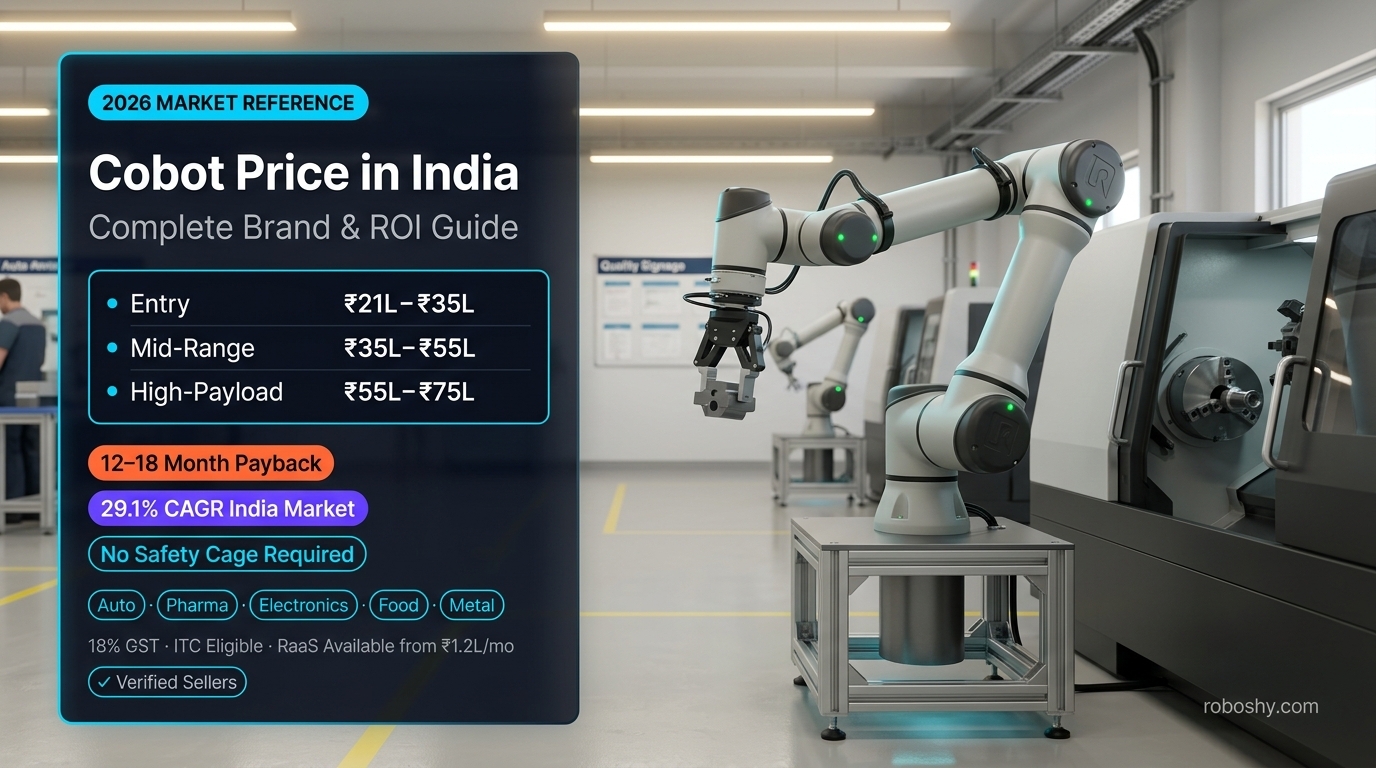
Cobot Price in India: What Indian Businesses Actually Pay in 2026
April 23, 2026
5:30 am
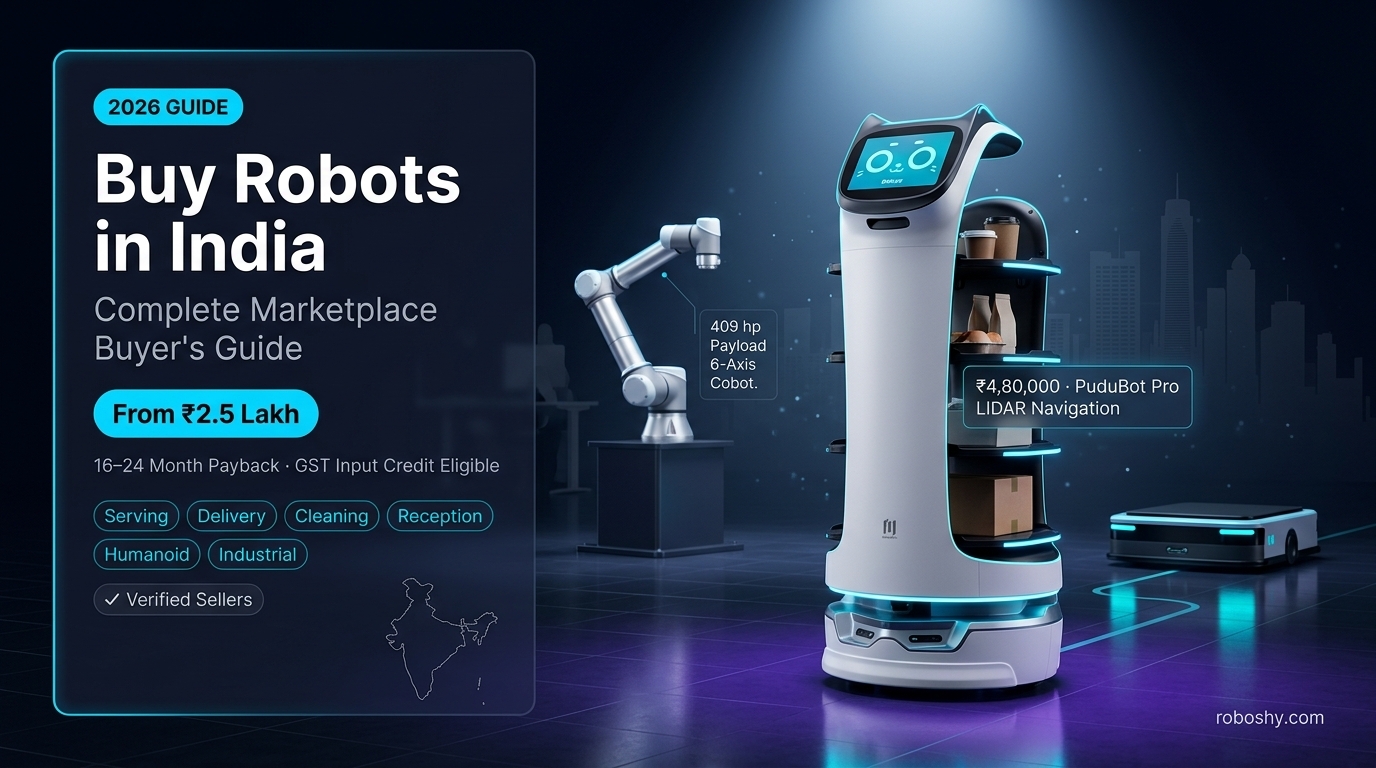
Buy Robots in India: The Complete Marketplace Buyer’s Guide
April 2, 2026
10:30 am
How Security Robotics Drive Business Impact and Operational Efficiency
March 13, 2026
9:52 am

Humanoid Robots Launching in 2026: What Buyers Need to Know Before They Purchase
February 28, 2026
10:34 am

AI Summit India 2026: Robotics, Humanoid AI, Automation & Future Technology Trends
February 21, 2026
6:12 am

How to Sell Robots Successfully: A Step-by-Step Business Guide by Roboshy
February 6, 2026
6:03 am

The Role of Advanced Robotics in Industrial Transformation in 2026
January 23, 2026
11:20 am
Food Serving Robot for Indian Restaurants: The Complete Guide
May 18, 2026
5:25 am
Agricultural Drones in India: Subsidies, Prices and Buyer Guide
May 7, 2026
5:18 am
Cobot Price in India: What Indian Businesses Actually Pay in 2026
April 23, 2026
5:30 am
Buy Robots in India: The Complete Marketplace Buyer’s Guide
April 2, 2026
10:30 am
How Security Robotics Drive Business Impact and Operational Efficiency
March 13, 2026
9:52 am
Humanoid Robots Launching in 2026: What Buyers Need to Know Before They Purchase
February 28, 2026
10:34 am
AI Summit India 2026: Robotics, Humanoid AI, Automation & Future Technology Trends
February 21, 2026
6:12 am
How to Sell Robots Successfully: A Step-by-Step Business Guide by Roboshy
February 6, 2026
6:03 am
The Role of Advanced Robotics in Industrial Transformation in 2026
January 23, 2026
11:20 am