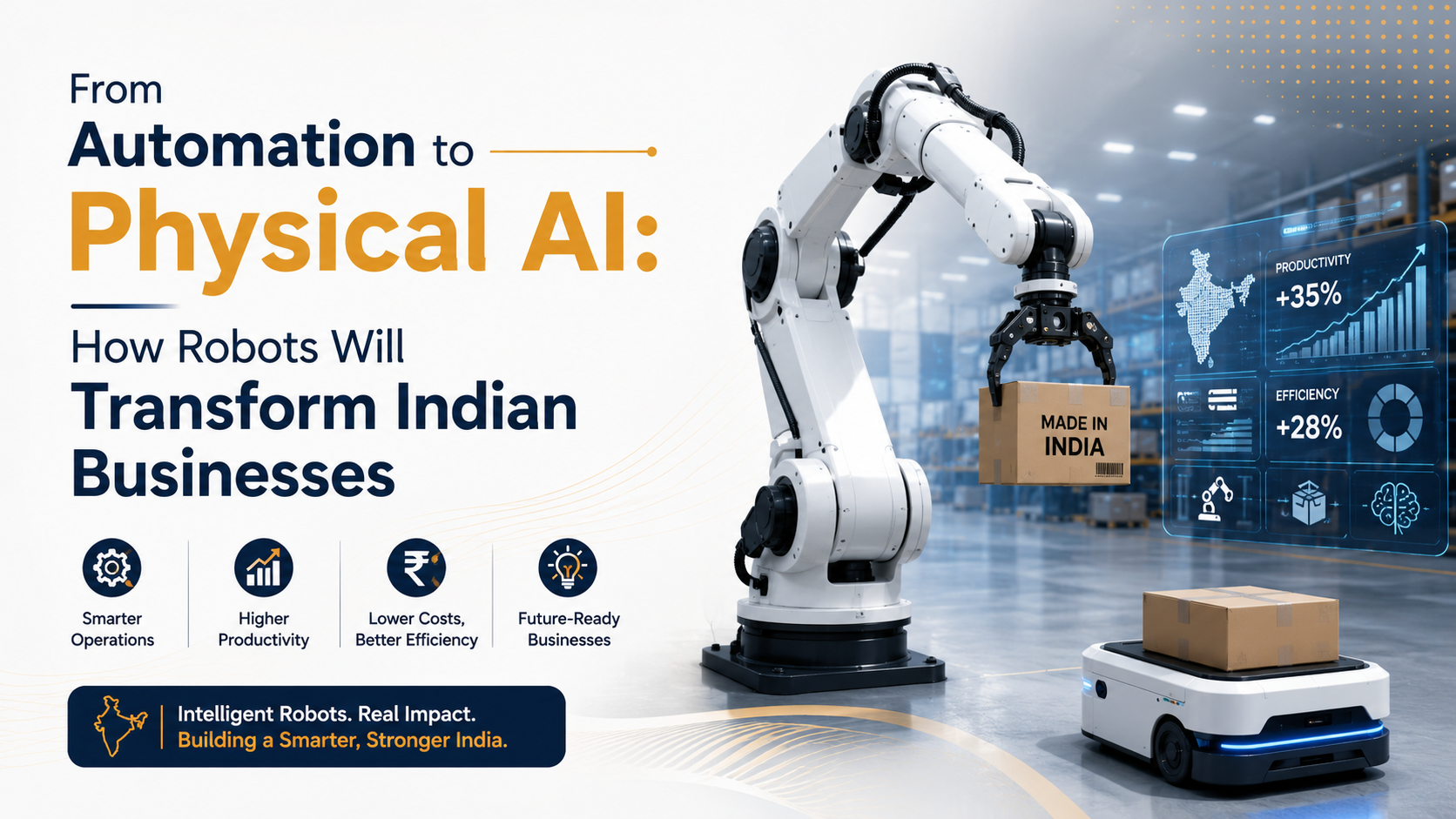
From Automation to Physical AI: How Robots Will Transform Indian Businesses
Physical AI is taking robotics beyond fixed automation. Instead of simply repeating pre-programmed movements, newer robotic systems combine sensors, computer vision, AI models, software, and mechanical control to perceive their surroundings and respond to changing conditions.
For Indian businesses, this shift could make automation more practical across manufacturing, warehousing, agriculture, healthcare, construction, and infrastructure.
The opportunity is significant. India installed 9,100 industrial robots in 2024, up 7% from the previous year, making it the sixth-largest market globally by annual installations. Automotive remained the biggest driver, accounting for 45% of installations.
At the same time, India’s relatively low level of automation leaves considerable room for further adoption. The next phase will not simply be about installing more robots. It will require stronger partnerships between robotics companies and Indian businesses to develop machines capable of working in environments that are less predictable, more variable, and more closely connected to human workers.
What Is Physical AI?
Traditional automation generally follows predefined instructions. If the environment changes significantly, the system may need to be reprogrammed.
Physical AI adds intelligence to the physical system.
A Physical AI system can combine:
- Cameras and sensors.
- Computer vision.
- AI and machine-learning models.
- Robotics software.
- Motion planning.
- Real-time decision-making.
- Mechanical actuators.
- Human instructions and feedback.
This allows robots to identify objects, understand their environment, adjust movements, and perform tasks with greater flexibility.
The distinction matters for India because many businesses operate in environments that are difficult to standardize completely. Warehouses contain mixed inventory, factories may produce multiple product variants, farms have changing conditions, and construction sites rarely look identical from one day to another.
Why Physical AI Matters for Indian Businesses
India’s automation opportunity is not limited to large automotive factories.
Businesses are increasingly looking for ways to:
- Improve productivity.
- Reduce workplace injuries.
- Address skilled-labor shortages.
- Increase production capacity.
- Reduce repetitive manual work.
- Improve quality control.
- Operate more consistently.
- Make better use of limited warehouse and factory space.
India’s robotics startup ecosystem is also attracting more capital. A 2026 analysis from 3one4 Capital reported that Indian robotics startup funding increased from $28.8 million in 2022 to $117 million in 2024 across more than 40 deals.
This suggests that robotics is moving beyond an experimental technology category and becoming a broader business opportunity.
Where Physical AI Is Being Deployed
Smart Manufacturing
Manufacturing remains one of the strongest use cases for robotics in India.
Robots can handle:
- Assembly.
- Welding.
- Material handling.
- Inspection.
- Packaging.
- Machine tending.
- Quality control.
AI-enabled vision systems can allow machines to identify variations in products instead of relying entirely on fixed positioning.
This is particularly relevant for Indian manufacturers moving from high-volume standardized production toward smaller batches and more customized products.
Warehouse and Logistics Automation
E-commerce, quick commerce, and modern retail are increasing pressure on warehouses to process more orders in less space.
Robotics can support:
- Sorting.
- Picking.
- Packing.
- Inventory movement.
- Pallet handling.
- Autonomous transportation.
- Order fulfillment.
Indian companies such as Unbox Robotics and Addverb are developing automation systems for logistics and warehousing, where robot serving can help support repetitive material-handling and sorting tasks. 3one4 Capital’s 2026 robotics analysis also highlights warehouse automation as a major opportunity in India.
The important shift is from individual robotic machines toward connected systems where robots, warehouse-management software, sensors, and AI work together.
Precision Agriculture
Agriculture presents a different robotics challenge.
Indian farms are often smaller and more fragmented than large industrial farms in developed markets. This makes conventional large-scale agricultural automation difficult.
Physical AI can nevertheless support:
- Crop monitoring.
- Precision spraying.
- Weed detection.
- Soil monitoring.
- Autonomous or assisted machinery.
- Drone-based inspection.
- Harvesting assistance.
Instead of trying to replace agricultural workers completely, these systems can target repetitive or precision-intensive tasks.
Healthcare
Healthcare robotics is another emerging area.
Robots can support:
- Surgical procedures.
- Hospital logistics.
- Disinfection.
- Supply movement.
- Rehabilitation.
- Patient assistance.
The opportunity is not simply replacing healthcare professionals. Robots can take over repetitive physical tasks, allowing medical staff to focus more time on patient care.
For India, this distinction is important because automation should help extend limited clinical capacity rather than create unnecessary complexity.
Construction and Infrastructure
Construction remains highly dependent on manual work and operates in environments that change constantly.
Robotics can potentially support:
- Material transportation.
- Inspection.
- Surveying.
- Concrete-related tasks.
- Hazardous operations.
- Demolition.
- Infrastructure maintenance.
The biggest challenge is adaptability. A factory floor can be standardized; a construction site cannot.
That makes Physical AI particularly relevant because robots need to perceive and respond to changing environments rather than simply follow fixed movements.
Urban Infrastructure
Robots are also being developed for difficult infrastructure tasks such as sewer inspection and cleaning.
For example, Genrobotics’ Bandicoot systems demonstrate how robotics can target hazardous work that exposes people to significant safety risks.
The strongest business case for these systems is not replacing people for the sake of automation. It is removing workers from dangerous environments while improving operational consistency.
India’s Robotics Opportunity: The Numbers
| Metric | 2024 Figure |
|---|---|
| Industrial robot installations in India | 9,100 |
| Year-on-year growth | 7% |
| Global ranking by annual installations | 6th |
| Automotive share of installations | 45% |
| Indian robotics startup funding | $117M |
| Robotics funding growth | $28.8M in 2022 → $117M in 2024 |
The installation figures come from the International Federation of Robotics, while the startup-funding figures are reported in 3one4 Capital’s 2026 robotics analysis.
These numbers show two different sides of the opportunity: industrial robotics is already scaling, while the startup ecosystem is creating new solutions for areas that remain under-automated.
From Automation to Adaptability
The biggest difference between traditional automation and Physical AI is adaptability.
Consider a warehouse robot.
A traditional automated system may be programmed to move products between specific locations.
A more intelligent system can use cameras and sensors to understand where products are located, identify obstacles, interpret changing inventory conditions, and adjust its actions.
This creates a new category of automation where software intelligence becomes as important as the mechanical system.
The same principle applies to manufacturing, agriculture, healthcare, and infrastructure.
The Business Case: Where ROI Matters
Businesses should not adopt Physical AI simply because robotics is becoming popular.
The better question is:
Which task creates enough economic or operational value to justify automation?
A practical robotics business case should measure:
- Labor savings.
- Productivity improvement.
- Error reduction.
- Downtime reduction.
- Safety improvement.
- Throughput.
- Quality improvement.
- Space utilization.
- Maintenance costs.
- Integration costs.
- Training requirements.
- Expected equipment life.
For example, automating a repetitive, high-volume warehouse task may produce a clear return on investment.
Automating a low-volume process with frequent product changes may not.
The strongest early opportunities are usually tasks that are repetitive, measurable, physically demanding, hazardous, or difficult to staff consistently.
Robotics-as-a-Service Can Lower the Entry Barrier
High upfront costs remain one of the biggest barriers to robotics adoption.
Robotics-as-a-Service (RaaS) offers another model.
Instead of purchasing an entire robotic system upfront, businesses may pay through:
- Monthly subscriptions.
- Usage-based pricing.
- Leasing.
- Managed automation services.
- Performance-based contracts.
This model can make automation more accessible to smaller manufacturers, warehouses, and businesses that cannot justify a large capital investment immediately.
For Indian SMEs, this could be particularly important because the question changes from:
“Can we afford to buy a robot?”
to:
“Can the productivity improvement justify the monthly automation cost?”
That is a much easier business case to evaluate.
Human-Robot Collaboration
The future of Indian robotics is unlikely to be completely human-free.
In many environments, the better model will be human + robot collaboration.
Robots can handle:
- Heavy lifting.
- Repetitive movement.
- Dangerous environments.
- High-speed sorting.
- Precision operations.
- Continuous monitoring.
Humans can handle:
- Judgment.
- Exception management.
- Complex problem-solving.
- Customer interaction.
- Supervision.
- Maintenance.
- Tasks requiring contextual understanding.
This model can improve productivity without assuming that every human task should be automated.
Workforce and Skill Development
Robotics will change jobs, but the impact will not be limited to job replacement.
As adoption increases, demand can grow for:
- Robotics technicians.
- Automation engineers.
- Controls engineers.
- Computer-vision specialists.
- AI engineers.
- Maintenance professionals.
- Robot operators.
- System integrators.
- Safety specialists.
Indian businesses will therefore need to invest in reskilling alongside automation.
A factory that buys advanced robots without developing the workforce capable of operating and maintaining them may create a technology bottleneck rather than a productivity advantage.
Data and AI Become Part of the Robotics Stack
Physical AI also creates a new data layer.
Robots can generate information about:
- Production cycles.
- Machine performance.
- Defects.
- Inventory movement.
- Energy consumption.
- Maintenance requirements.
- Worker-machine interaction.
- Environmental conditions.
Businesses can use this data to identify inefficiencies and predict maintenance requirements.
However, more connected robots also mean greater cybersecurity and data-management responsibilities.
Companies should consider:
- Who owns the operational data?
- Where is the data stored?
- Who can access it?
- How are robots updated?
- How are AI models monitored?
- What happens if the system loses connectivity?
- How is remote access protected?
Physical AI should therefore be treated as both an automation investment and a technology infrastructure investment.
India’s Policy Foundation
India has already identified robotics as an important emerging technology.
The Ministry of Electronics and Information Technology’s Draft National Strategy on Robotics identifies manufacturing, agriculture, healthcare, and national security as priority sectors for robotics adoption.
The policy direction matters because widespread robotics adoption requires more than private investment. It also depends on:
- Research and development.
- Skilled workers.
- Standards.
- Testing infrastructure.
- Safety frameworks.
- Startup support.
- Industry-academia collaboration.
- Access to capital.
A stronger policy environment can help Indian robotics companies develop solutions locally instead of relying entirely on imported systems.
Challenges Businesses Must Consider
High Initial Investment
Robotics hardware, integration, sensors, software, maintenance, and training can create significant costs.
Integration Complexity
A robot rarely operates alone. As robots in India become more connected, they may need to integrate with ERP systems, warehouse software, production systems, sensors, cameras, and existing machinery.
Skills Shortage
Businesses need employees who understand both robotics hardware and AI-enabled software.
Safety
Robots operating around people require appropriate safety systems, testing, monitoring, and operating procedures.
Unclear ROI
Not every process benefits from automation. Businesses need measurable baseline data before investing.
Cybersecurity
Connected robots increase the attack surface of industrial and operational systems.
Workforce Transition
Companies need a plan for retraining and redeploying workers whose roles change because of automation.
A Practical Roadmap for Businesses
Companies considering Physical AI can start with a focused approach.
Step 1: Identify the Problem
Do not begin with the question, “Where can we use a robot?”
Start with:
Which business problem is costing us the most?
Step 2: Measure the Current Process
Record:
- Labor hours.
- Production volume.
- Error rates.
- Downtime.
- Safety incidents.
- Maintenance costs.
- Cycle times.
Without a baseline, calculating ROI becomes difficult.
Step 3: Choose a Suitable Task
Prioritize processes that are repetitive, dangerous, high-volume, or highly measurable.
Step 4: Run a Pilot
Test the technology on a limited production line, warehouse zone, or operational workflow.
Step 5: Measure Results
Compare the automated process with the original baseline.
Step 6: Train Employees
Prepare workers to operate, supervise, maintain, and troubleshoot the new system.
Step 7: Scale Carefully
Only expand after confirming that the technology works reliably under real operating conditions.
What the Next Phase Could Look Like
The next stage of robotics will be less about isolated machines and more about intelligent systems.
A factory could have robots communicating with production software.
A warehouse could combine autonomous mobile robots, computer vision, inventory systems, and AI planning.
A farm could combine drones, sensors, weather data, and autonomous machinery.
A hospital could connect robotic logistics with scheduling and supply systems.
This is where Physical AI becomes strategically important: the robot becomes one part of a larger intelligent operating system.
Frequently Asked Questions
What is Physical AI?
Physical AI refers to AI systems that interact with and act in the physical world through robots, machines, sensors, and other hardware. Unlike traditional software AI, these systems must perceive real-world conditions and take physical actions.
How is Physical AI different from traditional automation?
Traditional automation generally follows predefined rules. Physical AI adds perception, AI-based reasoning, and adaptive decision-making, allowing machines to respond to changing environments.
Which Indian industries will benefit most from Physical AI?
Manufacturing, logistics, warehousing, agriculture, healthcare, construction, and infrastructure have strong potential because many of their processes involve repetitive, physical, hazardous, or precision-intensive work.
Is robotics adoption actually growing in India?
Yes. India installed 9,100 industrial robots in 2024, a 7% increase from 2023, according to the International Federation of Robotics. India ranked sixth globally for annual industrial-robot installations.
Will robots replace workers?
Some tasks will become automated, but many businesses will use robots alongside employees. The workforce will increasingly need skills in robot operation, maintenance, integration, AI, and supervision.
Is Physical AI affordable for Indian SMEs?
It depends on the application. Robotics-as-a-Service, leasing, and modular automation can reduce upfront investment and make some applications more accessible to smaller businesses.
What should a business consider before buying robots?
Businesses should evaluate the problem being solved, expected ROI, integration requirements, safety, maintenance, workforce training, cybersecurity, data ownership, and long-term operating costs.
What government support exists for robotics in India?
India’s Draft National Strategy on Robotics identifies manufacturing, agriculture, healthcare, and national security as priority areas. The broader ecosystem also includes programs supporting advanced manufacturing, electronics, semiconductors, and industrial skills.
Conclusion
Physical AI is moving robotics beyond fixed automation toward systems that can perceive, adapt, and act in real-world environments.
For Indian businesses, the opportunity is especially significant because automation adoption is growing while many industries still have substantial room to improve productivity, safety, quality, and capacity.
The winners will not necessarily be the companies that deploy the most robots.
They will be the companies that identify the right processes to automate, build strong human-machine workflows, measure ROI, develop the necessary skills, and use AI to make physical operations more intelligent.
India’s robotics story is therefore not simply about machines replacing manual work. It is about combining AI, robotics, data, and human expertise to build more productive and adaptable businesses.
The next decade could move Indian automation from fixed machines performing fixed tasks to intelligent physical systems capable of working alongside people and responding to the complexity of the real world.
Sources
- International Federation of Robotics — World Robotics 2025.
- Ministry of Electronics and Information Technology — Draft National Strategy on Robotics.
- Ministry of Electronics and Information Technology — Citizen Engagement / Draft National Strategy on Robotics.
- 3one4 Capital — Automating India: Investing in Robotics and the Future of Productivity.
Market figures, company deployments, funding data, and policy requirements can change. Verify current figures with the original sources before using the article for investment, client, or regulatory decisions.
Robotics-as-a-Service in India: Costs, Use Cases, and When Businesses Should Rent Robots
August 12, 2026
6:45 am
From Automation to Physical AI: How Robots Will Transform Indian Businesses
August 8, 2026
1:38 pm
Food Serving Robot for Indian Restaurants: The Complete Guide
May 18, 2026
5:25 am
Agricultural Drones in India: Subsidies, Prices and Buyer Guide
May 7, 2026
5:18 am
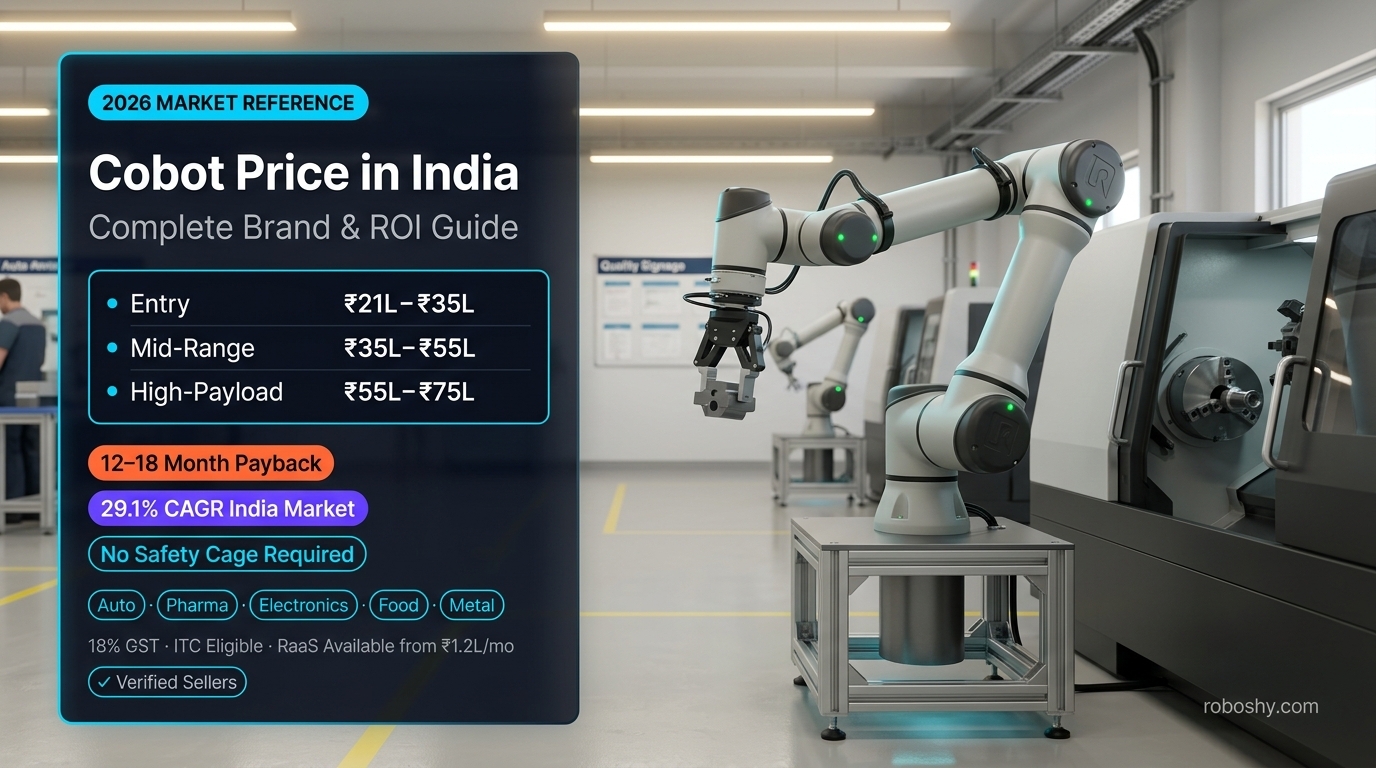
Cobot Price in India: What Indian Businesses Actually Pay in 2026
April 23, 2026
5:30 am
Buy Robots in India: The Complete Marketplace Buyer’s Guide
April 2, 2026
10:30 am
How Security Robotics Drive Business Impact and Operational Efficiency
March 13, 2026
9:52 am
Humanoid Robots Launching in 2026: What Buyers Need to Know Before They Purchase
February 28, 2026
10:34 am
Robotics-as-a-Service in India: Costs, Use Cases, and When Businesses Should Rent Robots
August 12, 2026
6:45 am
From Automation to Physical AI: How Robots Will Transform Indian Businesses
August 8, 2026
1:38 pm
Food Serving Robot for Indian Restaurants: The Complete Guide
May 18, 2026
5:25 am
Agricultural Drones in India: Subsidies, Prices and Buyer Guide
May 7, 2026
5:18 am
Cobot Price in India: What Indian Businesses Actually Pay in 2026
April 23, 2026
5:30 am
Buy Robots in India: The Complete Marketplace Buyer’s Guide
April 2, 2026
10:30 am
How Security Robotics Drive Business Impact and Operational Efficiency
March 13, 2026
9:52 am
Humanoid Robots Launching in 2026: What Buyers Need to Know Before They Purchase
February 28, 2026
10:34 am